6 min read
When people encounter Nap OS for the first time, the instinct is to treat it like every other product launch that crosses their feed: a shiny new platform, a founder with a confident pitch, and a promise to fix something broken in how careers get built. What that first impression misses is the timeline. Nap OS did not appear because someone had a good idea during a slow weekend. It is the output of roughly a decade of research, false starts, unpaid labour, and one particular academic thesis that, in hindsight, reads less like a dissertation and more like a blueprint.
The story starts in 2016, in Chennai, where Pugazheanthi Palani was completing a mechanical engineering degree at Anna University. It would be easy to assume a mechanical engineering background has little to do with workforce platforms and career infrastructure, but the connection is more direct than it looks.
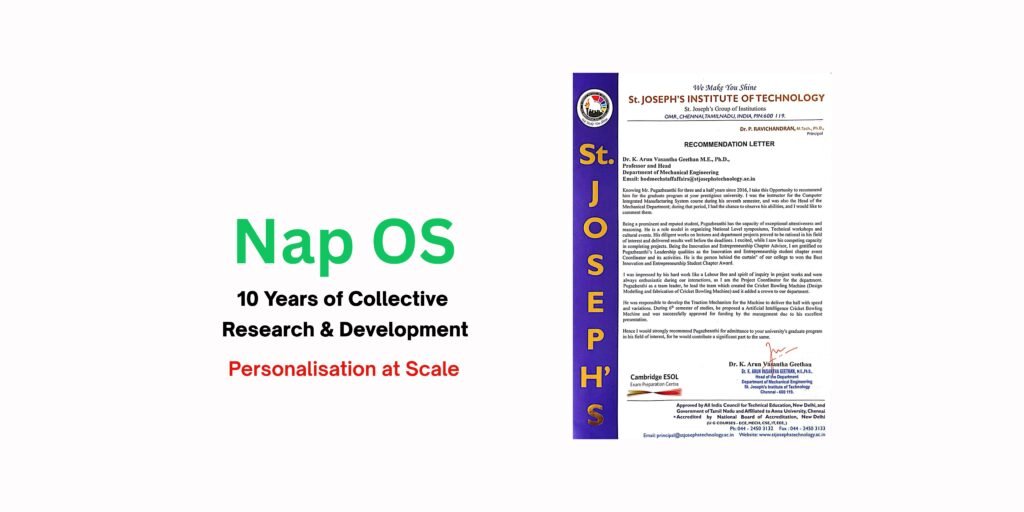
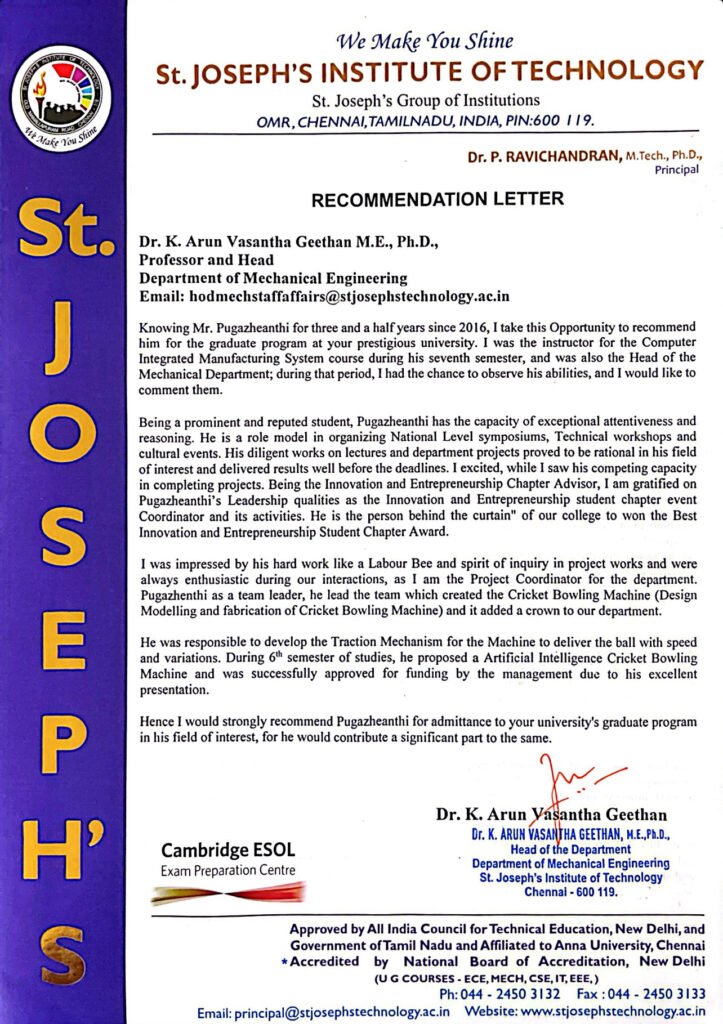
During those years, Palani founded the SJIT Entrepreneur’s Club, earned First Class Honours across four consecutive years, and led a team that designed and fabricated a cricket bowling machine, eventually proposing an AI-enabled version that secured internal funding. None of that reads like the biography of someone building a career platform. But it reads exactly like the biography of someone who has spent a decade obsessed with a single question: why does capability so rarely translate into recognised opportunity, even when the capability is real and demonstrable?
That question followed Palani out of engineering and into an independent research practice that has run continuously since 2016, spanning workforce development, labour market dynamics, project-based learning, and entrepreneurship. This is the part of the timeline that gets skipped when people talk about “founders” and “startups,” because independent research without a company attached to it does not look like progress from the outside.
There was no funding round, no press release, no product to point to. There was simply years of studying why talented graduates and professionals kept hitting the same wall: employers wanted proof of real-world capability, and the traditional credentialing system was structurally incapable of providing it.
The most revealing chapter, though, is the one that rarely gets told with any detail: the 2020 master’s thesis completed at Griffith College Dublin. On the surface, it looks like a conventional academic exercise, an exploratory study into what makes a good co-founder. Underneath, it is arguably the single most important document in understanding why Nap OS was built the way it was.
The thesis set out to answer a deceptively narrow question: why do so many startups collapse not from bad ideas but from conflict between the very people who founded them. Palani’s answer was to propose what he called the Elite Co-Founder theory, a framework built around three systems of intuition often described as head, brain, and heart, used to evaluate compatibility between a founder and a prospective co-founder before the partnership ever begins.
What makes this thesis genuinely intriguing as an origin story is the mechanism at its core. Palani did not stop at theory. He built an actual evaluation model, a scoring system that measured similarity and complementarity between two people’s profiles, with a defined threshold above which a candidate would be considered eligible to move forward as a co-founder. In other words, years before Nap OS existed, Palani had already built and tested a structured, evidence-based method for answering a question that most people leave to gut feeling: can this person actually be trusted to perform, and does the data back that up.
That is the exact same question Nap OS would later ask, just aimed at a different relationship. Instead of founder and co-founder, the question became employer and candidate, or platform and contributor. The scoring logic changed shape, but the underlying conviction did not: intuition alone is an unreliable filter for high-stakes professional relationships, and it can be replaced, or at least supported, by a structured, evidence-based system.
This is why the thesis deserves to be read as more than an academic requirement completed on the way to a degree. It was, in effect, a rehearsal. It proved to its own author that a real-world trust problem, people misjudging each other in high-stakes professional relationships, could be studied rigorously and then converted into a repeatable model rather than left to chance.
That conviction did not disappear after graduation. It resurfaced years later as the architecture behind Nap OS, a system built to verify capability through real project execution rather than through the same kind of unverifiable impressions that the co-founder thesis had identified as the root of startup failure.
Between 2022 and 2024, the path took what looks, on paper, like a detour. Two years as an International Marketing Specialist at WiLine Networks, running paid and organic campaigns and managing marketing operations, might seem disconnected from workforce infrastructure. In practice, this is where a lot of the operational muscle behind Nap OS was built, understanding how demand generation actually works, how automation changes what a small team can execute, and how to measure engagement rather than just activity.
Napblog Limited was founded in June 2024, and this is usually where an outside observer assumes the story begins. It does not. What launched in 2024 was the packaging of eight years of research, one formative thesis, and a marketing apprenticeship into a functioning system. Nap OS did not emerge as an idea in 2024; it emerged as the execution of a thesis on trust and evidence that had already been tested once, on a much smaller scale, back in 2020.
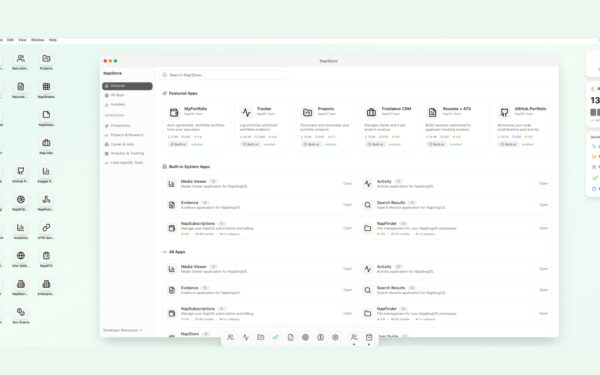
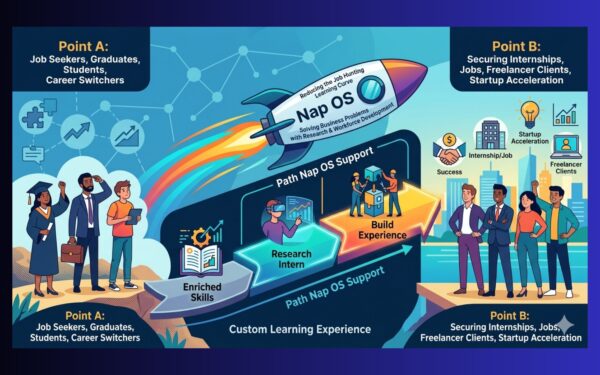
The platform organises itself around three functions that map onto the stages of a person’s professional life: Workforce, which builds talent through real business and research projects; Recruit, which deploys that talent into organisations that need it; and Incubate, which supports the creation of new ventures from people who have proven their capability through execution.
The specific problem Nap OS was built to solve is one rarely discussed with this level of precision outside the communities living through it. In Ireland, employers frequently require local experience before they will hire, particularly for visa holders and international graduates. At the same time, certain employment permits require documented employer evidence before they can be issued, and that evidence cannot exist without a local job in the first place.
This is not a paperwork inconvenience; it is a closed loop that traps thousands of qualified people regardless of ability. Nap OS’s response was a platform built around personalised, verifiable, employer-aligned project experience, an idea that traces its DNA directly back to a thesis about how to verify trust between people before it is too late to matter.
Over roughly two years of operation, Nap OS has worked with more than one hundred global contributors, with over fifty progressing into full-time employment. Those numbers represent the first visible, external evidence of a system that spent the better part of a decade being invisible, first as engineering-school entrepreneurship, then as an unfunded academic thesis about trust and evaluation, then as marketing groundwork, and only finally as a product.
There is a broader lesson here. Systems that attempt to fix structural problems, the mismatch between credentials and demonstrated capability, the closed loops that trap capable people in bureaucratic catch-22s, cannot be built quickly, because the problems themselves were not created quickly, and because the frameworks needed to solve them have to be tested long before they are trusted.
Nap OS is not a garage idea or a hackathon product. It is a decade of sustained attention to one stubborn question, first asked academically about co-founders in 2020, and only later answered practically about careers in 2024.