8 min read
When people look at Nap OS today, they see a Workforce Operating System.
They see technology, artificial intelligence, project-based experience, employability, workforce intelligence, university partnerships, entrepreneurship, research and a growing ecosystem around a new way of transitioning from education into work.
But before there was Nap OS, there was an idea.
And before there was the idea, there was my mother.
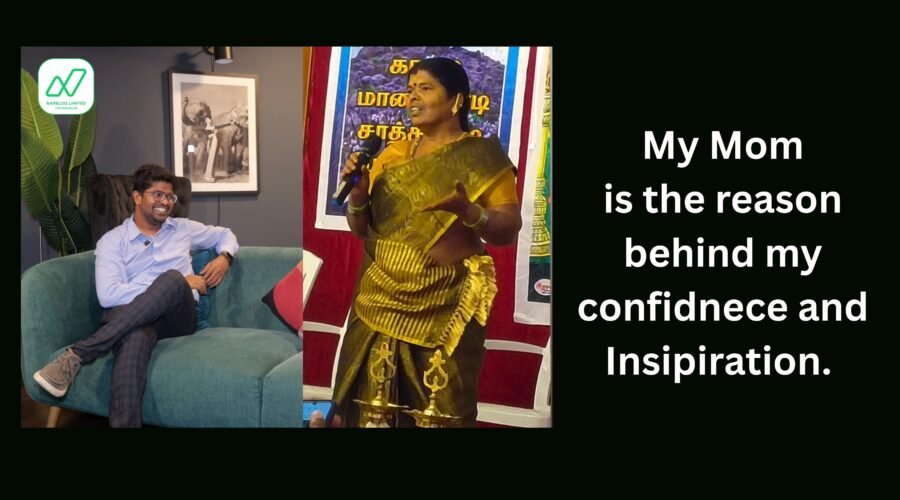
Her name is Padma Devi.
For more than 15 years, she has been one of the quietest and most important forces behind my journey. She has supported my brainstorming, encouraged my experiments, stood behind my decisions, helped me find courage when I had very little of it, and continued to believe in ideas long before there was evidence that they would work.
If I describe myself today as an entrepreneur, I have to acknowledge something uncomfortable with the usual founder narrative:
I did not build this alone.
Some of the most important capital I received was not financial.
It was confidence.
It was patience.
It was the freedom to experiment.
It was someone repeatedly saying, in different ways, “Keep going. Try again. Find a way.”
That person was my mother.
Before Nap OS, there was a philosophy
My mother has always had an unusual combination of qualities.
She can be deeply introverted and remarkably expressive when something matters to her.
She can be quiet in one room and completely command a room in another.
She is strong, courageous, observant and deeply caring.
But what has influenced me most is not simply her personality.
It is what she cares about.
She has always had a strong interest in healthcare and education, particularly in the idea that these should not become privileges available only to people who can afford them.
Her instinct has always been to ask a simple question:
Why shouldn’t people have access to something that can genuinely improve their lives?
That question stayed with me.
Over time, I began to understand that healthcare and education are not just sectors.
They are infrastructure.
When a person receives access to healthcare, their ability to live and contribute changes.
When a person receives access to meaningful education, their ability to think, work and create changes.
But there is another transition that happens after education.
The transition into work.
And that transition is where I eventually found my own problem to solve.
The experience paradox
A student graduates.
They apply for a job.
The employer asks for experience.
The student asks:
“How am I supposed to get experience if nobody gives me an opportunity to gain it?”
This is one of the oldest paradoxes in the graduate labour market.
Education tells people to prepare.
Employers ask them to demonstrate capability.
Students collect qualifications.
Recruiters look for evidence.
Universities teach knowledge.
The labour market demands application.
And somewhere between those systems sits a young person trying to prove that they are capable of doing something they have never officially been allowed to do.
I experienced versions of that transition myself.
I learned that confidence cannot simply be taught.
It has to be built through action.
A CV can say that somebody knows something.
A certificate can say that somebody completed something.
But real work creates a different kind of evidence.
You make a decision.
You make a mistake.
You solve a problem.
You communicate with somebody.
You deliver something.
You receive feedback.
You improve.
You do it again.
Eventually, you have something much more powerful than a claim.
You have evidence.
That became the foundation of Nap OS.
From my mother’s values to a technology system
Nap OS is being developed around a simple principle:
People should have a way to demonstrate capability before they have a long employment history.
Instead of asking a student to wait until somebody gives them their first opportunity, Nap OS creates structured pathways through which they can participate in real projects, develop skills, document their contribution and build verifiable evidence.
The ambition is not to manufacture experience.
It is to make genuine experience more accessible, structured and visible.
That distinction matters.
I don’t want to create another system where young people simply watch videos, complete quizzes and receive another certificate.
I want them to build.
I want them to make decisions.
I want them to work with other people.
I want them to experience deadlines, ambiguity, feedback, responsibility and delivery.
And I want the outcome of that work to become part of their professional identity.
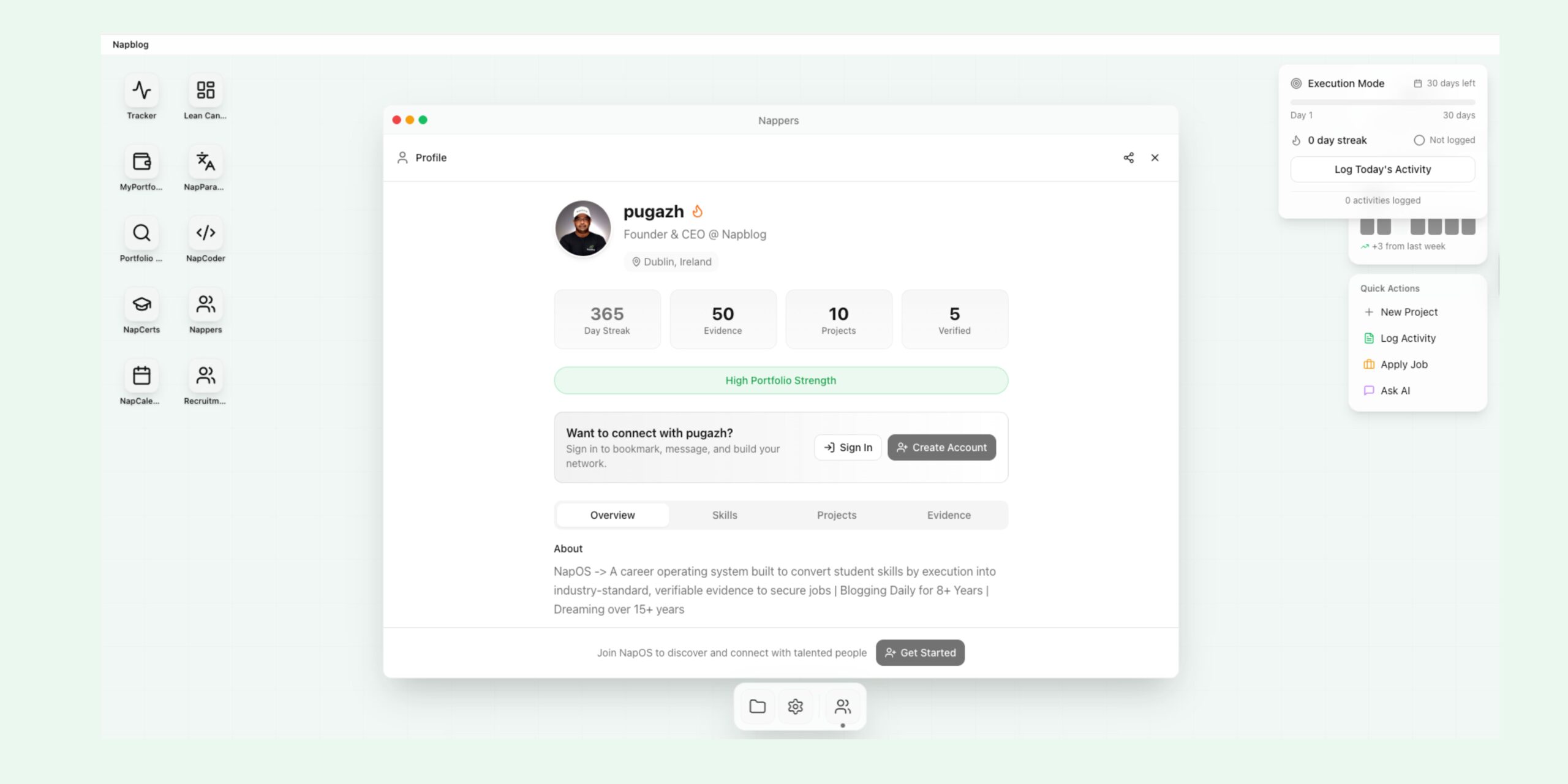
This philosophy has shaped Nap OS from its earliest experiments into what I now describe as a Workforce Operating System.
It is an attempt to connect the fragmented journey between education, experience, employability, entrepreneurship and work.
In many ways, that is the same philosophy I learned from my mother.
Access should not depend entirely on privilege.
My mother was an entrepreneur too
I sometimes describe myself as a third-generation solopreneur.
But when I say that, I don’t mean that entrepreneurship is simply something that runs through a family tree as a job title.
It is a way of thinking.
My mother taught me entrepreneurship without necessarily calling it entrepreneurship.
She taught me to think independently.
She taught me that an idea is worthless if you are unwilling to act on it.
She taught me that courage is not the absence of fear.
It is continuing despite fear.
She also taught me something that is difficult to put into a business plan:
You can build something for yourself while still building something for other people.
That distinction has stayed with me.
Nap OS is a company.
But I do not want its purpose to end with the company’s commercial success.
If it works, I want it to create a much larger social and economic effect.
I want students who cannot access traditional networks to have another route.
I want graduates who lack conventional experience to have a mechanism for building credible evidence.
I want career changers to demonstrate what they can actually do.
I want international students and newcomers to have a way of translating capability into locally relevant experience.
I want universities to have better visibility into what happens between learning and employment.
And ultimately, I want employers to have better signals than a CV alone.
Fifteen years of unseen investment
When founders talk about investment, the conversation normally becomes financial.
How much money was invested?
How much funding was raised?
What is the valuation?
What is the revenue?
Those questions matter.
But there is another kind of investment that rarely appears in a pitch deck.
For more than 15 years, my mother invested in me.
She invested in my ideas before they had names.
She listened to brainstorming sessions before there was a product.
She supported experiments that did not always work.
She stood behind decisions that carried uncertainty.
She watched me leave home.
She watched me start again.
She watched me fail.
She watched me continue.
And she kept supporting me.
That is a different definition of capital.
Human capital. Emotional capital. Family capital.
Entrepreneurship is often portrayed as an individual act.
In reality, many entrepreneurs are standing on years of invisible support from people whose names never appear on the company registration documents.
My mother is one of those people.
From one person’s experience to a global movement
Today, Nap OS is moving beyond the original problem I experienced personally.
The larger question is becoming:
What would happen if workforce transition itself became infrastructure?
The world is going through a major transition.
Artificial intelligence is changing how work is performed.
Universities are under increasing pressure to demonstrate employability outcomes.
Employers are changing how they evaluate talent.
Young people are questioning traditional career pathways.
Remote work has expanded the geographic boundaries of opportunity.
And millions of people are trying to move between education, employment, entrepreneurship and completely new careers.
The old model assumes that a person first gets an opportunity and then develops experience.
I believe we need to reverse part of that equation.
Build evidence. Create capability. Demonstrate contribution. Then unlock opportunity.
That is the transition Nap OS is trying to enable.
It is why I increasingly think about Nap OS not merely as a career platform, but as part of a broader global workforce-transition movement.
The technology is important.
The partnerships are important.
The research is important.
The commercial model is important.
But the underlying philosophy is even more important.
The journey from St. Joseph’s
My journey as an engineer began at St. Joseph’s Institute of Technology.
At the time, I could not have imagined that the experiences, failures, experiments and lessons that followed would eventually lead me toward building a workforce technology company in Ireland.
But perhaps that is the nature of education.
We rarely know which lessons will become important later.
Engineering taught me to look at problems as systems.
Entrepreneurship taught me that systems only matter when they work in reality.
And my mother taught me that the purpose of building something should ultimately extend beyond yourself.
Those three ideas now meet inside Nap OS.
Engineering gives me the system.
Entrepreneurship gives me the courage to build it.
My mother’s values give me the reason to build it.
The seed is hers too
When I look at the photograph of my mother and me, I don’t simply see a mother and son.
I see two different stages of the same journey.
She represents the person who gave me the confidence to think beyond immediate limitations.
I represent the person trying to turn those values into infrastructure.
That is why I say:
Nap OS is my company, but its seed is hers too.
Her belief in accessible education.
Her concern for healthcare.
Her instinct to help people.
Her courage.
Her ability to care deeply while remaining resilient.
Her willingness to support an unconventional path.
These things became part of how I think.
And eventually, they became part of what I build.
I cannot promise that Nap OS will solve every problem in the transition from education to employment.
No honest entrepreneur can.
But I can promise that I will continue trying to solve the problem.
Because somewhere behind every student struggling to get their first opportunity is a person who deserves to be seen for what they can become—not only for what they have already been given access to.
That is the world I want to build.
And when I build it, I carry my mother’s seed with me.
Padma Devi did not write the code for Nap OS.
She helped write the person who decided to build it.
And perhaps that is the most important part of the story.