7 min read
On 7 October 2026, the Nap OS team joined the National College of Ireland Part-Time Jobs Fair with a simple message: graduates should not have to wait for an employer to give them experience before proving what they can do. More than 100 students expressed interest in Nap OS, and over 30 took the next step as early adopters. For a workforce platform, this is a signal that students recognise the experience gap and are ready to test a project-based route into professional work.
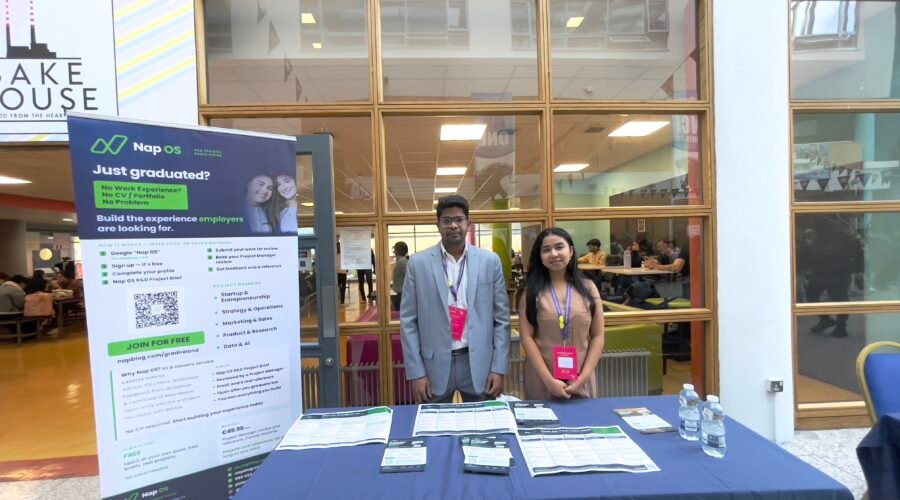
The event took place at NCI’s Mayor Square campus in Dublin. Nap OS attended as an employer, presenting a three-month, part-time paid AI internship and its wider project-based hiring model. A roll-up banner, project information and a QR-led registration journey connected the physical stand to the product. Students could ask questions and explore how relevant work might build evidence before an interview. A printed CV was welcome, but it was not the only way to be seen.
Why this event mattered
Career fairs often begin with a familiar exchange. A student hands over a CV, the employer explains a role, and both sides hope the document supports a later conversation. That process remains useful, but it disadvantages people whose strongest capabilities have not yet appeared in a formal job title. International students, recent graduates, career changers and independent learners face a circular problem: employers ask for experience, but candidates need an opportunity to obtain it.
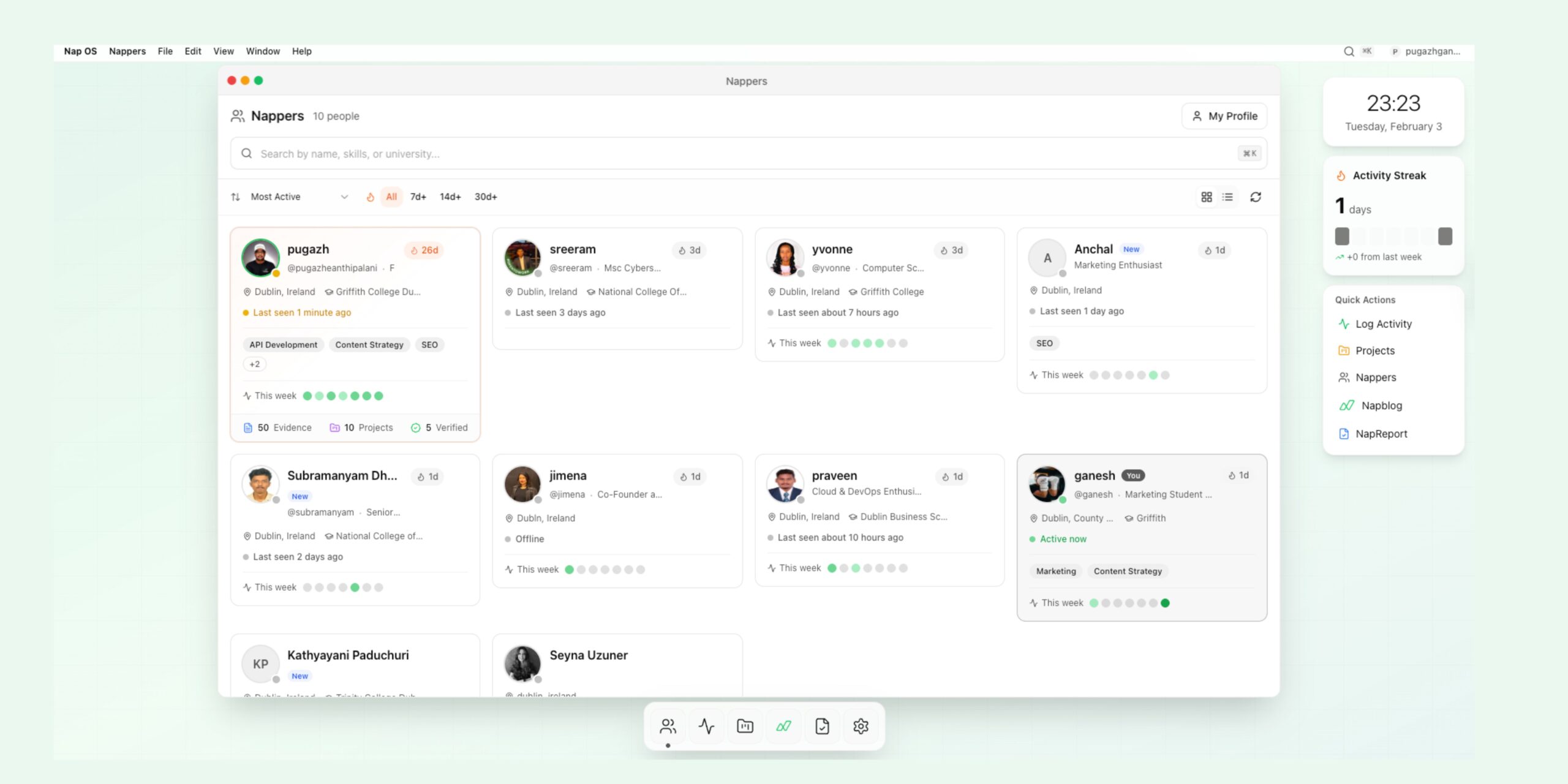
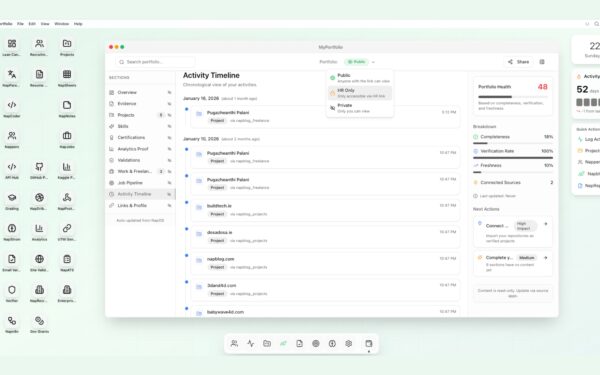
Nap OS is designed around that gap. Instead of asking students only to describe their potential, the platform offers R&D project briefs through which they produce relevant work. A candidate chooses a project, works through the problem, documents decisions and creates a reviewable output. Self-directed learners can start free. Paid services provide human Project Manager review, verified evidence and, where appropriate, a professional reference based on completed work. Participation builds evidence; it does not guarantee employment.
At NCI, that distinction made the conversation concrete. Students were invited to build something that could be examined, not collect another generic certificate or rewrite the same CV. For the AI internship, the work included testing AI tools, developing workflows and automations, supporting product development and documenting processes. Applicants could complete a relevant Nap OS project at no cost, helping the company assess practical ability before shortlisting candidates for interview.
From interest to early adoption
More than 100 expressions of interest show that the message attracted attention, but attention is not the same as adoption. The more important early result was that over 30 students moved beyond the first conversation and joined as early adopters. In this context, an early adopter is not simply someone who accepted a flyer. It is a student willing to enter the Nap OS journey, explore a project domain and test whether project evidence can strengthen their professional story.
That difference matters for honest product learning. A busy stand can produce encouraging conversations without proving people will use the product. Registration is a stronger signal, but only the beginning. The next evidence will come from activation: how many early adopters complete a profile, select a relevant project, begin the work and return. Completion, review, portfolio use, interview confidence and employer response will teach Nap OS more than the headline number alone.
The NCI outcome gives the team a useful cohort, not a finished success story. These students can expose onboarding friction, show which domains attract interest and reveal how much support a new user needs. Their questions can improve project briefs, platform language, review criteria and follow-up. Their work can also test whether employers understand and trust the evidence.
Human conversations around an AI product
The strongest part of the event was the opportunity to listen. Students asked about working hours, pay, technical expectations, academic internship requirements and the projects that could best demonstrate their skills. Their questions revealed the decisions students face while balancing study, employment, immigration considerations, confidence and career direction.
Nap OS uses technology and responsible AI to organise project-based learning and assessment, but human judgement remains central. A Project Manager can examine the reasoning behind an output, ask follow-up questions and provide feedback that a score or keyword match cannot capture. The goal is not to remove people from hiring. It is to create better evidence for a more useful conversation.
This matters as AI changes entry-level work. Students can generate text, code, analysis and presentations faster than before. Employers need to understand how a candidate defined the problem, checked the work, made trade-offs and responded to feedback. Project evidence can make those behaviours visible. A strong submission shows ownership and judgement, not only polished output.
What the team learned at NCI
First, the experience problem is easy for students to recognise. The message on the stand—build the experience employers are looking for—created an immediate starting point. Students did not need a long explanation of why evidence matters. Many already knew how difficult it can be to translate coursework, personal learning or part-time employment into a convincing professional profile.
Second, a defined opportunity makes the platform easier to understand. The paid AI internship gave students a clear reason to engage, while the free project route explained how Nap OS approaches shortlisting. The project was not an unpaid substitute for the role. It was an accessible way for candidates to demonstrate relevant thinking before the interview stage. Keeping that boundary clear is essential for trust.
Third, digital collection works best when it supports, rather than replaces, a personal exchange. The QR code reduced paper handling and made follow-up possible, but students still valued speaking with someone who could interpret the opportunity. The stand worked because the physical and digital journeys reinforced each other: conversation created relevance, the QR code captured intent, and the platform offered an immediate next action.
Fourth, follow-up must be segmented. Some students want AI or data roles; others need experience in product, research, marketing, sales, strategy, operations or entrepreneurship. Onboarding should identify the desired role, current capability, available weekly time and preferred domain. The right project is not the most impressive-sounding brief; it is the one that produces credible evidence for the learner’s chosen direction.
The next stage for the 30-plus early adopters
The immediate priority is activation. Each early adopter should receive a clear welcome, one primary action and an honest journey: complete a profile, select a project aligned with a target role and begin the first task. Follow-up should be helpful, not a stream of sales messages. Students need to know what to do, the likely time commitment, where to get help and what evidence they can produce.
Nap OS should monitor profile completion, project selection, first-task completion, return rate, submission, review booking and evidence issued. Qualitative feedback matters too. The team should ask what problem brought early adopters to the stand, why they chose Nap OS, what confused them and what would make the experience valuable enough to recommend.
For AI internship candidates, assessment must remain transparent. Project quality should be reviewed against published, role-relevant criteria. Interview decisions should remain separate from paid subscription choices, and no candidate should believe that purchasing a service secures employment. Clear communication protects students, strengthens the employer brand and keeps the model defensible.
A partnership built through employability
The National College of Ireland Careers team, including Caroline Kennedy and Laura Walshe, created space for direct employer-student engagement and supported a QR-led application process. Their invitation helped Nap OS meet students where career questions are immediate. A further invitation to NCI’s Festival of AI and AI for Business opens a route for continued discussion about technology, employer expectations and assessment.
For Nap OS, the value of the day was not simply collecting leads. It was seeing the product proposition tested in live conversation. Students understood the difference between claiming a skill and showing evidence. They responded to a free starting point, a real opportunity and access to human guidance. More than 100 expressions of interest created breadth; over 30 early adopters created a focused group with whom the product can now be improved.
The work after the fair will determine the significance of those numbers. If the team helps early adopters choose relevant briefs, complete meaningful work, receive rigorous feedback and present credible evidence, the NCI event will become more than a successful stand. It will be a practical demonstration of how colleges, learners and employers can meet around proof of work.
Nap OS began with the belief that potential deserves a way to become visible. At National College of Ireland, that belief found an audience—and more than 30 students chose to begin building the evidence for themselves.
Nap OS is operated by Napblog Limited. Self-directed project access is free. Paid services may include human Project Manager review, verified project evidence and professional references where the work supports them. Participation does not guarantee an internship, interview or employment.