7 min read
Ireland has built a genuinely strong support system for early-stage companies. New Frontiers, the Local Enterprise Office network, NDRC, the university innovation centres, Enterprise Ireland’s pre-seed and High Potential Start-Up pathways — taken together, few countries of comparable size offer as much to a founder with a validated idea and a company behind them.
The qualifier in that sentence is doing a great deal of work.
Nearly every one of those supports assumes the founder arrives having already answered the hardest questions: what problem am I solving, does anyone actually have it, and can I demonstrate that I can execute against it. That is a reasonable assumption for a second-time founder. It is an almost insurmountable one for a twenty-year-old in their second year of a business degree who has an instinct, some evidence, and no idea how to tell the difference between the two.
The result is a gap in the pipeline. Between the college enterprise society and the accelerator application there is very little structured support, and that gap sits exactly where the highest-value work happens.
What the gap looks like in practice
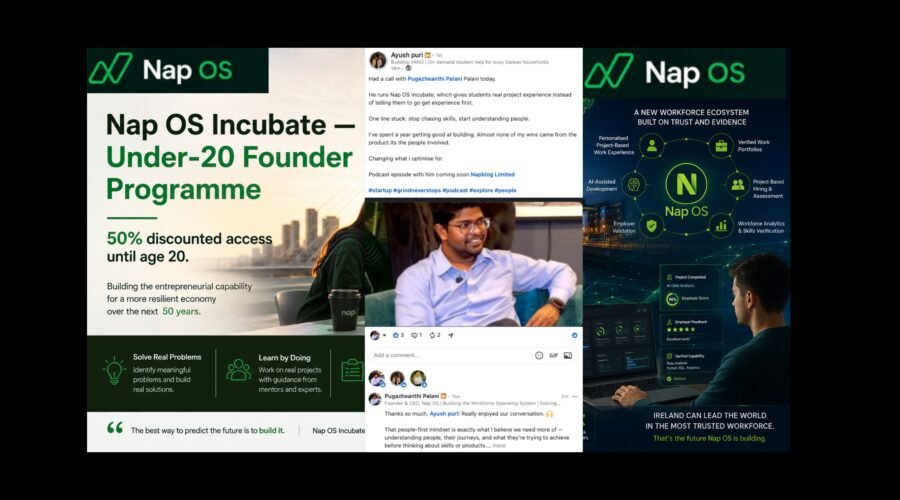
Last week I spent an hour with Ayush Puri, a business student at ATU in Galway. He is building VANO, a same-day household help marketplace matching Galway families with ID-verified student helpers for cleaning, garden work, dog walking and errands. It is live, it has real customers leaving reviews on platforms he cannot edit, and it has a properly written safety policy — which is more operational discipline than many funded companies manage.
He also runs a podcast interviewing other young founders, and after our conversation he wrote publicly that after a year of building, almost none of his wins had come from the product. They had come from the people involved, and he was changing what he optimised for.
That is an unusually clear-eyed observation, and it describes the gap precisely. He had spent a year becoming genuinely capable — and capability was not the binding constraint.
He is not unusual in this. He is unusual only in having noticed.
Three things first-time founders lack, and none of them is skill
A validated problem. Most early founders have an idea, which is not the same thing. An idea is a proposed solution; a problem is a documented pattern of people experiencing something costly enough to pay to remove. Founders who cannot articulate the second will pivot repeatedly, because each pivot is a search for the thing they never established at the start.
Access to judgement. Ireland’s real structural advantage is that it is small: the person running a university innovation office, a scaling company or a funding programme is usually two introductions away, and there is a strong culture of taking the call. Around twenty people materially shaped how I work, none of them assigned to me. Very few students use this advantage, because almost nobody tells them it is available or that they are entitled to ask.
Evidence anyone external will credit. This is the one nobody names. A student founder has no way of demonstrating what they have actually done. There is no transcript for shipping a product, no credential for having run a marketplace, no record a funder, an employer or a programme assessor can check. Their execution is real and completely illegible from the outside — which is the same structural problem faced by every graduate told they need experience to get experience.
Skill acquisition, meanwhile, is the one input that has become abundant. A capable twenty-year-old can now learn to build a working product in months. That abundance is precisely why building feels like progress while the real constraint goes unaddressed.
The failure mode of early incubation
There is a reason support programmes hold back from this stage, and it is a defensible one: pre-validation founders are hard to help and harder to measure.
But the common response — admitting them and applying the standard apparatus anyway — produces a specific and recognisable failure. The founder arrives with a half-formed instinct. A mentor with a template reshapes it into something the programme knows how to process. The founder leaves with a business model canvas, a pitch deck and a plan they do not privately believe. They have been made legible to the programme rather than useful to a customer.
This is worse than no support at all, because it consumes the founder’s most valuable asset — conviction about a problem they chose — and returns a plan they are executing on someone else’s authority.
Incubation at this stage therefore has to do something different. It has to help the founder establish whether the problem is real and whether they care about it enough to still be working on it in two years, and it has to produce evidence of execution along the way. Plans come later, and they come easily once those two things are settled.
How Nap OS Incubate is designed
Nap OS exists to address the “no experience” catch-22: employers require experience, and people without it cannot obtain it. Our principal product gives people supervised project work and an independently verifiable record of what they produced.
Incubate applies the same mechanism to a different destination. Where our Workforce members are building towards employment, Incubate members are building towards a venture. The pathway is identical — take a real problem, scope it into a defined project, execute it, produce outputs, have them reviewed against published criteria, validate the result — but the output is a tested business problem and a documented record of execution rather than a job.
It costs €49.99 per month. What a member receives is structure and a project manager who will assess their work honestly and in writing. What they do not receive is funding, a guarantee, or a template into which their idea will be fitted.
It is the least developed of our three product lines and we are explicit about that. It works because the underlying method is proven: of the participants who have come through our programmes, most moved into employment, and several went on to found companies or work independently instead.
Validation before commitment
At the end of that conversation in Galway, I offered to support Ayush through Incubate. He told me directly that he is short of funds and about to travel.
What we agreed instead is the principle the programme is built on. He will independently establish whether the core problem he is solving is the one he genuinely wants to spend the next several years on — before any formal incubation relationship begins. We reconnect at the end of September.
That is not commercial reticence. A founder who joins a structured programme before identifying their problem will use the programme to avoid identifying it, and both parties will waste six months discovering this. Any incubation offering that will not tell a prospective member to go away and validate first is selling structure to people who need clarity, and the two are not interchangeable.
Why this matters beyond individual founders
Ireland’s economic strategy depends on a founder pipeline. Enterprise Ireland’s High Potential Start-Up programme, the innovation centres and the pre-seed funds all draw from the same upstream pool, and that pool is fed by people who started building young enough to have failed a few times before it mattered.
At present that upstream stage relies almost entirely on individual initiative — on a student having the confidence to start, the network to ask, and the persistence to continue without any external recognition that the work counts. Some do. Most, reasonably, do not.
Making that stage legible is not a soft objective. It determines how many founders reach the point where the existing, well-designed support system can do its job.
To the students already building
There are considerably more of you than the public conversation suggests — running real ventures between lectures in Galway, Cork, Maynooth, Athlone and Dublin, largely unrecorded.
A few things worth acting on. Establish your problem before your product. Approach five to ten mentors this month rather than waiting until you feel you have earned the introduction; you have. Choose collaborators who raise the standard rather than the ones who happen to be nearby. And keep a record of what you actually build, because in two years it will be the only evidence you have that any of it happened.
If you are building something and want to talk it through — whether or not any of our programmes ever suit you — the conversation is available. That is how the ecosystem I benefited from operates, and it continues only if people keep doing it.
Pugazheanthi Palani is the founder of Nap OS, built by Napblog Limited, Dublin — an Industry Partner Member of the EdTech Ireland Network. Nap OS Incubate helps students and early-career founders turn ideas into validated problems and documented execution. Nap OS exhibits at the gradireland Graduate Careers Fair, RDS Dublin, on 6 October 2026; students and student founders are welcome to come and talk.