7 min read
Every durable company owns something competitors can’t simply decide to build. Not a feature — features get copied in a quarter. Something that compounds: an asset that gets more valuable the longer you hold it, and more expensive for anyone else to start.
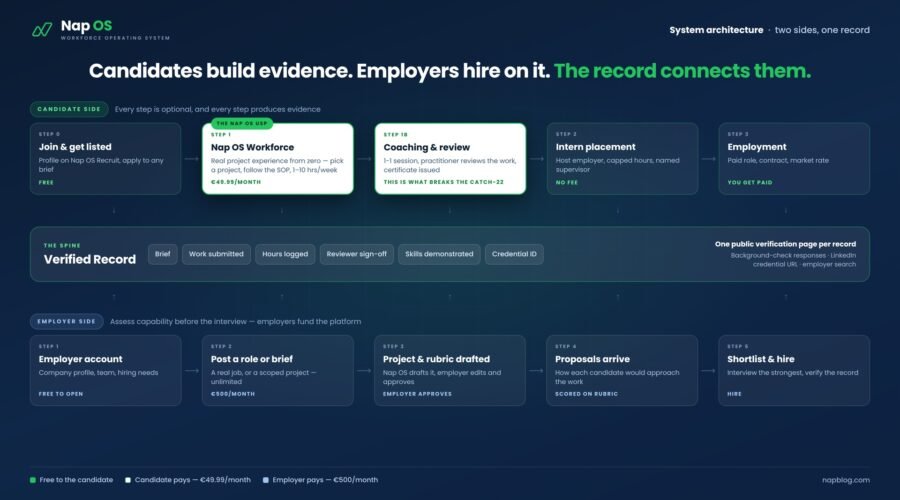
Nap OS is being built around one of those. It isn’t the platform, the projects or the certificate. It’s the verified record — and, more precisely, the position of being the party the market trusts to confirm what someone has actually done.
Here’s the argument for why that position is winnable, why it has to be won from Ireland, and what would destroy it.
The category that doesn’t exist yet
There is a well-developed market for claims about capability. CVs, LinkedIn profiles, cover letters, course certificates. Enormous industry. Almost none of it is checkable.
There is a well-developed market for credentials. Degrees, professional qualifications, accredited awards. Rigorous, respected, and slow — three years and thousands of euro before you have one, which is no use to someone who needs work in October.
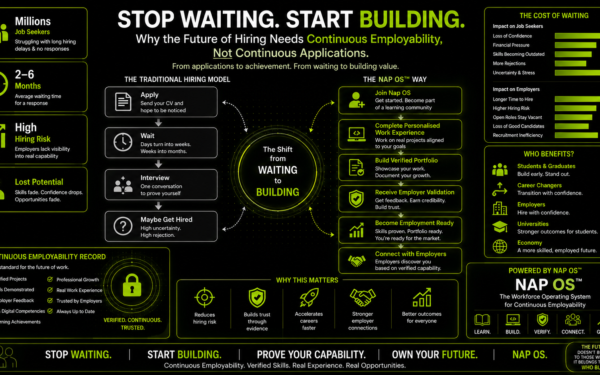
Between them sits a gap: verified capability. Evidence that a specific person did a specific piece of work to a specific standard, assessed by someone qualified, confirmable by a third party, and produced in weeks rather than years.
That category has no incumbent. Not because nobody wants it — employers ask for it constantly, in the form of “do you have relevant experience?” — but because building it requires assembling four things that don’t naturally sit together: real work to do, people to do it, practitioners to judge it, and an institution willing to stand behind the answer for years afterwards.
Why the obvious players can’t take it
Job boards match claims to vacancies. Their entire economic model runs on volume of listings, not on the quality of evidence behind an applicant. Building verification would slow their funnel and add a cost centre nobody is asking them to fund.
LinkedIn owns the claims layer so completely that verification threatens it. If profiles carried checkable evidence, most of the platform’s content would be exposed as unverified. Turkeys, Christmas.
Bootcamps and course providers issue certificates about their own teaching. They can tell you someone completed a course. They can’t tell you how that person performed on real work, because they have no employers and no live projects. And their incentive runs the wrong way: they’re paid for enrolments, so scrutiny of outcomes is a cost, not a product.
Universities have rigour and legitimacy, but they move on academic calendars and accreditation cycles. A university cannot spin up a new micro-credential in six weeks because an employer needs data analysts now.
ATS and screening vendors are already close, and they’re the group to watch. But they process what employers send them; they don’t create evidence, and they have no relationship with candidates before an application exists.
Each of them is structurally blocked, not merely slow. That’s what makes the gap durable rather than temporary.
The five things that compound
1. The verification channel. When a screening firm writes to confirm someone’s history, whoever answers accurately, for years, becomes part of that infrastructure. This is unglamorous and enormously defensible: it can’t be bought, only accumulated, and it dies the moment you confirm something untrue. A competitor starting today needs several years of reliable answers before anyone treats their confirmations as meaningful.
2. Outcome data. Nap OS already holds something rare: a traceable record of roughly fifty people — what they did on the programme, for how long, and where they work now. Amazon, JPMorgan Chase, ServiceNow, Bosch Rexroth, ESB Networks. Extend that and it stops being a testimonial list and becomes a dataset that answers a question nobody in Irish hiring can currently answer: which kinds of demonstrated work actually predict who succeeds in a role? Every cohort makes that model sharper, and the model is not reconstructable by a competitor without running the same years of cohorts.
3. The SOP library. Each project brief is written once and serves hundreds of people. Written properly — reviewed by practitioners, updated as tools change — it becomes an asset with the economics of software and the credibility of industry practice. Copying the text is easy; earning the practitioner input that makes it trustworthy is not.
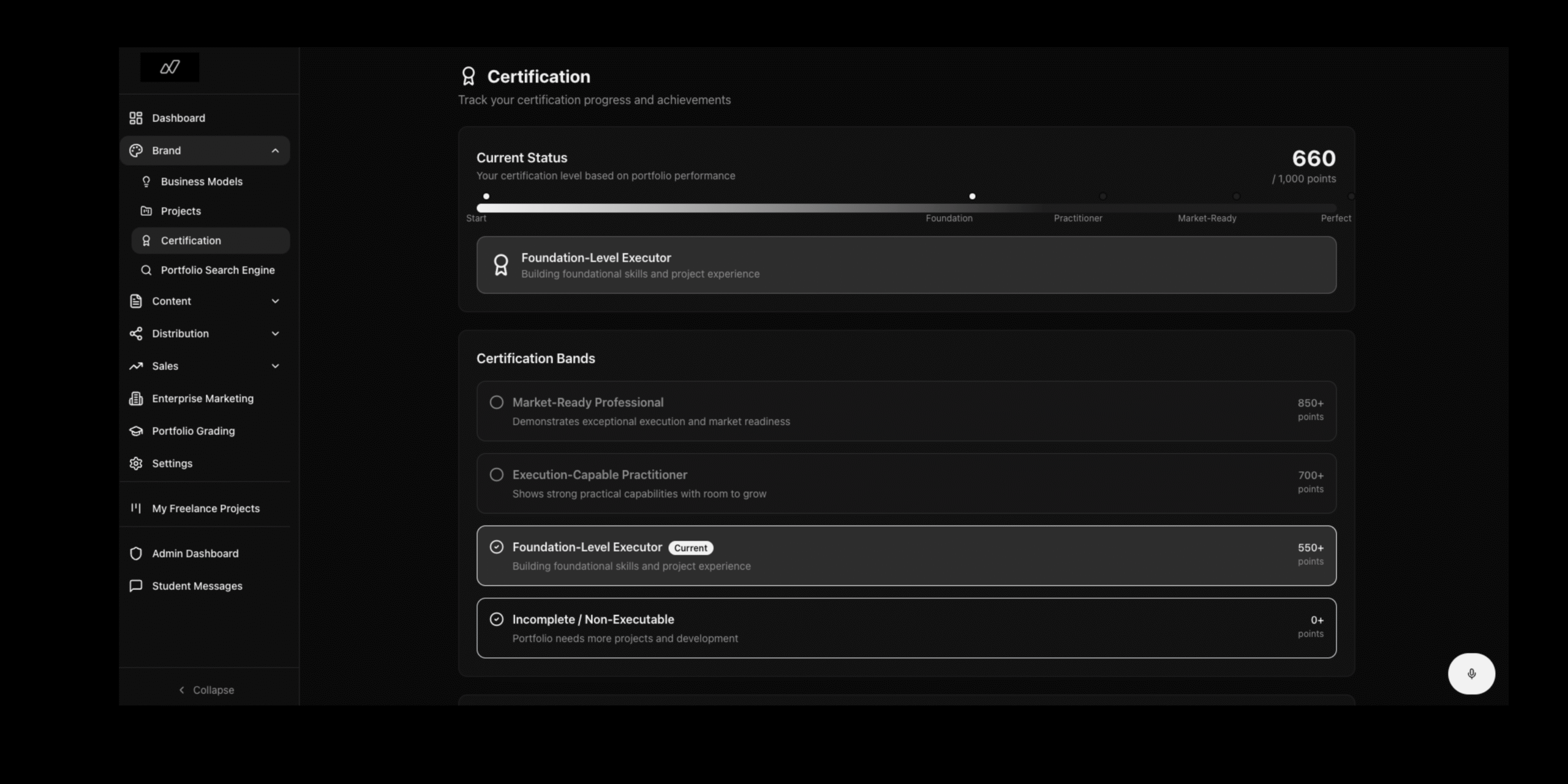
4. The reviewer network. Working professionals who sign off on submissions in their own field. This is the slowest thing to build and the hardest to poach, because it runs on relationships rather than contracts. It’s also the component that converts self-issued evidence into industry-validated evidence, which is the difference between a certificate and a reference.
5. Institutional embedding. Once a careers service, an ETB or a Technology Gateway routes students through you, switching costs are real: staff training, process, internal advocacy. The slow sales cycle that makes institutions frustrating to sell to is the same thing that protects you once you’re in.
None of these is decisive alone. Together they interlock: the reviewer network makes the record credible, the record makes verification meaningful, verification attracts employers, employers supply projects, projects generate outcome data, outcome data persuades institutions, institutions supply candidates. Each loop feeds the next.
Why Ireland is the right place to build it
Ireland is small enough to saturate. Around 150,000 people are actively looking for work. There are roughly twenty higher education institutions, a countable number of recruitment agencies, thirty-one Local Enterprise Offices and seventeen Technology Gateways. A determined company can genuinely reach most of that in two years — and a proof point that covers a whole national market is far more persuasive than a fragment of a large one.
Ireland is also where the EU’s rules land first and hardest. GDPR, and now the AI Act, which treats candidate evaluation as high-risk with real obligations around transparency, bias monitoring and human oversight. Most workforce-tech companies experience that as a burden. For a company that builds to those standards deliberately, it becomes the export advantage: a product that is already compliant in the market everyone else has to retrofit for.
And Ireland has the specific problem in acute form. A large international student population that arrives qualified and is told it lacks “local experience”. A long-term unemployed cohort that grew by 7,200 in a year while the headline rate barely moved. If the catch-22 can be broken anywhere, it’s in a country small enough to try it properly and diverse enough for the result to mean something.
Why “R&D company” is the honest description
The temptation is to describe Nap OS as a platform. It isn’t, yet. What it actually is right now is a company running an experiment: does verified project evidence predict job performance better than CV screening, and does it widen or narrow access?
That’s a real research question, and nobody has answered it properly for this market. Answering it — ideally with an academic partner, funded through an Innovation Voucher, using the outcome data — produces something no competitor can assert: not “we believe this works”, but “here is the evidence, independently analysed.”
In a category built on trust, being the company that can prove its own method is the position worth holding.
What would destroy it
Being honest about the failure modes is part of the argument, because each one is avoidable and each one is fatal.
Confirming something untrue. One inflated job title verified into a screening database and the whole asset devalues. The discipline that feels pedantic — refusing to describe a programme participant as an analyst — is the moat.
Selling the badge instead of earning it. If verification correlates with who paid rather than who performed, employers work it out and the evidence becomes worthless.
Scaling the profitable half. The training programme scales beautifully and generates revenue. Real placements are capacity-limited and free. Drift toward the first without growing the second and you become a course provider with a ladder most people can’t climb.
Getting the employment questions wrong. A model built on unpaid participation has to be structured correctly, documented, and legally reviewed. One WRC case, and no university in Ireland will touch it.
The sequence
Ten practitioner reviewers across ten fields. Twenty employers posting real briefs. A verification page with a credential ID that resolves publicly. The outcome dataset analysed by an academic partner. Two institutions routing students through it.
That’s not a large list. It’s roughly eighteen months of unglamorous work, and at the end of it the position is genuinely difficult to take — not because of a patent or a lock-in, but because trust accumulated over time is the one asset that can’t be bought at any price.
Nap OS is built by Napblog Limited, Dublin. Exhibiting at the gradireland Graduate Careers Fair, RDS Dublin, 6 October 2026.
Figures: CSO Monthly Unemployment July 2026 and Labour Force Survey Q2 2026.