9 min read
Ireland has a small population, but an unusually ambitious startup ecosystem.
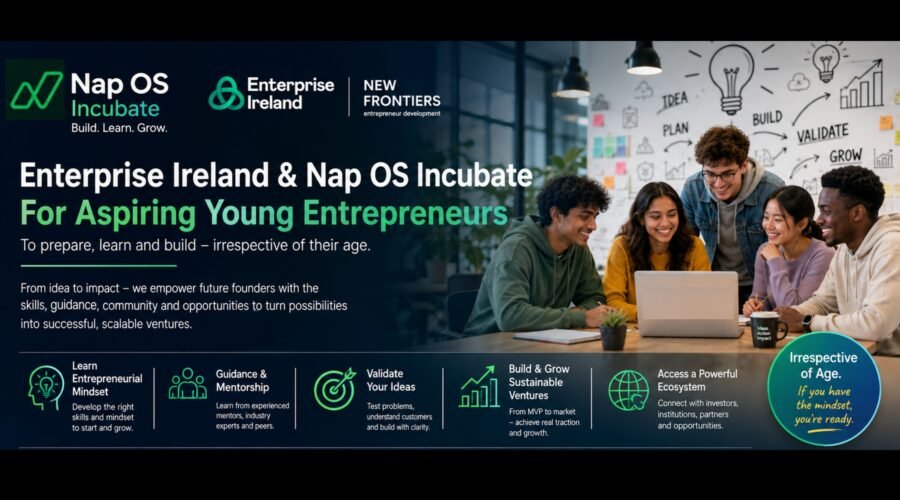
In 2025, almost 500 individuals took part in Phase 1 of Enterprise Ireland’s New Frontiers programme. Enterprise Ireland describes New Frontiers as its national programme for developing the entrepreneurial skillset of early-stage founders, delivered through third-level institutions across 18 locations in Ireland.
At first glance, 500 people may not sound enormous.
But put it against a simplified population benchmark of five million people:
500 / 5,000,000 = 0.01%
That is approximately one person in every 10,000 people.
Of course, this is not a population participation rate—New Frontiers applicants are a self-selected entrepreneurial group, rather than a random sample of Ireland’s population. Ireland’s actual population was approximately 5.46 million in April 2025, according to the Central Statistics Office.
Nevertheless, the ratio gives us an interesting way to think about the scale of entrepreneurial participation: hundreds of individuals voluntarily entered a structured process designed to challenge their assumptions, investigate markets and determine whether their ideas could become sustainable businesses.
For Nap OS Incubate, this creates an important question:
What can we learn from the process that hundreds of Irish founders went through in 2025—and how should those lessons influence the next generation of founders?
Our view is simple:
The most valuable part of an incubation programme is not the certificate at the end. It is the change in the founder’s decision-making process.
1. New Frontiers is not simply a startup course
One of the biggest misunderstandings about entrepreneurship programmes is that founders join to “learn how to start a business.”
The reality is more demanding.
Enterprise Ireland positions New Frontiers as a programme designed to develop entrepreneurial skills and help founders take an idea or early-stage business through its initial development stages and towards fundraising and growth. Enterprise Ireland also describes the programme as a pipeline for promising startups into the wider Local Enterprise Office and Enterprise Ireland ecosystem.
Phase 1 has a particularly important role.
IADT’s current description of Phase 1 says it helps founders research and test market potential, evaluate their idea, understand customer needs, identify their value proposition and reach a go/no-go decision.
That changes the meaning of “incubation.”
The objective is not:
Idea → programme → startup
It is closer to:
Idea → assumptions → customer discovery → evidence → decision
Sometimes the decision is go.
Sometimes it is change direction.
And sometimes it should be no-go.
That is a feature, not a failure.
2. The first lesson: fall in love with the problem, not the product
One of the strongest lessons in the New Frontiers ecosystem is the importance of problem discovery.
New Frontiers guidance explicitly encourages founders to identify the problem, conduct discovery interviews and understand customer pain before becoming overly attached to their solution. It describes Phase 1 as an opportunity to validate the idea with the market and move towards a go/no-go decision.
This is particularly relevant in the current AI environment.
It is now easier than ever to build something.
A founder can create:
- a website,
- an AI assistant,
- an application,
- an automation,
- a prototype,
- a dashboard,
- or an MVP
in a fraction of the time that would have been required several years ago.
But building faster does not mean customers need the product.
The scarce resource is increasingly not technical production.
It is validated understanding.
Who has the problem?
How frequently do they experience it?
What do they currently do about it?
What does the problem cost them?
Who controls the budget?
What alternatives already exist?
And, critically:
Would someone actually change their behaviour—or pay money—to solve it?
That is where customer discovery becomes more valuable than another feature.
3. The second lesson: customer conversations are part of product development
A founder can spend six months developing a product in isolation.
Or they can spend six weeks speaking to customers and discover that their original assumptions were wrong.
The second founder may appear to have made less progress.
In reality, they may have reduced the greatest risk.
New Frontiers’ own material around customer-focused development emphasises getting out of the building, identifying assumptions, building an MVP, measuring customer reactions and learning from the evidence.
This is the process we believe should become normal founder behaviour:
Hypothesis → Conversation → Experiment → Evidence → Learning → Iteration
Not:
Idea → Build → Launch → Hope
For Nap OS Incubate, this is particularly important because our philosophy is centred around people before products.
A founder needs to understand the human being behind the transaction.
An employer is not merely a customer.
A student is not merely a user.
A university is not merely a partner.
An investor is not merely a source of capital.
Each stakeholder has different incentives, concerns, language and definitions of value.
Understanding those differences can determine whether a startup succeeds.
4. The third lesson: validation is not the same as enthusiasm
Another important distinction is between people liking an idea and people validating a business.
A founder can receive dozens of positive comments:
“That’s a great idea.”
“I’d definitely use that.”
“This could be huge.”
But those statements are weak evidence.
Stronger evidence includes:
- a customer agreeing to pilot;
- a customer returning repeatedly;
- someone paying;
- an employer signing a letter of intent;
- users referring others;
- customers requesting additional functionality;
- measurable retention;
- repeatable acquisition;
- or a buyer allocating budget.
This is where incubation should evolve from opinion collection to evidence generation.
The question isn’t:
“Do people like my startup?”
It is:
“What behaviour demonstrates that the problem is important enough for someone to act?”
For a founder, this distinction can save enormous amounts of time and money.
5. The fourth lesson: an MVP is a learning machine
A minimum viable product should not simply be the smallest possible version of a product.
It should be the fastest mechanism for learning whether an important assumption is true.
This is why the MVP is so powerful.
Suppose a founder believes:
“Employers will pay for verified candidate evidence.”
The founder doesn’t necessarily need to build the entire workforce operating system before testing that hypothesis.
They need an experiment capable of answering:
Will an employer engage with this proposition?
Similarly:
“Students want supervised project experience.”
The founder needs to test behaviour—not simply conduct a survey.
New Frontiers’ customer-focused guidance reinforces this experimentation mindset: identify assumptions, test them, measure reactions and change direction when evidence disproves the hypothesis.
For Nap OS, this principle is central.
The product itself should continuously generate evidence.
6. The fifth lesson: incubation is also about founder transformation
A programme can provide workshops, mentors, networks and frameworks.
But ultimately, the founder has to change.
That transformation can involve moving:
from builder → to businessperson
from assumptions → to evidence
from product obsession → to customer understanding
from activity → to measurable progress
from “I think” → to “the market shows”
This is one reason peer communities matter.
Enterprise Ireland describes New Frontiers as creating connections between founders, business experts and advisers, while the national programme brings together participants across Ireland.
The diversity of founders is valuable.
A healthcare founder can learn something from a software founder.
A food entrepreneur can learn something from a B2B SaaS founder.
A media entrepreneur can learn something from a medical-device founder.
The industries differ.
The entrepreneurial questions often don’t.
7. From Phase 1 to Phase 2: evidence should determine progression
The New Frontiers structure illustrates another important principle.
Progression should follow validation.
Phase 1 is designed around early market research, customer understanding, value proposition development and a go/no-go decision. Phase 2 is the more intensive, full-time programme focused on founders developing and scaling high-potential startups. IADT describes Phase 2 as competitive.
This creates a logical progression:
Phase 1
Is there a meaningful problem?
↓
Validation
Do customers care?
↓
Early traction
Will they act?
↓
Phase 2
Can this become a scalable business?
↓
Further funding and growth
Can the company build a sustainable and internationally scalable model?
The important word is evidence.
A founder shouldn’t pursue the next stage simply because they completed the previous stage.
They should pursue it because the evidence justifies doing so.
8. What does 500 people actually represent?
The headline number—almost 500 Phase 1 participants in 2025—is useful, but the deeper significance is not the number itself.
It represents 500 individual attempts to convert uncertainty into evidence.
And that is an important contribution to Ireland’s entrepreneurial ecosystem.
Enterprise Ireland reported that 158 founders from the 2025 New Frontiers class were progressing through Phase 2 around the time of its February 2026 national networking event.
Historically, New Frontiers has also produced founders who went on to establish companies, raise investment and create employment. Enterprise Ireland says that since the programme launched in 2012, more than 5,000 participants have received funding and intensive support to develop startup ideas.
Therefore, the programme should not be viewed simply as a classroom.
It is part of a national entrepreneurial pipeline.
9. The Nap OS Incubate perspective: build people, not just companies
This is where Nap OS Incubate sees a broader opportunity.
Ireland does not only need more startups.
It needs more people who understand how startups are actually built.
That includes:
- customer discovery;
- experimentation;
- market research;
- sales;
- product development;
- communication;
- leadership;
- resilience;
- networking;
- fundraising;
- commercial validation;
- and learning from failure.
These capabilities are transferable.
A founder whose first startup fails does not necessarily return to zero.
If they learned how to identify customers, test assumptions, build teams and sell, they carry those capabilities into the next venture.
The same principle applies to early-career professionals.
This is one reason Nap OS exists.
We believe that capability should be demonstrated through work, not merely claimed through a CV.
The entrepreneurial ecosystem and the workforce ecosystem therefore have something important in common:
Evidence of capability is more powerful than a declaration of capability.
10. The future: from certificates to verified evidence
The next generation of workforce and entrepreneurship programmes can go further.
Instead of simply recording:
“Participant completed Programme X.”
we should increasingly be able to demonstrate:
What did the participant actually do?
What problem did they investigate?
What project did they deliver?
Who supervised the work?
What feedback did they receive?
What changed because of their contribution?
What capability did they demonstrate?
That is the philosophy behind the Nap OS model.
The future of employability should increasingly move from:
CV → claims
towards:
Portfolio → evidence → verification → trust
And the future of entrepreneurship education can make the same transition:
attendance → participation → experimentation → evidence → outcomes
Conclusion: 500 founders are not 500 startups—they are 500 experiments in learning
The most important lesson from the nearly 500 Phase 1 participants in Enterprise Ireland’s New Frontiers programme in 2025 is not that Ireland produced 500 new entrepreneurs.
It is that hundreds of people were given a structured opportunity to test whether their entrepreneurial assumptions could survive contact with reality.
Using the user’s simplified five-million-population lens, 500 people represents roughly 0.01%, or one in 10,000 people.
But the real significance is qualitative rather than statistical.
Each founder represents an experiment.
An attempt.
A hypothesis.
A problem to understand.
Customers to interview.
A proposition to test.
A product to build.
Evidence to collect.
And eventually, a decision:
Go. Change. Or stop.
That is what makes incubation valuable.
At Nap OS Incubate, our view is that the best founder-development systems should not teach entrepreneurs simply to look like founders.
They should help people think, test, build, learn and demonstrate evidence like founders.
Because in entrepreneurship, as in employment, the future belongs increasingly to people who can move beyond saying:
“I can do this.”
and instead demonstrate:
“Here is what I did. Here is the evidence. Here is what I learned. And here is the value I created.”
That is the transition from potential to proof.
And that is the lesson we take from Ireland’s 2025 New Frontiers cohort.