8 min read
A candidate needed help finding a job. A career coach reviewed their CV, suggested improvements to LinkedIn, helped identify suitable roles, prepared interview questions and provided advice about how to navigate the recruitment process.
There was genuine value in this.
But artificial intelligence has changed the economics of information-based career advice.
Today, a job seeker can give an AI system a job description and ask it to analyse the requirements. They can compare those requirements with their CV, identify missing keywords, draft a cover letter, generate interview questions, practise answers, research an industry and create a structured job-search plan.
Tasks that once required hours of career-coaching time can increasingly be performed instantly and repeatedly.
The research supplied for this article points to exactly this change: AI integration is increasingly commoditising basic résumé and interview preparation, while human coaches are being pushed toward deeper forms of mentorship and support.
So an uncomfortable question deserves to be asked:
If AI can provide career advice at enormous scale, what exactly should humans be paying career-support providers for?
The answer may define the next generation of the industry.
Career coaching solved an information problem
Traditional career coaching exists for good reasons.
Candidates often need an outside perspective. They need accountability. They may not understand how recruiters evaluate applications or how to communicate their experience effectively.
The research supplied here identifies several traditional benefits: objective perspective, assistance with career transitions, skill development and accountability.
But it identifies weaknesses too.
Quality can vary. Return on investment can be difficult to quantify. High-touch coaching can be expensive, particularly for the entry-level workers who may need assistance most.
Most importantly, much of the traditional product is fundamentally information.
How should I structure my CV?
What should my LinkedIn headline say?
How should I answer “Tell me about yourself”?
What skills does this job require?
What questions might I receive in an interview?
How should I approach my job search?
These are exactly the types of problems generative AI is extremely well suited to addressing.
That does not mean human career coaches disappear.
It means that simply providing information becomes harder to defend as a premium product.
The question changes from:
“Who can give me career advice?”
to:
“What can a human career service provide that an AI cannot?”
AI has a proof problem
Imagine a graduate applying for a marketing position.
They ask AI:
“Help me prepare for this marketing job.”
AI can explain campaign strategy.
It can generate a sample campaign.
It can teach Google Ads terminology.
It can explain conversion rates.
It can analyse a dataset.
It can simulate interview questions.
It can even help the candidate construct a portfolio.
But now imagine the employer asks:
“What have you actually done?”
That is a fundamentally different question.
An AI-generated answer cannot substitute for evidence that the candidate personally completed work, received feedback, revised it and demonstrated capability.
The same applies across disciplines.
Someone interested in sales can learn sales methodologies with AI.
Someone interested in research can ask AI to explain research methodologies.
Someone interested in product can ask AI to build a product-management framework.
Someone interested in data can ask AI to explain an analysis.
But knowledge about work and evidence of doing work are not the same thing.
This is where the next career-support opportunity begins.
Career Coaching 1.0: Advice
The first model can be summarised simply:
“I will tell you what you should do.”
The coach possesses knowledge the candidate does not.
That knowledge creates value.
The candidate pays to access it.
For many years, this worked because professional knowledge was relatively expensive to obtain and difficult to personalise.
The internet weakened that advantage.
AI is accelerating the change.
Career Coaching 2.0: AI Assistance
AI changes the model to:
“Tell me your situation and I will help you work through it.”
Suddenly personalised assistance becomes inexpensive and available 24/7.
A candidate can run 50 mock interview questions instead of paying for one mock interview.
They can create ten versions of their CV.
They can ask why every sentence should be changed.
They can compare twenty job descriptions.
They can ask unlimited follow-up questions.
This doesn’t eliminate the value of human judgement, empathy, accountability or specialised expertise.
But it substantially raises the standard that a paid human service must meet.
“We help improve your CV” is no longer a particularly strong technological moat.
Neither is:
“We provide interview questions.”
Nor:
“We help you identify your skills.”
AI can participate in all three.
So career support needs another layer.
Career Support 3.0: Proof of Work
This is the model Nap OS is being built around.
Instead of beginning with:
“How do we give candidates more advice?”
Nap OS begins with:
“How do candidates build evidence?”
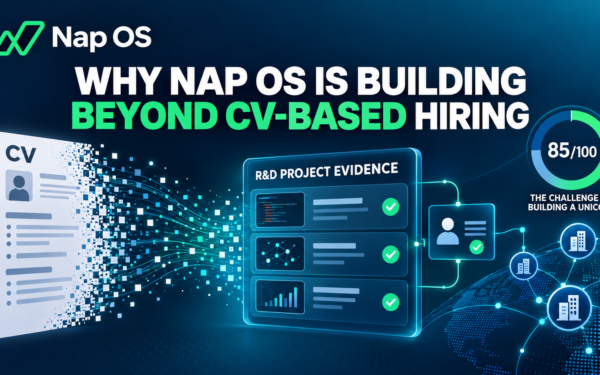
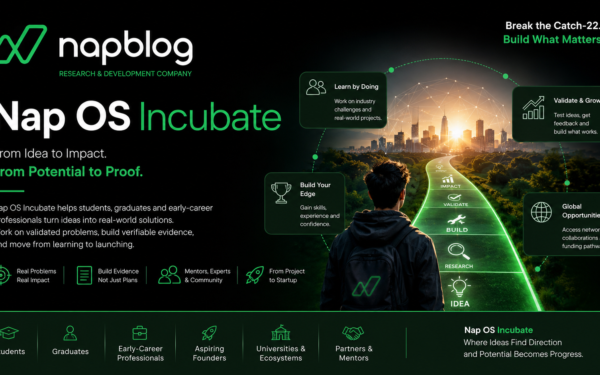
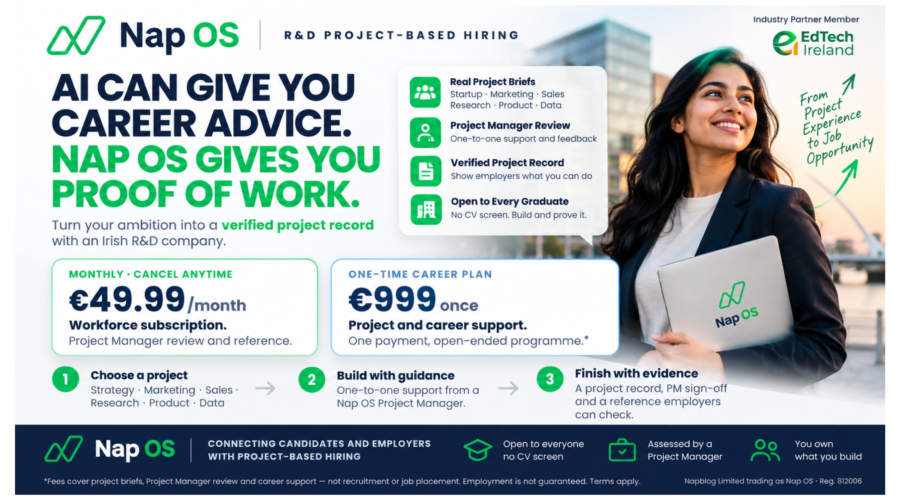
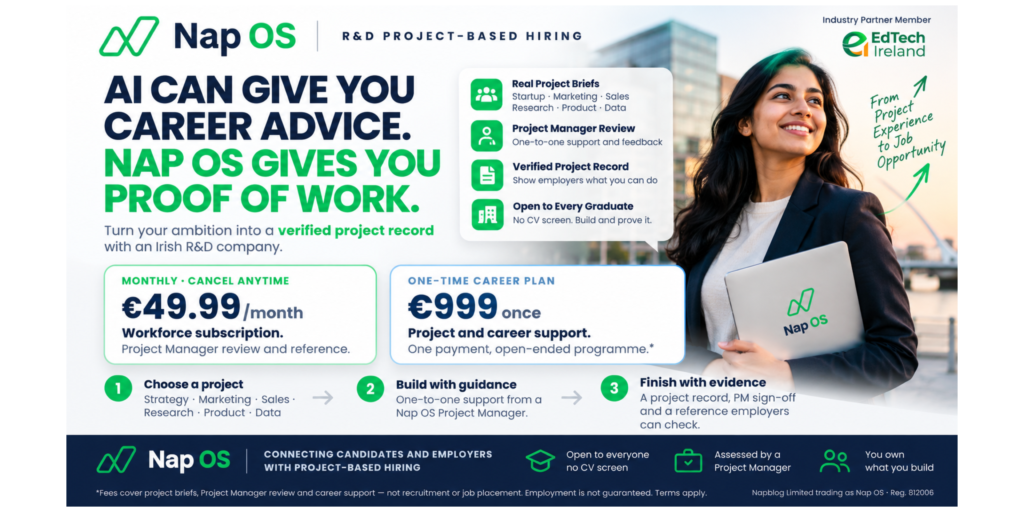
The current Nap OS model offers career-matched R&D project briefs with defined purpose, deliverables, acceptance criteria, suggested tools and time budgets. Participants complete the work and submit it for human project-manager review. The published model also includes written feedback and a record of completed practice.
That changes the relationship.
The candidate isn’t simply consuming advice.
They have to produce something.
A marketing candidate might build campaign work.
A research candidate might conduct structured research.
A product candidate might investigate and define a product problem.
A data candidate might analyse a dataset and communicate findings.
The project becomes the conversation.
AI can still participate.
In fact, AI should participate.
Modern professionals increasingly use AI at work. Preventing candidates from using AI altogether would miss part of the transformation happening in professional work.
But AI becomes a tool used during execution, rather than the final source of credibility.
The candidate still has to explain decisions, produce deliverables, respond to feedback and demonstrate what they contributed.
And a human reviewer can evaluate that output.
The human role changes
This is why the future may not belong to the traditional career coach alone.
It may belong to a different combination:
AI + Project Manager + Recruiter + Employer + Candidate.
AI provides intelligence and assistance.
The project provides the environment for execution.
The project manager provides human review and feedback.
Recruitment relationships can provide labour-market context.
Employers ultimately decide whether the demonstrated capability meets their requirements.
And the candidate does the work.
This distinction matters.
The objective isn’t to manufacture a line on someone’s CV.
It is to create something the candidate can actually discuss and demonstrate.
From career coaching to project & career support
That is why Nap OS should not be understood simply as another career-coaching business.
The proposed category is:
Project & Career Support
And, where genuine employer and recruitment relationships exist:
Employer & Recruitment-Backed Project & Career Support
The difference is subtle but important.
A conventional career coach might help a candidate talk about their potential.
Nap OS is attempting to help candidates build evidence of that potential through projects.
Its existing positioning describes itself as helping graduates and job seekers build proof-of-work and employer-aligned experience through real business projects.
That is a much more interesting problem than CV formatting.
“No local work experience?”
This problem becomes particularly visible for graduates, international talent and career changers.
Employers understandably want evidence.
Candidates need an opportunity to produce that evidence.
But opportunities themselves can be competitive.
That creates the familiar experience problem:
You need experience to get the opportunity.
But you need the opportunity to get experience.
Nap OS’s answer is deliberately simple:
NO LOCAL WORK EXPERIENCE? BUILD IT.
Choose a project.
Do the work.
Get reviewed.
Improve it.
Create evidence.
Then take that evidence into the employment market.
The employer still decides.
The candidate still competes.
And employment should never be represented as guaranteed.
That distinction is also consistent with Nap OS’s existing published results. Nap OS states that some previous participants subsequently joined outside employers, while explicitly noting that they were not hired through Nap OS and won those roles themselves.
That transparency should remain central as the product grows.
So why would anyone pay €999?
This is where the business model becomes interesting.
If €999 buys somebody generic career advice, AI makes the proposition increasingly difficult to defend.
If €999 buys a rewritten CV and several coaching calls, candidates can reasonably compare that against dozens of alternatives.
But consider a different proposition:
€999 — Project & Career Support Until You Get a Job
The value proposition is no longer:
“Pay us to tell you how to get employed.”
It becomes:
“We will provide a structured environment in which you can continue building projects, receiving human review, developing evidence and receiving career support while you pursue employment.”
Employment is not guaranteed.
Nap OS does not make the hiring decision.
The candidate still has to perform.
But the service does not end after somebody rewrites their CV and conducts a mock interview.
That is a fundamentally different relationship.
Alongside it, a €49.99 monthly Workforce subscription can provide a lower-commitment route for candidates who want flexible access.
One is flexible.
The other is outcome-duration-oriented support.
Neither should sell a job.
Both sell the infrastructure around becoming more demonstrable to employers.
AI doesn’t kill career coaching. It forces it to evolve.
There will continue to be excellent career coaches.
Human beings can provide context, judgement, accountability and interpersonal understanding that an automated system may not replicate.
But the industry should confront what AI has changed.
Information is becoming abundant.
Advice is becoming inexpensive.
Content is becoming instantaneous.
What remains scarce?
Opportunity.
Human judgement.
Credible feedback.
Professional relationships.
Evidence.
And ultimately:
Trust.
That is where human-led career services can move.
Instead of competing with AI to write a better cover letter, use AI.
Instead of selling information AI can reproduce, build environments where candidates have to execute.
Instead of telling someone they have potential, give them a structured opportunity to demonstrate it.
Nap OS Is the Future We Are Building
Nap OS is based on a simple belief:
The future of career support isn’t better advice. It’s better evidence.
AI can help a candidate understand strategy.
Nap OS can give them a strategy project to complete.
AI can explain marketing.
Nap OS can ask them to produce marketing work.
AI can teach research methodology.
Nap OS can give them a research problem.
AI can help analyse data.
Nap OS can require a candidate to turn analysis into a reviewed deliverable.
And employers can judge the resulting evidence for themselves.
That is why the future of career support may increasingly move beyond career coaching toward project + career support.
The question candidates ask is changing.
It is no longer only:
“Can someone help me get ready for a job?”
Increasingly, it is:
“How can I prove I can do the job?”
That is the problem Nap OS intends to solve.
AI can tell you how to become more employable.
Nap OS is building a place to prove what you can do.
That is the future of career support.
That is Nap OS.