6 min read
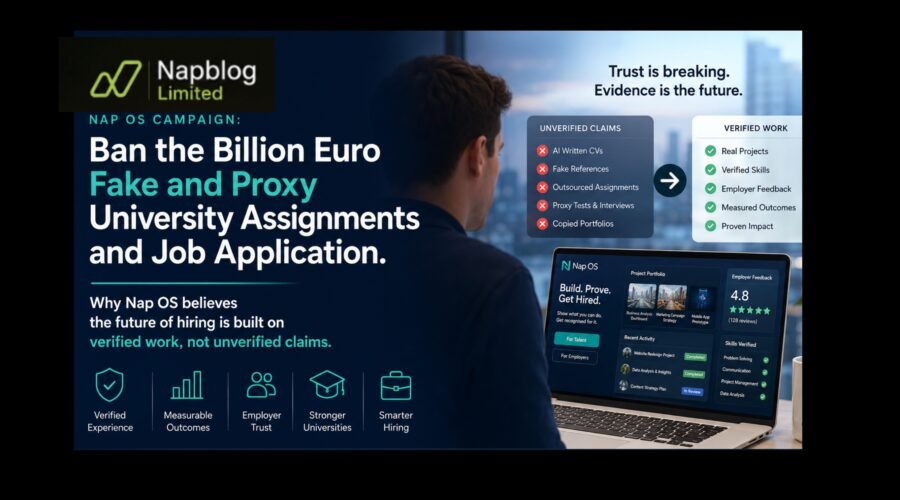
Why Nap OS believes the future of hiring is built on verified work, not unverified claims.
For decades, hiring has relied on trust.
An employer receives a CV, reads a cover letter, conducts one or two interviews, checks a reference, and makes a decision. Everyone involved assumes that what the candidate says is true.
That system worked reasonably well when creating a fake work history required significant effort.
Today, that assumption is breaking down.
Artificial intelligence can generate polished CVs in seconds. Cover letters can be written instantly. Online portfolios can be copied. University assignments can be outsourced. Technical interviews can be completed with hidden AI assistance. Remote assessments can be taken by someone else.
The problem is no longer whether these things happen.
The problem is how often employers simply cannot tell.
A growing number of organisations are asking themselves a difficult question:
Can we still trust what we see on a CV?
At Nap OS, we believe this is becoming one of the biggest workforce challenges of the AI era.
The trust crisis nobody wants to talk about
Most hiring discussions today focus on AI replacing jobs.
We think the bigger problem is something else.
AI is replacing trust.
Employers are increasingly struggling to distinguish between candidates who genuinely possess skills and candidates who simply know how to present themselves well.
Consider what employers face today.
A candidate submits:
- an AI-written CV
- an AI-written cover letter
- a polished LinkedIn profile
- certificates from online courses
- a portfolio filled with copied templates
- interview answers generated by ChatGPT
- coding assessments completed using AI tools
- references that reveal very little about actual capability
Every document looks professional.
Every candidate sounds impressive.
Yet many employers still make expensive hiring mistakes.
Not because people are dishonest.
Because traditional hiring methods were never designed for a world where almost every document can be generated or enhanced by AI.
The cost of hiring the wrong person
Hiring mistakes are incredibly expensive.
A poor recruitment decision affects far more than salary costs.
It impacts:
- team productivity
- customer satisfaction
- project delivery
- manager time
- onboarding costs
- training investment
- company culture
For startups, one poor hire can delay product development by months.
For SMEs, replacing an employee can cost tens of thousands of euros.
For larger organisations, recruitment mistakes scale into millions annually.
Yet employers continue making decisions based largely on documents that are becoming increasingly difficult to verify.
Universities face the same challenge
The problem doesn’t start with employment.
It starts during education.
Universities worldwide are dealing with:
- contract cheating
- ghost-written assignments
- AI-generated coursework
- copied programming projects
- outsourced dissertations
- proxy examinations
Students who complete their own work are competing with students who simply know how to outsource it.
Educators spend increasing amounts of time trying to detect academic misconduct instead of supporting learning.
Even when plagiarism software identifies copied content, it often cannot determine whether AI assisted the work or whether the student genuinely understands the material.
As a result, academic credentials alone are becoming less reliable indicators of practical capability.
Experience has become the new qualification
This is why employers increasingly ask one simple question:
“Show me what you’ve actually built.”
Not what you studied.
Not what course you completed.
Not what software you know.
But what have you actually delivered?
Can you:
- solve problems?
- work with others?
- communicate effectively?
- manage deadlines?
- complete projects?
- learn continuously?
These qualities cannot be measured through multiple-choice exams or AI-generated CVs.
They can only be demonstrated through real work.
The experience paradox
Unfortunately, another problem exists.
Employers want experience.
But graduates cannot gain experience without employers.
It is the classic Catch-22.
Many talented graduates spend months applying for jobs without success because every vacancy asks for one, two or three years of experience.
Career changers face similar barriers.
International professionals often struggle because employers ask for local experience before offering employment.
The result?
Thousands of capable people remain overlooked despite having enormous potential.
Hiring should be based on evidence
Imagine if recruitment worked differently.
Instead of asking candidates:
“Tell us about your skills.”
Employers could simply ask:
“Show us.”
Imagine opening a candidate profile and seeing:
- real projects completed
- documented progress over time
- employer feedback
- project deliverables
- verified contributions
- measurable outcomes
- continuous learning history
Instead of relying on promises, employers would evaluate evidence.
That is a fundamentally different hiring model.
This is why we built Nap OS
Nap OS was never designed as another job board.
It was never intended to become another online learning platform.
Nor another portfolio website.
Nap OS was built around one simple belief:
People should be hired for what they can prove—not what they can claim.
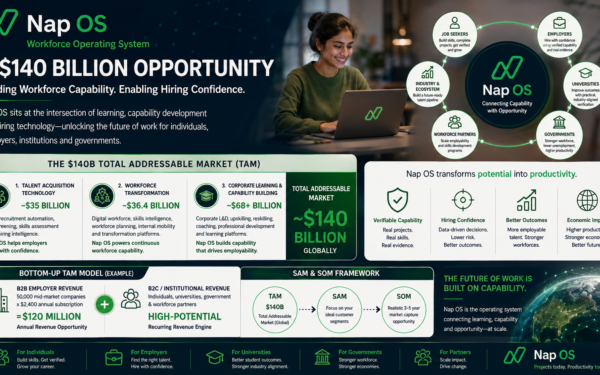
Our platform enables individuals to build personalised, project-based work experience while giving employers the opportunity to evaluate capability through actual work rather than CVs alone.
Instead of asking candidates to describe their skills, Nap OS helps them demonstrate those skills through structured business projects.
Project-Based Hiring
One of the newest capabilities inside Nap OS is Project-Based Hiring.
Rather than filtering hundreds of CVs, employers can invite candidates to complete real business challenges.
These are not hypothetical exercises.
They are genuine projects aligned with the organisation’s needs.
Employers observe:
- how candidates think
- how they solve problems
- how they communicate
- how they collaborate
- how consistently they deliver
- how they respond to feedback
The hiring decision becomes evidence-based.
Everyone benefits.
Candidates receive meaningful work experience.
Employers reduce hiring risk.
Building employer trust
Trust cannot be generated by AI.
Trust is earned through consistency.
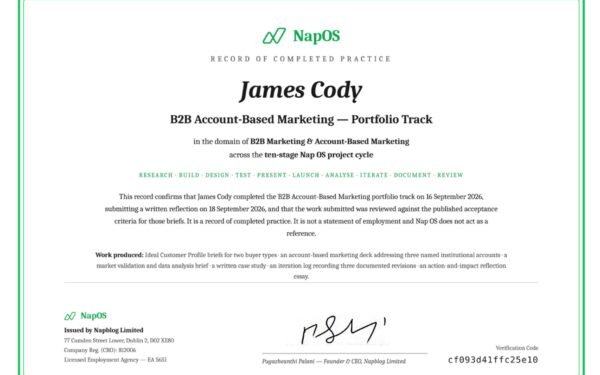
Every project completed on Nap OS contributes to a growing record of demonstrated capability.
Over time, individuals build:
- verified work portfolios
- project histories
- employer evaluations
- practical experience
- measurable outcomes
Instead of one interview determining someone’s future, capability becomes visible through continuous evidence.
Helping employers recruit differently
Employers are overwhelmed by applications.
Many receive hundreds or even thousands of CVs for a single position.
Screening them consumes enormous time.
Project-based hiring changes the conversation.
Instead of asking:
“Who has the best CV?”
Employers begin asking:
“Who performed best?”
That subtle difference transforms recruitment.
Performance replaces presentation.
Evidence replaces assumptions.
Capability replaces keywords.
The future of workforce development
We also believe learning itself is changing.
Traditional education teaches knowledge.
Employers increasingly reward execution.
Future workforce development will combine:
- learning
- practical application
- project delivery
- employer feedback
- continuous improvement
Learning and working will no longer exist separately.
They will happen together.
A stronger relationship between universities and employers
Universities already invest heavily in employability.
Placement programmes.
Internships.
Industry projects.
Career services.
Yet employers still struggle to verify practical capability.
Project-based hiring provides an opportunity to strengthen this connection.
Students graduate with more than academic transcripts.
They graduate with evidence of work.
Universities gain stronger employment outcomes.
Employers reduce recruitment risk.
Students build confidence before entering the labour market.
AI should strengthen trust—not weaken it
Artificial intelligence is not the enemy.
At Nap OS, we actively embrace AI.
We use AI to help individuals:
- identify skill gaps
- receive personalised guidance
- organise portfolios
- improve learning
- navigate career development
But AI should never replace genuine evidence.
Technology should make trust stronger—not weaker.
Looking ahead
The future of hiring will not belong to organisations that collect the most CVs.
It will belong to organisations that can confidently identify genuine capability.
Likewise, the future will favour candidates who can demonstrate consistent performance rather than simply describe it.
We believe this shift has already begun.
Across education, research, startups, SMEs and enterprise organisations, employers are asking for more evidence and less marketing.
That is exactly what Nap OS is building.
The future isn’t about who you know.
It isn’t even about what you say you know.
It is about what you can consistently demonstrate.
As AI continues to reshape education and employment, trust will become one of the most valuable assets in the workforce.
At Nap OS, we’re building the infrastructure to restore that trust—one verified project, one employer assessment, and one work portfolio at a time.
Because in the future of work, proof will matter more than promises.