Last updated: May 29, 2026
6 min read
The gap between education and employment has never been more visible. Students graduate with degrees, certifications, and theoretical knowledge, yet struggle to translate that into real opportunities. Employers, on the other hand, continue to demand experience—even for entry-level roles. This contradiction is not new, but it is becoming more critical in a world shaped by rapid technological change, evolving job roles, and increasing competition.
At Napblog Limited, we approach this problem differently. Instead of trying to fix hiring from the outside, we rebuild how experience itself is created. Through Nap OS and Napblog Projects (NLPs), we enable students to generate real, verifiable work experience before they even enter the job market.
This is not simulated learning for the sake of engagement. It is structured execution designed to produce outcomes that matter in real hiring decisions.
The Core Problem: Experience Without Opportunity
Most students face a simple but frustrating loop:
You need experience to get a job.
You need a job to get experience.
Traditional solutions attempt to break this loop through:
- Internships (often limited and competitive)
- Certifications (widely accessible but weak in signaling real capability)
- Personal projects (valuable but often unstructured and hard to validate)
What is missing is a system that consistently converts effort into credible, job-relevant experience.
This is where NLPs come in.
What Are Napblog Projects (NLPs)?
Napblog Projects (NLPs) are structured, execution-driven projects designed to simulate real-world work environments while producing tangible, measurable outputs.
They are not theoretical assignments.
They are:
- Problem-based
- Outcome-focused
- Tool-driven
- Documented
- Verifiable
Each NLP is built around real industry tasks such as:
- Running a digital marketing campaign
- Building a data analysis report
- Creating a product positioning strategy
- Designing a user interface prototype
- Automating workflows using AI tools
The objective is simple: replicate the kind of work employers expect, and document it in a way that proves capability.
The Role of Nap OS in Structuring NLPs
NLPs do not exist in isolation. They are powered and structured through Nap OS—the execution operating system.
Nap OS acts as the infrastructure layer that ensures every project is:
- Logged
- Tracked
- Measured
- Documented
- Converted into portfolio evidence
Without Nap OS, projects remain scattered.
With Nap OS, they become structured career assets.
Inside the system:
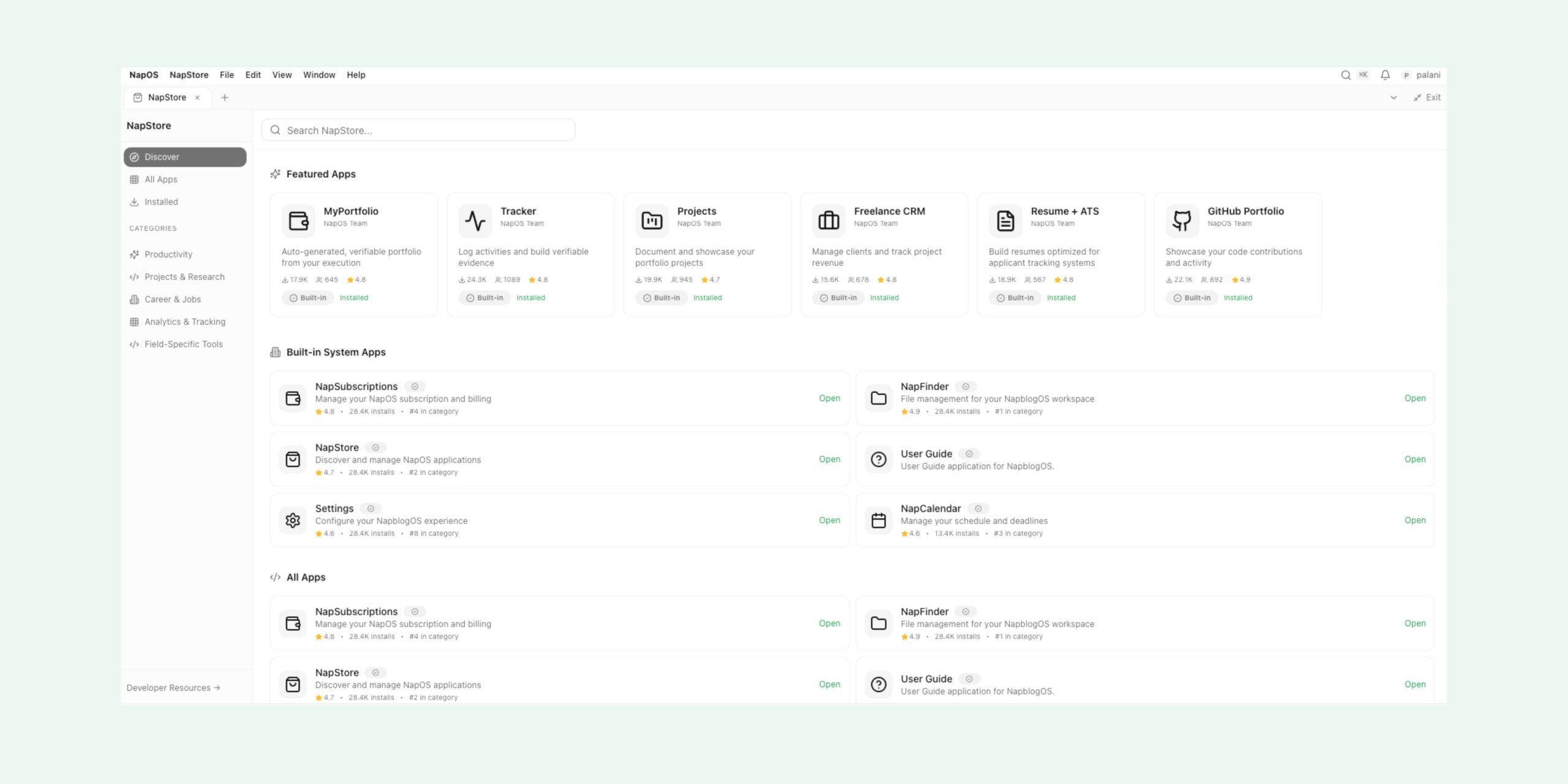
- Students select skill-based applications through NapStore
- Each skill maps to specific tools and workflows
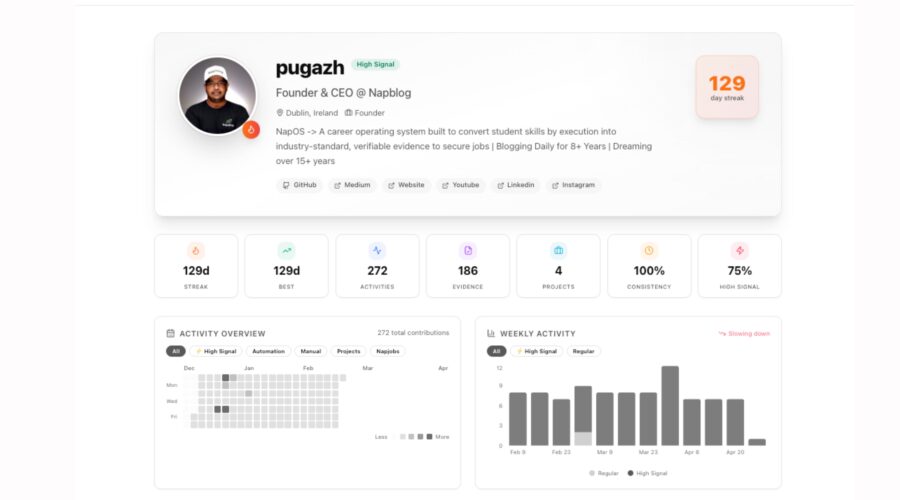
- Activities are tracked daily
- Outputs are captured as evidence
- Progress is measured through consistency and completion
This transforms random effort into structured execution.
From Learning to Doing
One of the biggest shifts NLPs introduce is the transition from passive learning to active execution.
Traditional learning focuses on:
- Watching tutorials
- Completing quizzes
- Passing exams
NLPs focus on:
- Solving real problems
- Using real tools
- Producing real outputs
- Iterating based on results
For example, instead of learning “Google Ads” theoretically, a student:
- Sets up a campaign
- Chooses targeting parameters
- Writes ad copy
- Tracks performance metrics
- Documents results
This is not learning about work.
This is doing the work.
Building Verifiable Work Experience
The biggest advantage of NLPs is not just execution—it is verification.
Every activity inside Nap OS produces:
- Screenshots
- Reports
- Files
- Links
- Analytics data
- Documentation
These are stored as evidence.
Over time, this creates a portfolio that shows:
- What was done
- How it was done
- Which tools were used
- What outcomes were achieved
This replaces vague claims like:
“I have experience in SEO.”
With:
“Here is a project where I conducted keyword research, optimized content, and improved traffic metrics.”
Verification changes everything.
Aligning Projects With Market Demand
Not all experience is valuable.
NLPs are designed to align with real market demand.
This means:
- Skills are mapped to job roles
- Tools reflect industry standards
- Outputs match employer expectations
For example:
A student targeting a marketing role works on:
- Campaign execution
- Content strategy
- Analytics reporting
A student targeting a tech role works on:
- Coding projects
- API integrations
- Data analysis
This ensures that every project contributes directly to employability.
Navigating the Job Search With Nap OS
The job search process is often chaotic.
Students typically:
- Apply to multiple roles
- Track applications manually
- Use generic resumes
- Forget follow-ups
- Lose opportunities due to poor organization
Nap OS solves this by integrating a recruitment CRM within the system.
This allows students to:
- Track every job application
- Customize resumes based on roles
- Monitor progress through hiring stages
- Manage follow-ups
- Align applications with their portfolio
Instead of applying blindly, students operate strategically.
From Portfolio to Opportunity
The ultimate goal of NLPs is not just to build projects.
It is to convert those projects into opportunities.
With Nap OS:
- Portfolios are shareable
- Recruiters can verify work instantly
- Applications are supported by real evidence
- Candidates stand out in crowded pipelines
This shifts the dynamic from:
“Please consider my application.”
To:
“Here is proof of what I can do.”
The difference is significant.
The Psychological Impact of Execution
Beyond skills and hiring outcomes, NLPs also impact mindset.
Students often struggle with:
- Lack of confidence
- Uncertainty about their abilities
- Fear of rejection
- Overthinking career decisions
Execution changes this.
When students:
- Complete real tasks
- See measurable outputs
- Track their progress
- Build consistency
They gain confidence grounded in reality.
Confidence is no longer based on hope.
It is based on evidence.
The Role of Consistency
Nap OS introduces a streak-based system that encourages daily execution.
This matters because:
- Skills improve through repetition
- Discipline builds over time
- Momentum compounds
Instead of working in bursts, students:
- Engage consistently
- Build habits
- Maintain progress
Consistency becomes a competitive advantage.
Bridging the Gap Between Students and Employers
NLPs act as a bridge.
For students:
- They provide structure
- They create direction
- They build capability
For employers:
- They provide visibility
- They reduce hiring risk
- They offer proof of work
This alignment benefits both sides.
Why Traditional Systems Fall Short
Traditional education systems focus on:
- Curriculum completion
- Academic performance
- Theoretical understanding
But they often lack:
- Real-world application
- Continuous validation
- Industry alignment
NLPs fill this gap.
They do not replace education.
They extend it into execution.
The Advantage in a Competitive Market
In today’s job market:
- Thousands of candidates apply for the same role
- Many have similar qualifications
- Differentiation is difficult
NLPs create differentiation through:
- Verified portfolios
- Real project experience
- Structured execution history
This gives students an edge.
Real Work Before the First Job
One of the most powerful outcomes of NLPs is that students gain real work experience before their first job.
This changes their starting point.
Instead of entering the job market as beginners, they enter as:
- Practitioners
- Problem solvers
- Contributors
This accelerates career growth.
Scaling Opportunity Through Systems
NLPs are scalable.
Unlike traditional internships, which are limited by:
- Company capacity
- Geographic location
- Availability
NLPs can be accessed globally through Nap OS.
This democratizes opportunity.
Students anywhere can:
- Build experience
- Develop skills
- Prepare for careers
The Long-Term Impact
Over time, NLPs contribute to:
- Better hiring decisions
- Reduced skill gaps
- More efficient job markets
- Stronger alignment between education and industry
This is not just about individual success.
It is about system-level improvement.
Conclusion
Napblog Projects (NLPs), powered by Nap OS, redefine how students build work experience.
They replace passive learning with active execution.
They transform effort into evidence.
They align skills with market demand.
They structure the job search process.
And most importantly, they enable students to prove their capability before they are hired.
In a world where opportunity is competitive and attention is limited, proof matters more than promises.
NLPs ensure that students do not just prepare for the future.