8 min read
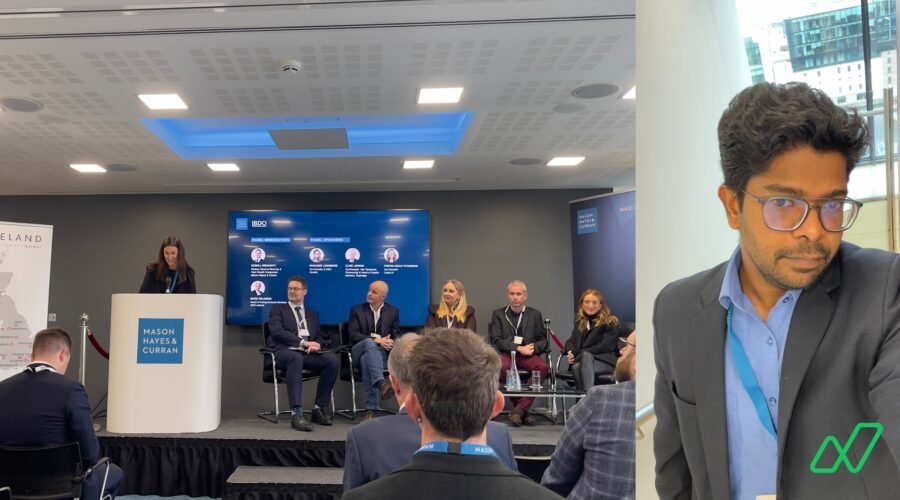
Pugazheanthi Palani, Founder & CEO, represented the Nap OS team at Mason Hayes & Curran in Dublin on 5 November 2026.
Building a company requires more than an ambitious idea. It requires the ability to explain a problem clearly, demonstrate progress, earn trust, and turn limited resources into meaningful outcomes. For founders preparing for seed investment, the challenge is not simply getting into a room with investors. It is giving those investors a credible reason to believe.
That challenge brought an important context to Nap OS’s participation in the Seed Funding Founders Chat at Mason Hayes & Curran, South Bank House, Barrow Street, Dublin, on Thursday, 5 November 2026.
Pugazheanthi Palani, Founder & CEO, represented the Nap OS team at the event, connecting the company’s work on project-based experience and employability evidence with the broader conversation about building investment-ready businesses.
For Nap OS, the occasion offered a useful lens through which to consider a central question: how can a growing company demonstrate that its purpose, product, and execution belong together?
A Meeting Point for Founders, Advisers, and the Startup Community
The event programme combined a founder-focused discussion with opportunities for networking. Registration, tea, and coffee began at 11:30am, followed by the scheduled fireside chat at noon. A light lunch was planned for 1:00pm, with the event closing at 1:30pm.
The speaker line-up brought together:
- Rosanne Longmore, Co-Founder & CEO of Coroflo.
- Clive Lennox, Co-Founder of The Tomorrow Partnership and Head of Capital Markets at Teybridge.
- Portia Healy O’Connor, Co-Founder of Linda AI.
Moderating the discussion were Conall Geraghty, Partner, Corporate, at Mason Hayes & Curran LLP, and Mark Waldron, Head of Entrepreneurial Services at BDO Ireland. The event photograph shows the panel setting and the Mason Hayes & Curran and BDO branding displayed behind the speakers.IMG_0085.jpg
The combination of founder, corporate advisory, and capital-markets perspectives made the programme particularly relevant to a team thinking about how to develop a business responsibly.
Nap OS’s participation should not be confused with an announcement of investment, a funding commitment, or a commercial partnership. It was an opportunity to engage with the founder ecosystem and reflect on the standards of evidence a growing company should be prepared to meet.
Why This Conversation Matters to Nap OS
Nap OS’s product direction centres on a practical ambition: helping people develop experience they can explain, demonstrate, and substantiate.
That ambition creates a connection with fundraising. A graduate asking an employer for an opportunity and a founder asking an investor for capital face different decisions, but both must address uncertainty.
The graduate needs to show what they can contribute. The founder needs to show why the company deserves resources to move forward.
Neither should rely entirely on presentation.
A polished CV cannot explain every aspect of someone’s capability. Equally, a polished pitch deck cannot establish whether a company understands its users or can deliver its promises.
For Nap OS, evidence is the connecting principle.
The product should help users make their contributions visible. The company, in turn, should be able to make its own progress visible through clear priorities, documented learning, responsible product development, and outcomes that can withstand scrutiny.
Representing a Team, Not Just an Idea
Pugazheanthi Palani’s attendance represented more than an individual founder’s interest in fundraising. He attended on behalf of the Nap OS team.
That distinction matters because a company’s credibility should not rest entirely on its founder’s enthusiasm. It should also reflect the people, processes, and decisions behind the product.
Representing Nap OS means communicating a shared direction while remaining accountable for what the team has actually built and what still requires development.
It also means listening. Founder events are useful not only as places to explain a business, but as opportunities to test assumptions about its direction.
Which parts of the product story are immediately understandable? Which require stronger explanation? Where does the team need more evidence? Which ambitions should remain future plans rather than present-tense claims?
Those are productive questions for Nap OS to bring back into internal discussions.
From an Employability Problem to a Focused Product
The employability challenge Nap OS seeks to address can be expressed simply: people need opportunities to build capability and credible ways to demonstrate it.
Turning that ambition into a focused business, however, requires sharper decisions.
“Helping students” is a purpose, not yet a complete product strategy. “Improving employability” describes an intended benefit, not proof that a particular approach delivers it.
Nap OS therefore needs to make its proposed value concrete:
- Who is the first user group the product should serve particularly well?
- What difficulty does that group encounter?
- What activity will users complete through the product?
- What evidence will the activity generate?
- Who will find that evidence useful?
- What result would justify continued participation or payment?
These questions connect product design with commercial discipline. They also help prevent the company from expanding its promises faster than its ability to deliver.
A Portfolio Needs More Than a Finished File
Within Nap OS’s proof-of-work approach, a finished project should be the beginning of an explanation, not the end.
Consider a hypothetical student who produces a market-research report. The report may look professional, but an employer may still want to understand how the student selected sources, interpreted conflicting information, and reached a recommendation.
Similarly, a coding project becomes more informative when its owner can explain the requirements, development decisions, testing, and limitations.
Nap OS’s product ambition should therefore extend beyond collecting attractive outputs. It should help users communicate the relationship between the task, their contribution, and the result.
A useful project record could include:
- The original brief and intended outcome.
- The participant’s specific responsibilities.
- Selected drafts or development milestones.
- Feedback and the changes made in response.
- A final deliverable and explanation.
- A reflection on limitations and next steps.
This is a proposed standard for meaningful project evidence, not a claim that every element is already implemented across Nap OS.
Seed Readiness Starts with Questions the Team Can Answer
Without attributing particular advice to the event’s speakers, the seed-funding theme provides a useful framework for Nap OS’s next stage of thinking.
What would an external investor need to understand before making a decision?
The answer should include the problem, the customer, the product, the business model, the team, and the purpose of any proposed funding.
For Nap OS, that means being able to distinguish between interest and use, participation and completion, and promising feedback and demonstrated outcomes.
It also means defining what capital would accomplish. A funding plan should connect resources to specific priorities rather than treating investment itself as the achievement.
For example, a future plan might prioritise testing a focused user journey, strengthening review processes, or assessing whether employers find particular forms of project evidence useful.
Such priorities would need budgets, ownership, and realistic milestones before becoming an investment proposition.
Measuring Progress Without Overstating Impact
Nap OS should apply the same care to its company narrative that it wants users to apply to their portfolios.
A registration is not a completed project. A completed project is not automatically verified competence. An interview is not a job offer. A job offer does not, by itself, establish which intervention produced the outcome.
Keeping these categories separate makes communication more useful.
A measurement framework could examine participation, completion, review quality, user understanding, and employer response as distinct areas.
For example, the team could ask whether participants can explain their work more clearly after completing a project. Separately, it could assess whether reviewers can identify individual contributions consistently.
Employment outcomes, where collected, would need careful definitions and appropriate context.
The objective is not to avoid ambitious goals. It is to make the journey towards those goals observable, so that progress can be assessed rather than merely asserted.
Building Trust Responsibly
Proof-of-work infrastructure also raises responsibilities around ownership, privacy, accessibility, and review.
Not every useful project can be published openly. A participant may work with confidential information, commercially sensitive material, or content involving other people.
Nap OS should therefore consider how evidence can be shared selectively and how users can understand the visibility of their work.
Likewise, “verified” should have a clear meaning. Did someone confirm participation, examine a deliverable, assess individual contribution, or test the participant’s understanding? Those are different levels of assurance.
Making such distinctions explicit would help protect users and prevent employers from interpreting a project record more broadly than intended.
For a company seeking trust, these details belong within the product strategy rather than being left until later.
Turning Participation into Practical Follow-Through
The value of attending a founder event depends partly on what happens afterwards.
For Nap OS, practical follow-through should begin with an internal review: what questions did the occasion sharpen, what assumptions require testing, and what should the team prioritise next?
A useful next-stage agenda would be to:
- Clarify the initial user and customer proposition.
- Define the minimum evidence a project record should contain.
- Separate existing capabilities from planned development.
- Establish measurable product-learning milestones.
- Prepare a funding narrative tied to specific execution needs.
Networking should follow the same principle. Conversations are starting points, not endorsements. Any future collaboration would need its own discussion, agreement, and clearly defined responsibilities.
That approach keeps the public story aligned with the company’s actual position.
Building a Company That Can Demonstrate Its Work
Pugazheanthi Palani’s representation of the Nap OS team at the Seed Funding Founders Chat placed the company within a relevant conversation about entrepreneurship, capital, and execution.
The significance lies not in implying that attendance changes the company’s funding status, but in connecting its ambitions with the questions a credible business must answer.
Nap OS wants people to move beyond unsupported claims about capability. The company should hold itself to that same standard: show the problem clearly, explain the work, document the learning, and make progress understandable.
That is the foundation for a stronger product, a more credible investment story, and a company whose actions support its purpose.