6 min read
One room in the middle, five groups around it
Most graduates hit the same wall. Entry-level jobs ask for experience, and experience needs a first job. AI has made the wall harder to climb: a polished CV and cover letter now take minutes to produce, so they prove less than they used to.
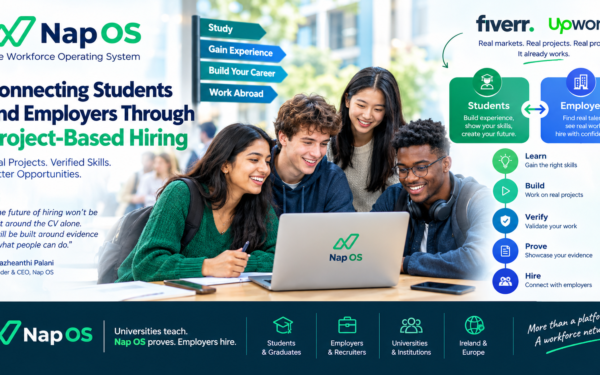
That wall does not only hurt students. Universities, employers, recruiters and experienced professionals each stand on one side of it, each holding part of the answer to someone else’s problem. They rarely meet in the same place.
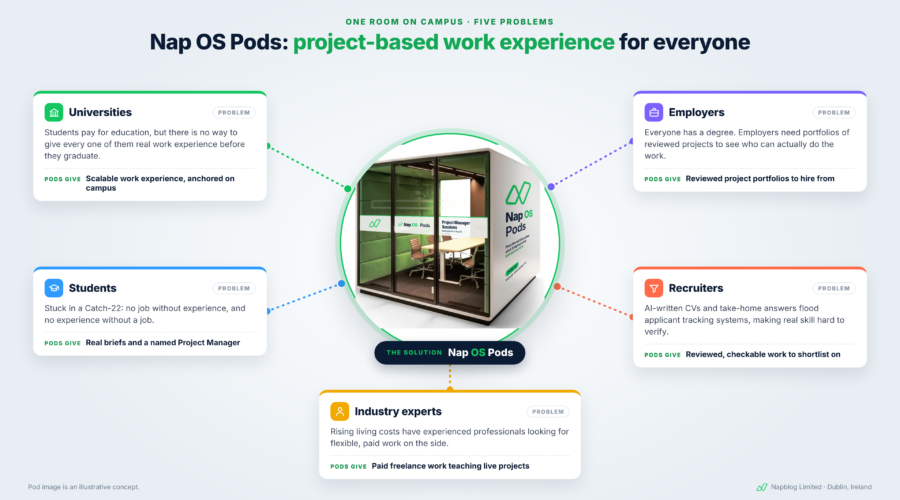
Nap OS Pods are designed to be that place. A pod is a customisable meeting room on a university or college campus, where students work on real project briefs with a named Project Manager and employers can review the finished work. Here is how one room speaks to five different problems.
1. Universities: paid to educate, judged on employment
The problem. Students and their families pay for an education, and increasingly they judge it by what happens after graduation. Yet no university can find a placement or internship for every student. Careers teams are small, employer contacts are stretched, and the students who most need experience are often the least likely to find it alone.
What a pod gives. A pod anchors scalable, supervised work experience on campus, open to any student rather than the lucky few. Much of the project work happens online; the pod is where students meet their Project Manager and get their work reviewed. Nap OS brings the briefs and the Project Managers, so the careers team gains capacity without adding headcount. The pod is also visible: on an open day, a branded room in the library or student hub shows in one glance that the institution takes employability seriously.
A pod needs floor space and power, not building works, so it can open in a semester rather than a planning cycle.
2. Students: stuck in a Catch-22
The problem. They cannot get a job without experience, and cannot get experience without a job. Most students do not know where that first experience comes from. The ones who find it usually have a contact, a confident CV or a lucky timetable. Everyone else graduates with coursework, a part-time job and a CV that looks like everyone else’s. International students feel it most: no local network, no local record, and a fixed post-study visa window.
What a pod gives. A route anyone can follow. A student picks a real brief in one of five domains (Startup and Entrepreneurship, Strategy and Operations, Marketing and Sales, Product and Research, or Data and AI), books a session with a named Project Manager, and submits work that gets written feedback. There is no CV screen at the door.
What they leave with is theirs to keep: reviewed work they can show, and the experience of explaining what they built to someone who knows the field.
3. Employers: everyone has a degree
The problem. When every applicant holds a similar degree, the degree stops telling candidates apart. Graduate hiring then leans on CVs, cover letters and take-home tests, all of which AI can now help produce. A junior hire is a real cost, and employers want to see how someone thinks and delivers before they make it.
What a pod gives. A portfolio of reviewed project work to hire from. Through Nap OS Recruit, an employer can set a real brief, such as a market scan, a data analysis or a product test. Students work on it with Project Manager support in the pod, and the employer reviews finished, assessed work from students who choose to share it.
The hiring decision always stays with the employer. What changes is the evidence in front of them: a piece of work they recognise, rather than a list of claims.
4. Recruiters: AI-written applications, unverified skill
The problem. AI-written CVs and take-home answers now flood applicant tracking systems. Those systems were built to match keywords, job titles and dates, so polished applications pass while real skill stays hard to verify, and a capable graduate without the right words can be filtered out before anyone reads their work.
What a pod gives. A different signal to shortlist on. Each Nap OS project ends in a record stating what the student did and what it was judged against, with a link an employer or recruiter can check. That record sits alongside the CV in whatever system a recruiter already uses, so shortlisting can start from proof of work rather than keywords alone.
For recruiters filling junior roles in competitive fields like Data and AI, that is the difference between guessing at potential and seeing it.
5. Industry experts: skills to share, costs to meet
The problem. Rising living costs have pushed many experienced professionals to look for flexible, paid work alongside their main role. Many of them would gladly pass on what they know, but most teaching routes demand formal qualifications, fixed timetables or long commitments.
What a pod gives. Paid, flexible work as a Nap OS Project Manager. Project Managers have at least five years in their field, review student work against criteria published in advance, and run short one-to-one sessions, in the pod or online. They are paid by the hour, not per submission, so careful review is rewarded rather than rushed.
This is the side of the model that people often overlook. A student’s work only becomes experience when someone who has done the job reads it and explains what works. Industry experts are that someone.
Why one room works as the hub
Each of these five problems has been tackled on its own before: careers fairs for universities, online simulations for students, assessment tools for employers, smarter software for recruiters, freelance platforms for experts. What is missing is a place where they meet, so that one group’s need becomes another group’s answer.
The pod is that meeting point:
- Students bring effort and ambition.
- Industry experts bring judgement, and are paid for it.
- Employers bring real briefs and, in time, sponsorship.
- Recruiters gain a signal they can shortlist on.
- Universities host it all, and can show it working on their own campus.
Why a physical room, when so much can happen online? Because trust is now the scarce thing. When anyone can generate a CV, a cover letter or a take-home answer, work that was planned, discussed and reviewed with a named person carries more weight. A pod makes that process visible and regular, on campus, where students already are. Much of the project work can still happen online; the pod is where it is anchored, checked and talked through.
It is also honest about what it is not. Nap OS covers project briefs, Project Manager review and career support, not recruitment or job placement, and no student is promised a job.
The evidence so far, and what comes next
The demand is already visible. At the gradireland Graduate Careers Fair at the RDS in Dublin on 6 October 2026, 115 graduates registered with Nap OS at our stand, 97 of them on the day. Nobody was offered a job. They signed up for project work and review. Two in three asked for Data and AI projects.
Pilots start on campuses in 2027, the first step in our plan for 1,000 Nap OS Pods worldwide. Each of the five groups has a way in:
- Universities and colleges: host a pilot pod with your careers service or innovation hub.
- Employers: set real briefs through Nap OS Recruit, or sponsor a pod on a campus you hire from.
- Recruiters: use reviewed project records alongside CVs when you shortlist graduates.
- Industry experts: apply to join the bench as a paid Project Manager in your field.
- Students: start a free career plan at napblog.com and pick your first brief.
The Catch-22 has lasted because each group has tried to solve its piece alone. Put them in one room, and the loop starts to break.
Pugazheanthi Palani, Founder & CEO, Napblog Limited 77 Camden Street Lower, Dublin 2, D02 XE80, Ireland · palani@napblog.com · napblog.com