7 min read
How students and graduates can keep building proof of work while navigating recruitment delays in the UK, Ireland, and the United States.
You prepare for the interview. You research the organisation, practise your answers, rearrange your schedule, and explain why you are right for the role.
The conversation ends positively.
“We will be in touch.”
Then comes the waiting.
For students and recent graduates, this period can feel like an unofficial pause button on their future. Should they follow up? Keep applying? Prepare for another round? Or assume the opportunity has disappeared?
Nap OS is built around a different principle: your professional development should not depend entirely on somebody else’s recruitment timetable.
While an employer considers its decision, you can continue applying, reflecting, and developing evidence of your capabilities. Structured projects and Project Manager assessment can support that process—not by eliminating recruitment delays, but by giving you a constructive activity alongside the search.
How Widespread Is the Problem?
There is no single reliable headcount of students frustrated by interview delays across the UK, Ireland, and the United States. Available research measures different populations and experiences.
However, the evidence shows that poor communication is a substantial concern.
Greenhouse’s 2026 Future of Hiring Report, as reported by People Management, surveyed 1,100 jobseekers across the UK and Ireland. It found that 47% had received no response after an interview. This is a finding about surveyed jobseekers—not specifically students or international graduates.
In Ireland, HERO Recruitment’s LinkedIn poll of STEM candidates found that 49% selected lack of communication or feedback as their biggest job-search frustration, while 29% selected long hiring processes. HERO explicitly cautions against treating the poll as nationally representative without supporting methodology.
These findings should not be combined into a claim that a fixed percentage of all students experiences the same problem. They do, however, identify a clear issue: candidates need better communication and more control over their next steps.
Waiting Is Not the Same as Receiving Feedback
Three experiences often become blurred together.
A candidate may be waiting for a decision, waiting for the next interview, or waiting for feedback after rejection. Each requires a different response.
A status update tells you whether a process is still active. A hiring decision tells you whether you were selected. Developmental feedback explains something you can improve.
An email saying “we are still reviewing applications” provides useful clarity, but little guidance for the next interview. A rejection saying “another candidate was a closer fit” closes the process without explaining much.
Nap OS’s contribution is separate from both: assessment of work against a defined brief.
It cannot explain an employer’s private decision. It can help participants identify specific strengths and weaknesses in something they have produced.
The Pattern Extends Beyond One Market
Recruitment delays are not exclusively a UK or Irish concern.
Yello cites Robert Half research in which six in ten workers identified waiting to hear back after an interview as the most frustrating part of the search. However, the article does not provide enough methodological detail to present that figure as a current, student-specific US estimate for 2026.yello
The distinction matters.
Students deserve evidence that clarifies their situation, not statistics stripped of dates, populations, and limitations.
For Nap OS, the useful conclusion is not that every recruitment system behaves identically. It is that uncertain communication creates a recognisable problem across different hiring environments—and candidates need a practical way to keep progressing.
Why Employers May Take Time
Silence does not reveal its own cause.
HERO identifies possible sources of delay including internal approvals, changing budgets, unavailable decision-makers, and unclear ownership of communication. These may explain a delay without justifying a failure to update candidates.hero
A candidate cannot reliably infer their performance from the length of the wait alone.
The interview may have gone well while the vacancy remains unresolved. Alternatively, the employer may have selected someone else without closing the loop.
Neither possibility makes repeated inbox-checking a useful assessment method.
A better approach is to separate what you know, what you can ask, and what remains outside your control.
Keep a Pipeline, Not a Single Hope
An interview is an opportunity, not a commitment from the employer.
A practical job-search approach is to keep several suitable applications moving rather than suspending everything for one preferred role.
That does not mean applying indiscriminately. It means maintaining a manageable pipeline:
- Roles being researched.
- Applications being prepared.
- Interviews scheduled.
- Decisions pending.
- Follow-ups due.
- Closed opportunities.
A simple spreadsheet is sufficient.
The purpose is not to make the search mechanical. It is to prevent one uncertain process from consuming all your attention.
Continue assessing opportunities on their merits, and review written offer terms and any conditions carefully before making major decisions.
Follow Up Without Making Waiting Your Main Activity
At the end of an interview, ask when an update is expected and who will contact you.
If that date passes, send a concise check-in:
Thank you again for discussing the role with me. You mentioned an update around this time, so I wanted to ask whether there is a revised timeline. I remain interested and would appreciate any information about next steps.
Where no timeline was given, a check-in after roughly a week can be a reasonable starting point, adjusted for the circumstances.
The key is proportionality. Follow-up should be one small task within the search—not the centre of your week.
Meanwhile, keep applying, preparing, and attending other interviews where appropriate.
Where Nap OS Fits
Nap OS’s stated proposition is twelve months of work projects, assessed by Project Managers.
Its relevance to the waiting period is straightforward: participants can develop something more tangible than another unanswered application.
An aspiring analyst could work through a reporting brief. A marketing applicant could develop a campaign proposal. A product candidate could document a research exercise.
These are illustrative uses, not promises that every project or reviewer is available.
The aim is to build work that can support a future conversation:
Since my last interview, I completed this project, received feedback, and improved the result.
That is progress the participant can describe without depending on a hiring decision.
Build Evidence, Not Busywork
A project should have a purpose.
Completing unrelated tasks simply to remain occupied can consume time without strengthening an application.
Before starting, ask:
- Which target role does this support?
- What capability will it help me practise?
- What deliverable will I produce?
- How will the work be assessed?
- What could I explain in an interview afterwards?
Nap OS’s product value should lie in connecting these elements.
The sequence matters: brief, execution, assessment, revision, and reflection. A collection of attractive documents is less useful if the participant cannot explain the reasoning behind them.
Turn Interview Uncertainty Into a Learning Question
Imagine an illustrative graduate who interviews for a business analyst role.
They struggle to answer a question about handling conflicting stakeholder requirements. The employer provides no detailed feedback.
The graduate should not conclude that this answer caused the rejection. They do not know.
But they can identify it as an area worth practising.
A suitable project might ask them to document competing requirements, explain priorities, and justify trade-offs. Project Manager feedback could then address the quality of that reasoning.
This does not recreate the employer’s assessment. It creates an independent learning opportunity based on a difficulty the participant noticed.
Project Feedback Is Not Employer Endorsement
The distinction between assessment and hiring must remain clear.
A Project Manager can review a submission against stated criteria. That does not mean an employer has approved the participant, that the work meets every industry requirement, or that a job offer will follow.
Likewise, a simulated brief must not be described as paid employment or client experience.
A credible portfolio should identify the project type, individual contribution, assistance received, feedback, and limitations.
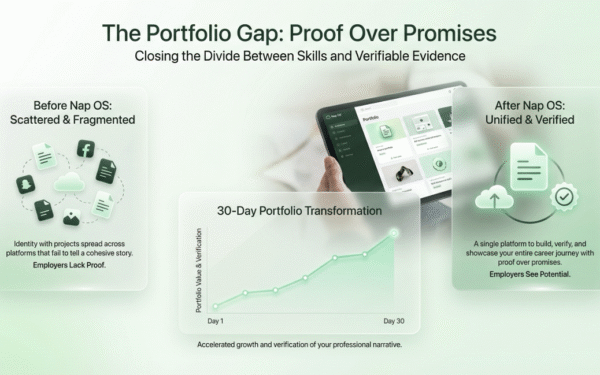
Proof of work becomes useful when someone can inspect and question it—not merely because a platform labels it verified.
Nap OS should preserve that standard in both delivery and marketing.
Development Must Leave Room for Rest
There is a danger in telling jobseekers to make every uncertain hour productive.
Students may already be balancing coursework, paid work, family responsibilities, financial pressure, or immigration deadlines. Another demanding programme is not automatically the right choice.
A realistic routine should leave room for applications, interview preparation, networking, project development, and rest.
Nap OS should complement a participant’s priorities rather than become another source of guilt.
If the service is paid, students should understand the fees, workload, reviewer access, and refund terms before joining. Free university careers services and other available support may also be appropriate.
Employers Still Have a Responsibility
Candidate resilience does not excuse employer silence.
HERO recommends clear timelines, communication when decisions change, and proper closure. People Management similarly reports warnings that post-interview ghosting can damage trust and employer reputation.peoplemanagement.co+1
Candidates should not have to purchase career support simply to compensate for a poorly managed hiring process.
Nap OS can help people develop evidence while searching. Employers must still communicate respectfully.
Both ideas can be true.
Keep Moving Without Pretending the Wait Is Easy
Waiting after an interview can be frustrating precisely because so much feels unresolved.
Nap OS cannot control recruitment budgets, interview schedules, employer decisions, or the number of suitable vacancies. It cannot guarantee a job or accelerate a particular application.
Its contribution is narrower: structured opportunities to practise, receive assessment, improve work, and build a professional story grounded in evidence.
Keep following up appropriately. Keep considering other opportunities. Keep using support that fits your circumstances.
And where project-based development is useful, build something you can explain.
Nap OS: Your next employer may still be deciding. Your development does not have to stop