7 min read
Introduction:
The traditional education and employment system was designed for a world where knowledge changed slowly, careers followed predictable paths, and employers primarily hired based on degrees. That world no longer exists.
Today, industries evolve faster than academic curricula. Artificial Intelligence is reshaping job roles monthly. Employers increasingly seek demonstrated capability rather than theoretical knowledge. At the same time, students and early-career professionals struggle to gain meaningful experience because most opportunities require experience before experience can be earned.
This creates a significant workforce gap.
Nap OS was designed to solve this challenge through a Workforce-as-a-Service (WaaS) model that bridges the distance between learning and employment. Rather than treating education, work experience, mentoring, and professional development as separate systems, Nap OS integrates them into a single architecture that continuously develops employable talent through real-world project execution.
The core principle behind Nap OS is simple:
People learn best by doing meaningful work in structured environments with guidance, feedback, and measurable outcomes.
This article explores the architecture behind Nap OS and how its technology specification creates personalized pathways that transform capability gaps into practical workforce readiness.
The Problem Nap OS Solves
Modern learners face four major challenges.
Skills Gap
Many individuals complete educational programs without developing the practical skills required by employers.
Degrees often demonstrate knowledge acquisition, but they do not always prove workplace readiness.
Experience Gap
Employers seek candidates with experience.
Candidates seek opportunities to gain experience.
This creates a circular problem where individuals cannot gain employment because they lack experience, yet cannot gain experience without employment.
Relevance Gap
Technology and industry practices evolve rapidly.
Educational systems often struggle to update content at the same pace as market demand.
As a result, learners may spend years studying concepts that are no longer fully aligned with workplace realities.
Confidence Gap
Many talented individuals lack confidence because they have never applied their knowledge in authentic work environments.
Without real-world validation, skills remain theoretical.
Nap OS addresses these gaps through a structured operating system for workforce development.
The Nap OS Vision
Nap OS is not simply a learning platform.
It is an operating system for talent development.
The platform creates an ecosystem where users:
• Identify capability gaps
• Select real-world challenges
• Receive personalized project frameworks
• Collaborate with experts
• Build professional relationships
• Receive continuous feedback
• Produce measurable outcomes
• Develop employment-ready portfolios
The goal is to create a scalable infrastructure that develops workforce capability while simultaneously supporting innovation and industry problem-solving.
High-Level Architecture
The Nap OS architecture consists of six interconnected layers.
Layer 1: Portfolio Intelligence Engine
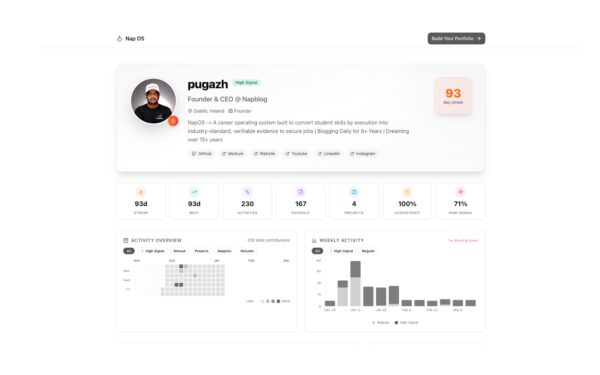
The user journey begins with portfolio creation.
Rather than collecting only traditional information such as education and employment history, Nap OS builds a multidimensional profile that captures:
• Skills
• Interests
• Career goals
• Project history
• Learning preferences
• Industry aspirations
• Strengths
• Development areas
This profile becomes the foundation for gap analysis.
The system continuously evaluates the difference between:
Current Capability vs Desired Capability
This analysis forms the user’s personalized development roadmap.
Layer 2: Gap Analysis Framework
Once the user profile is established, Nap OS performs a structured gap analysis.
The platform identifies:
• Missing skills
• Missing experiences
• Missing portfolio evidence
• Missing industry exposure
• Missing leadership opportunities
Instead of presenting generic learning recommendations, Nap OS generates action-oriented pathways.
The focus shifts from:
“What should I learn?”
to
“What should I build?”
This represents a fundamental change in workforce development philosophy.
Layer 3: Problem and Project Selection Engine
After identifying capability gaps, users choose from a range of opportunities:
• Industry problems
• Innovation challenges
• Product concepts
• Research initiatives
• Business projects
• Community challenges
• Startup opportunities
This layer ensures every learning journey is connected to practical outcomes.
Rather than consuming content passively, users actively contribute to solving meaningful problems.
The selected challenge becomes the user’s workplace simulation environment.
AI-Powered SOP Generation
One of the most innovative components of Nap OS is the AI-driven Standard Operating Procedure (SOP) Generator.
Traditional learning systems provide static instructions.
Nap OS dynamically generates personalized operating frameworks.
The AI engine evaluates:
• User skill level
• Project complexity
• Industry requirements
• Expected deliverables
• Learning objectives
Based on these inputs, the platform creates customized SOPs that guide users through project execution.
These SOPs may include:
• Research activities
• Project milestones
• Stakeholder engagement
• Documentation requirements
• Presentation frameworks
• Quality standards
• Feedback checkpoints
The result is a personalized pathway that reduces uncertainty while maintaining flexibility.
Human Relationship Layer
Technology alone cannot develop workforce readiness.
Professional growth requires human interaction.
For this reason, Nap OS includes a dedicated relationship-building architecture.
Project Manager Integration
Every project can involve project management support.
Project managers help users:
• Understand objectives
• Clarify expectations
• Navigate challenges
• Improve communication
• Develop workplace habits
This interaction creates an authentic professional environment.
Users learn not only technical skills but also workplace behavior and collaboration.
Industry Expert Integration
Industry experts provide contextual relevance.
Their role includes:
• Knowledge transfer
• Industry insights
• Strategic guidance
• Professional mentorship
• Market perspective
This creates authentic learning experiences grounded in real industry expectations.
The combination of AI guidance and human expertise creates a hybrid development model that balances scalability with authenticity.
Proposal and Feedback Architecture
Learning accelerates when feedback is timely and actionable.
Nap OS incorporates continuous evaluation mechanisms.
Users develop project proposals and submit deliverables throughout the project lifecycle.
The platform captures feedback from:
• AI systems
• Project managers
• Industry experts
• Peer collaborators
• Client stakeholders
Feedback focuses on:
• Quality
• Innovation
• Execution
• Communication
• Problem-solving
• Professional readiness
This creates a continuous improvement loop.
Instead of waiting until the end of a course or project, users receive guidance throughout the process.
Experience Creation Engine
Perhaps the most important component of Nap OS is the Experience Creation Engine.
Traditional systems measure learning through:
• Exams
• Assignments
• Certifications
Nap OS measures learning through:
• Deliverables
• Outcomes
• Contributions
• Portfolio evidence
• Industry engagement
The platform transforms projects into demonstrable experience.
This allows users to build professional credibility before securing full-time employment.
The outcome is not merely knowledge acquisition.
The outcome is evidence of capability.
Nap OS Workforce Architecture
At the workforce level, Nap OS operates using a simple equation:
User Gap = Custom Experience
When a gap is identified, the platform generates a corresponding experience designed to close that gap.
For example:
A marketing student lacking campaign experience may receive:
• Campaign planning tasks
• Audience research projects
• Content strategy development
• Performance analysis assignments
A software engineering student may receive:
• Product development projects
• API integration challenges
• Technical documentation tasks
• System design exercises
The experience becomes the bridge between current and desired capability.
Nap OS R&D Architecture
On the organizational side, Nap OS supports research and development activities.
The equation becomes:
Client Expectations = Client Outcomes
Organizations frequently struggle to execute innovation initiatives because resources are limited.
Nap OS provides access to structured workforce capacity through project-based collaboration.
Organizations can submit:
• Research problems
• Innovation opportunities
• Product concepts
• Market analysis projects
• Process improvement initiatives
The workforce ecosystem contributes to solving these challenges while simultaneously developing practical experience.
This creates value for both learners and organizations.
The Workforce-as-a-Service Model
The Workforce-as-a-Service model transforms workforce development into a continuous operating system.
Instead of viewing talent as a fixed resource, Nap OS treats talent as an evolving ecosystem.
Key characteristics include:
Personalized
Every development pathway is unique.
Project-Based
Learning occurs through execution.
AI-Augmented
Technology enhances productivity and personalization.
Expert-Guided
Industry professionals provide relevance.
Outcome-Driven
Success is measured through deliverables and impact.
Scalable
The model can support thousands of users simultaneously.
Future Development Roadmap
The future architecture of Nap OS may include:
AI Career Copilot
Personalized career navigation powered by predictive analytics.
Skills Graph Intelligence
Dynamic mapping of emerging industry skills and workforce demand.
Employer Matching Engine
Connecting portfolio evidence directly to hiring opportunities.
Innovation Marketplace
A platform where organizations submit challenges and users collaborate on solutions.
Workforce Reputation System
A verified capability score based on project contributions and outcomes.
Global Talent Network
Connecting learners, mentors, employers, and innovators across multiple countries.
Conclusion:
The future of workforce development will not be defined by classrooms alone. It will be defined by systems that enable people to learn, contribute, and create value simultaneously.
Nap OS represents a new approach to workforce readiness—one that combines AI, project-based learning, industry expertise, continuous feedback, and authentic work experiences into a unified operating system.
Its architecture is designed around a simple belief:
People do not become employable by studying work. They become employable by doing work.
By identifying capability gaps, generating personalized experiences, connecting users with experts, and enabling real-world project execution, Nap OS creates a scalable Workforce-as-a-Service infrastructure capable of preparing talent for an increasingly dynamic global economy.
As industries continue to evolve, the organizations that succeed will not simply train people. They will build systems that continuously develop capability.
Nap OS is designed to be that system. It is not just a platform for learning. It is an operating system for building the workforce of the future.