5 min read
For most of modern recruitment history, the industry has been built to serve one side of the hiring table: the employer. Job boards are optimised for postings, applicant tracking systems are optimised for filtering, and recruitment agencies are typically paid by companies to fill seats as quickly and cheaply as possible. Candidates are left holding the short end of that arrangement, submitting CVs into automated systems that often reward keyword-matching over genuine capability. Nap OS Recruit was built to change that balance. Branded as “The Recruitment Agency for Candidates,” it is one of three connected products inside Nap OS, a broader operating system from Napblog Limited designed to support people across education, employment, and entrepreneurship. Recruit is the layer where verified capability meets real employer demand.
The Trouble With CV-Based Hiring
The case for rethinking recruitment starts with a fairly blunt observation: the current system is fragmented and inefficient for almost everyone involved. Job seekers frequently lack access to real-world experience before they are expected to prove it, and career guidance tends to be generic rather than personalised. Employers, meanwhile, face high recruitment costs and struggle to see past the noise of CV-based screening to find candidates with the skills a role actually requires.
Universities feel pressure to demonstrate graduate outcomes but often lack the employer integration to back that up. And at a policy level, governments contend with youth unemployment and skills mismatches that are difficult to solve with generic, one-size-fits-all programmes. Nap OS Recruit approaches these problems from the candidate’s side first, treating verified capability, rather than a polished CV, as the real currency of hiring.
Introducing Nap OS Recruit
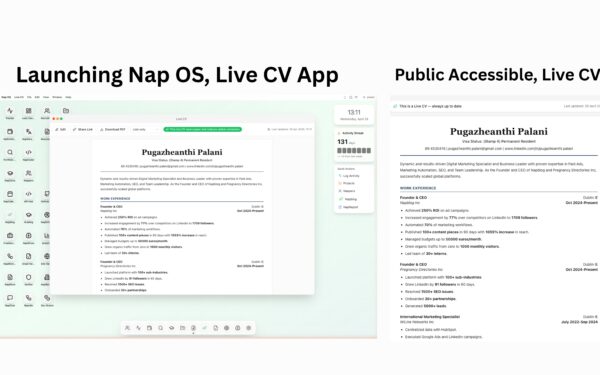
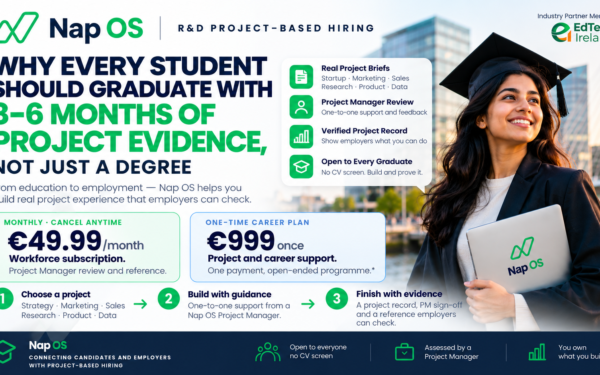
At its core, Nap OS Recruit exists to connect employers with candidates who can demonstrate what they can actually do, rather than simply describe it. Instead of screening resumes for keywords, employers using Recruit get access to a pool of candidates with verified, capability-based profiles built through the Workforce side of Nap OS: structured digital portfolios, documented work experience, and skills that have been assessed rather than self-reported.
For candidates, that means less time spent reformatting a CV for every application and more time building a track record that speaks for itself. For employers, recruiters, HR teams, universities, and talent agencies, it means faster hiring decisions backed by stronger signals about who a candidate really is and what they can do from day one.
Four Pillars: Training, Referencing, Sourcing, Contracting
Nap OS Recruit organises its service around four pillars, each aimed at reducing friction for candidates while giving employers more confidence in who they are hiring. Training ensures candidates arrive with relevant, up-to-date skills rather than a static qualification earned years earlier. Referencing replaces the traditional, often superficial reference check with a more substantive verification of a candidate’s real work and conduct. Sourcing connects candidates to opportunities that genuinely match their demonstrated skills and career direction, rather than relying on a generic keyword search.
Contracting handles the practical, often tedious mechanics of formalising an offer, so neither candidates nor employers get stuck in administrative back-and-forth once a match has been made. Together, these four functions are what allow Nap OS Recruit to describe itself as an agency built around the candidate’s interests, without losing sight of what employers actually need.
How It Works
Behind Recruit sits an AI-driven matching layer that pairs verified talent profiles with employer requirements based on demonstrated skills rather than surface-level qualifications. Employers get a dashboard to manage talent pipelines, review portfolio-first applications, and draw on a verification layer that adds a degree of trust largely missing from conventional CV-based hiring.
Because Recruit draws on the same profiles built through Nap OS Workforce, a candidate’s skills-gap analysis, project history, and even AI-assessed interview performance can travel with them into the hiring process, instead of being reduced to a couple of bullet points on a resume. The intent is straightforward: replace CV filtering with capability-based hiring, and give both sides of the table better information before they commit to each other.
Built for Five Stakeholders
Recruit is designed as part of a multi-sided platform, meaning its value shows up differently depending on who is using it. Individuals gain a more direct path from developing a skill to actually being hired for it. Employers gain access to talent intelligence and a meaningfully lower-friction hiring process. Universities can point to verified graduate outcomes and stronger employer relationships instead of relying on self-reported placement statistics. Governments and workforce bodies get a system that can help address youth unemployment and skills mismatches in a more measurable way. Ecosystem partners, including accelerators, training providers, and other recruitment firms, get a talent pipeline that has already been developed and vetted before it reaches them.
Part of a Bigger System
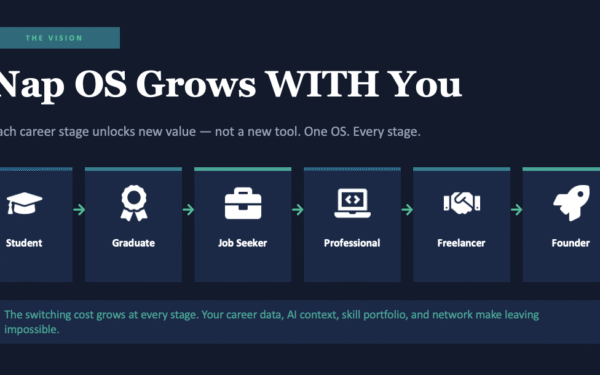
Recruit does not operate in isolation. It is the demand-side product inside Nap OS, sitting alongside Workforce, which helps individuals build job-ready skills and a verified digital identity, and Incubate, which supports people who want to move from employment into founding their own ventures. The logic is cyclical rather than linear: someone develops capability through Workforce, gets matched to real opportunities through Recruit, and, for those who want it, can eventually use Incubate to build something of their own, feeding fresh experience and data back into the system. It is this closed loop that Nap OS points to as the underlying reason Recruit can offer something a standalone recruitment agency generally cannot.
Early Signals of Momentum
The broader platform already counts paying Workforce subscribers, ongoing conversations with technology companies interested in talent infrastructure, and a fast-growing content engine, including a daily newsletter and organic search presence, that is driving a steady stream of new users toward the ecosystem. For Recruit specifically, that groundwork matters: a recruitment product is only as strong as the pool of verified candidates feeding into it, and Nap OS Workforce is where that pool is being built.
Questions? Talk to the Nap OS Team
Nap OS Recruit is still evolving, and the team behind it expects candidates to have questions that a slide deck or web page cannot fully answer. Anyone considering Nap OS Recruit, whether as a candidate looking to be matched with real opportunities or simply trying to understand how the process works, is encouraged to reach out directly to the Nap OS Team with anything left unanswered. Candidates interested in taking the next step can share their CV along with a brief scenario describing their situation and goals by emailing palani@napblog.com.