6 min read
Every founder building something genuinely new eventually faces the same uncomfortable question: what stops someone else from watching what you do, copying the mechanics, and launching a near-identical version a few months later? For Nap OS, a platform built around structured workforce validation, mentor-guided project work, and employer-trusted evidence generation, that question is not hypothetical. The workflow is visible from the outside, the value proposition is easy to describe, and the barrier to entry for a superficial clone is low. What is far harder to copy, and what Nap OS is deliberately building around, is the layered intellectual property strategy sitting underneath the visible product.
Newcomers to any fast-growing category tend to follow the same playbook. They sign up for the product, study the user journey screen by screen, and rebuild the parts that look replicable in a fraction of the time it took the original team to design them. This works well against companies that have only a front-end experience worth imitating. It works far less well against a company that has treated its scoring logic, its validation criteria, its onboarding methods, and its brand identity as distinct, separately protected assets from day one. Nap OS has chosen the second path, and the difference shows up precisely at the moment a copycat tries to reproduce not just the interface, but the judgment embedded inside it.
At the center of this effort sits the Nap OS Core Innovation and Patent Specification, a foundational document that lays out the problem the platform solves, the existing solutions it improves upon, the technical architecture of the workflow, and exactly where the novelty lies. This document does double duty. It is written carefully enough to survive scrutiny from a patent attorney, and it also draws a clear line between what can be discussed publicly and what must remain confidential. That distinction matters more than most early-stage teams realize, because IP protection is not just about filing paperwork later, it is about controlling disclosure from the very first conversation with a partner, investor, or journalist.
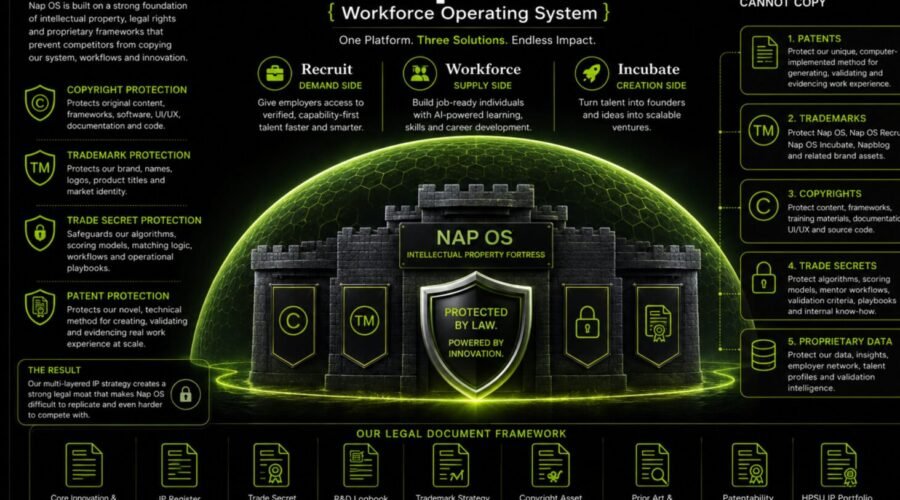
Patents alone, however, are a slow and narrow tool, especially for a computer-implemented workflow where patentability is not guaranteed. That is why the more immediate and arguably more powerful layer of protection is the trade secret register. This confidential log captures the scoring algorithms that convert supervised project work into competency evidence, the matching logic that connects candidates to opportunities, the mentor workflows that guide participants through the programme, the validation criteria that determine when work is credible enough to present to an employer, and the operational playbooks used to onboard employer partners. None of this is published, none of it is exposed through the interface in a way that lets an outsider reverse-engineer it, and all of it is treated as confidential from the moment it is created.
This is precisely the layer that a newcomer cannot copy by observation. A competitor can watch a candidate move through the Nap OS Recruit or Nap OS Incubate journey and infer the general shape of the process, but they cannot see the underlying competency scoring framework that decides which pieces of project work actually count as evidence of skill. Without that logic, any imitation ends up being a shell: a similar-looking product without the calibrated judgment that makes employers trust the output. Trade secret protection works precisely because it does not require public disclosure, unlike a patent, which means the most valuable part of the system stays invisible for as long as the company keeps it that way.
Sitting alongside the trade secrets is the copyright asset register, an inventory of every piece of training content, framework, standard operating procedure, assessment rubric, documentation set, interface design, and section of source code, each stamped with a creation and version date. Versioned frameworks such as the Nap OS Recruit Framework and the Nap OS Incubate Framework describe the workflow of each product in enough detail to prove authorship and originality, while remaining distinct from the confidential scoring logic that stays inside the trade secret register. Copyright will not stop a determined competitor from writing their own similar-sounding materials, but it does establish, with dated evidence, who wrote the original description of the method first, which matters enormously if a dispute ever arises.
Brand protection is handled through a dedicated trademark strategy covering the Nap OS name itself along with Napblog, Nap OS Incubate, and Nap OS Recruit, together with the matching domains and social handles. This is a deliberately unglamorous but essential piece of the puzzle. Even if a rival somehow reconstructed a comparable workflow from scratch, they could not call it Nap OS, could not trade on the Napblog content library, and could not quietly acquire lookalike domains to confuse candidates or employers searching for the real platform. Trademark protection is often the fastest and cheapest form of IP to secure, and it is frequently the first thing a copycat runs into when they try to build credibility around a similar name.
Underneath all of these registers sits the R&D logbook, a dated record of experiments, iterations, and outcomes. This is the least visible document externally, yet it may be the most important internally. It supports inventorship and priority-date claims if a patent application is ever filed, and it also underpins any research and development tax credit claims the company chooses to pursue. A copycat working quickly from the outside has no equivalent paper trail. They cannot manufacture months or years of dated iteration history after the fact, which means that in any dispute over who actually originated a given technique, the party with a contemporaneous logbook holds a significant evidentiary advantage.
None of this assumes that a patent is guaranteed or even necessarily the right tool. The competitive landscape and prior art analysis exists precisely to test that assumption, reviewing existing patents and publications across adjacent fields such as professional networking platforms, applicant tracking systems, learning management systems, coding bootcamps, and digital credentialing to see whether the Nap OS method is genuinely novel or simply a new combination of known techniques. That analysis feeds directly into a formal patentability assessment prepared with a qualified patent attorney, and only if that assessment confirms a viable, defensible invention does the company move toward an actual provisional or priority patent filing. This staged, evidence-led approach avoids the common mistake of filing expensive patent applications on ideas that would not survive examination.
All of these individual pieces eventually feed into a single compiled artifact, the HPSU IP Portfolio Pack, which bundles the core innovation document, the IP register, the trade secret register, the trademark strategy, and the patentability assessment into one package designed to support a High Potential Start-Up application to Enterprise Ireland. Reviewers evaluating a start-up for that kind of support want to see more than an interesting product demo. They want evidence of a defensible, well-documented, and strategically managed intellectual property position, and a scattered pile of half-finished documents does not communicate that nearly as well as a coherent, dated, and versioned portfolio.
Taken together, this is why Nap OS is difficult to copy in any way that matters. A newcomer can clone a landing page in an afternoon and a general workflow in a few weeks, but they cannot clone a confidential scoring algorithm they have never seen, cannot use a trademarked name they do not own, cannot point to a dated R&D history they never kept, and cannot present the polished, evidence-backed IP portfolio needed to win institutional support. The lesson for any founder watching this process is simple: the interface is the least defensible part of a product, and the discipline of documenting, dating, and separating what is public from what is confidential is what actually keeps the door closed to imitators.
Mail to palani@napblog.com if like to know more about Nap OS