6 min read
There is a particular conversation that happens in Ireland several thousand times a year.
A graduate applies for a role. They have the degree. They have the grades. Sometimes they have years of professional experience from another country. The reply comes back, politely: we’re looking for someone with Irish experience.
So they go looking for Irish experience. Every route to it — an internship, a placement, a graduate programme — requires someone to choose them first. And the thing that would make someone choose them is the Irish experience they cannot get.
That is the entire problem. It is not a skills gap. It is a permission gap.
We spent this week studying every serious platform that claims to solve it. The conclusion was not what we expected, and it changed how we describe ourselves.
The four questions that sort the whole category
Marketing copy in this sector is almost interchangeable. Everyone says industry projects, employability, real-world experience. To get past that, we stopped reading the websites and asked four structural questions instead — questions about how each business is actually built, not what it says.
- Who has to say yes before a person can start?
- Does a human being read the work?
- Is there evidence an employer can independently check?
- Who pays, and why would they?
Applied to the category, they sort it immediately.
| Who must say yes first | Human reads the work | Checkable record | Who pays | |
|---|---|---|---|---|
| Forage | Nobody | No | Automatic certificate | Employers |
| Practera | A partner university | Yes | Academic credit | Universities, employers, governments |
| Riipen | A partner university | Yes, via faculty | Academic credit | Institutions |
| Parker Dewey | An employer selects you | Yes, the client | A real engagement | Employers — students are paid |
| Nap OS | Nobody | Yes | Verified project record | The member |
Read the first two columns together. That is the finding.
Forage has no gate — anyone can sign up, and over six million students have. But nobody reads your work. The simulations are excellent, free, and assessed by software. You finish, you get a certificate, and no human being has formed an opinion about what you produced.
Practera reads the work. It is a serious business — founded in Sydney, backed by a Series A led by CSIRO’s Main Sequence Ventures, with 130+ university partners, 7,000+ industry project clients and more than 150,000 users across 70+ countries. But its distribution runs entirely through universities. If you graduated last year, arrived in Ireland with a degree from elsewhere, or are changing career, Practera cannot reach you. Not because it doesn’t want to — because your university is the customer, and you are no longer at one.
Riipen works the same way: projects arrive inside coursework, mediated by faculty.
Parker Dewey is the most honest model in the category — employers pay, projects are real, and students are paid rather than charged. But an employer has to select you. That is precisely the thing our members cannot get.
So the category splits cleanly: you can have an open door, or you can have a human reviewer. Nobody offers both.
What we sell, stated plainly
Nap OS sells Irish R&D Project Briefs and Project Manager review.
Two things, deliberately. Not a platform, not a network, not a marketplace.
The brief is a scoped document. It carries a purpose, what is in scope, what is explicitly out of scope, the exact deliverable, the acceptance criteria you will be assessed against, a suggested tool and a time budget. It is modelled on the research and development work a product team does — structured the way a professional brief is structured, because learning to read a brief properly is itself a workplace skill most graduates have never practised.
The review is a project manager reading what you produced and telling you, specifically, what is strong and what is not — against those published criteria, one to one, within seven days.
The second thing is the expensive one. It is also the one that cannot be automated, which is why the free platforms don’t do it. Reading a submission properly takes a person thirty minutes. Multiply that by six million students and you see immediately why Forage issues certificates automatically.
Why this is hard to copy
A differentiator that a competitor can adopt next quarter is a feature. One they would have to dismantle their business to adopt is a moat.
| Competitor | What they would have to give up to match Nap OS |
|---|---|
| Forage | Hire human reviewers for six million users. The unit economics of a free, employer-funded model cannot carry it. |
| Practera | Sell directly to individuals — abandoning the university channel that is their entire distribution and revenue base. |
| Riipen | The same, plus the academic credit structure that makes them valuable to faculty. |
| Parker Dewey | Remove employer selection — which is the product. |
None of those are small changes. They are business-model changes.
Meanwhile, the thing we would have to give up to match them is our openness — and that is the one thing our members are actually buying.
Who can actually enrol
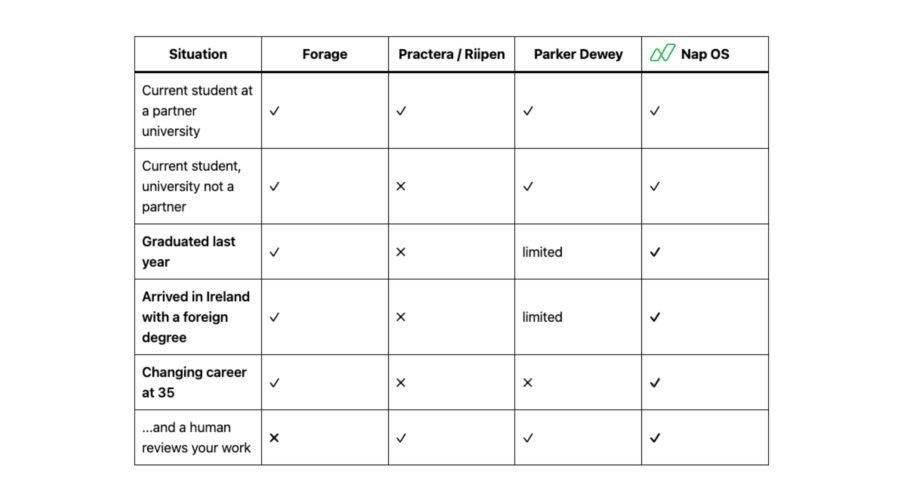
This is the practical version of the same table, and it is the one that matters to a person standing in a careers fair.
| Situation | Forage | Practera / Riipen | Parker Dewey | Nap OS |
|---|---|---|---|---|
| Current student at a partner university | ✓ | ✓ | ✓ | ✓ |
| Current student, university not a partner | ✓ | ✗ | ✓ | ✓ |
| Graduated last year | ✓ | ✗ | limited | ✓ |
| Arrived in Ireland with a foreign degree | ✓ | ✗ | limited | ✓ |
| Changing career at 35 | ✓ | ✗ | ✗ | ✓ |
| …and a human reviews your work | ✗ | ✓ | ✓ | ✓ |
The bottom row is where everything collapses to one column.
What we are not
A comparison article that only flatters its author is worth nothing, so here is the other half.
We are not an employer. Project briefs are structured practice reviewed against published criteria. This is not employment, not an internship, and not a placement. Nobody has to hire you before you start — which is the point — but equally, you are not working for us. You own everything you produce; we do not use it, adopt it or commercialise it.
We are not a hiring channel yet. Forty-nine people have come through Nap OS. Twenty-three are now with outside employers, across twenty-one companies including Amazon, JPMorgan Chase, ServiceNow, ESB Networks, Bosch Rexroth and Accenture. That is our named roster, not an audited study, and we do not publish a success rate. Nobody in that group was hired through us. They did the work, they got the jobs, and we can point at it — that is a different and more modest claim than the one our category usually makes.
We are not free, and we are not pretending the alternative is bad. Forage is genuinely good and costs nothing. If your university runs placements, use them — they are better than anything you can buy. We exist for the gap those two leave: the person with no institution to go through and no employer willing to pick them yet.
We are not the biggest. Practera has been at this for over a decade and reaches 150,000 people. We have reached forty-nine. The argument of this article is not that we are larger. It is that we are differently shaped, and the shape is the point.
The one sentence, and why it survives scrutiny
Most positioning statements in this sector describe a category: connecting students and employers, bridging the skills gap, work-integrated learning at scale. Every company in the category fits those. They are not claims; they are a description of the room.
Ours is a claim, and it can be tested against every competitor in it:
Nap OS sells Irish R&D Project Briefs and Project Manager review.
Practera cannot say it — their briefs come from 7,000 third-party clients, not their own R&D programme. Forage cannot say it — nobody reviews the work. Riipen cannot say it — the reviewer is faculty, and you must be enrolled. Parker Dewey cannot say it — an employer has to pick you first.
And the reason it matters to the person reading it is simpler than any of that.
Everyone else needs permission first. We don’t — and a person still reads your work.
Nap OS is a product of Napblog Limited, Dublin (CRO 812006). Project briefs are structured practice reviewed against published criteria. Nap OS is not an employer, this is not an internship, and project work is not employment. Membership is for 18s and over.
Sources: Practera company materials and Crunchbase; Main Sequence Ventures portfolio; Forage published business model and EAB acquisition announcement; Riipen and Parker Dewey published programme information. Figures are those published by each company and were current in September 2026.