4 min read
“If millions of graduates need career coaches just to get their first job, the problem isn’t the graduates. It’s the system.”
Every year, millions of students graduate believing they have done everything society asked of them. They attended lectures, completed assignments, passed examinations, paid tuition fees, and earned degrees that promised opportunity. Yet after graduation, many discover a painful reality: they still don’t know how to get hired.
This is where the career coaching industry steps in.
For hundreds or even thousands of euros, graduates are offered CV reviews, LinkedIn optimisation, interview preparation, networking advice and motivational coaching. Some coaches provide excellent guidance. Many genuinely care about helping people. But the industry’s rapid growth raises a more fundamental question:
Why has career coaching become necessary in the first place?
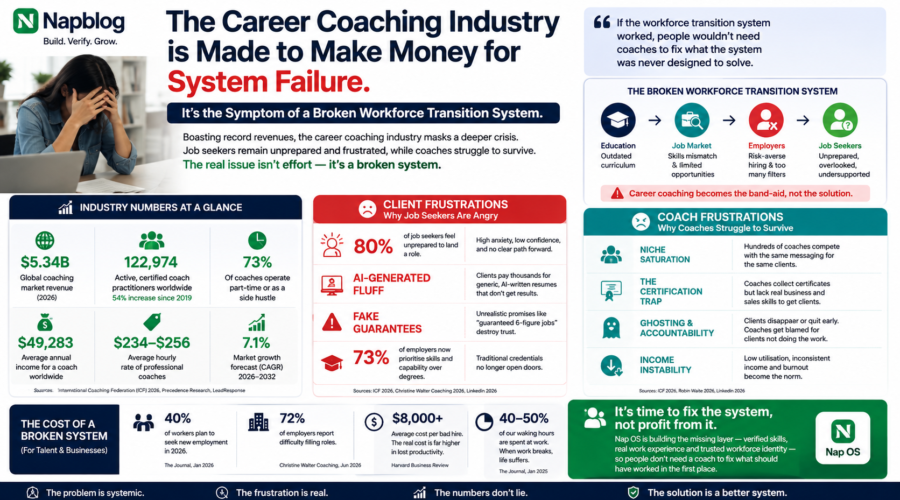
At Nap OS, we believe the growth of career coaching is not evidence of success. It is evidence that the education-to-employment transition has become unnecessarily difficult.
Career coaching should be an optional accelerator, not a requirement for entering the workforce.
The transition from education to employment is broken
Modern education successfully teaches academic knowledge.
Employers hire demonstrated capability.
These are not the same thing.
A graduate can leave university with excellent grades while having little evidence of solving real business problems.
Employers then ask for experience.
Graduates respond:
“How do I get experience if nobody hires me?”
This chicken-and-egg problem has existed for decades.
Instead of redesigning the transition, society has built an entire ecosystem around helping graduates navigate it.
Recruitment consultants.
Career coaches.
CV writers.
Interview trainers.
LinkedIn experts.
Personal branding consultants.
Each solves one small piece of the problem.
None fixes the underlying system.
A graduate shouldn’t need five different experts
Imagine a graduate who wants to become a digital marketer.
They might pay:
- €250 for a CV review.
- €400 for LinkedIn optimisation.
- €800 for interview coaching.
- €500 for personal branding.
- €300 for career coaching.
Yet after spending thousands of euros, they still lack what employers value most:
Evidence of real work.
A polished CV cannot replace genuine experience.
A perfect LinkedIn profile cannot demonstrate problem-solving.
An interview coach cannot manufacture achievements that never happened.
The labour market rewards evidence.
Not advice.
Career coaches are solving symptoms, not causes
Many career coaches are highly professional.
They genuinely help people build confidence.
They explain hiring processes.
They encourage resilience.
Those services have real value.
But expecting a generalist career coach to understand software engineering, biotechnology, cybersecurity, architecture, finance, pharmaceuticals, marketing, AI, healthcare and manufacturing equally well is unrealistic.
Every profession has different expectations.
Different hiring processes.
Different portfolios.
Different technical standards.
Different evidence.
No single coach can master them all.
This isn’t a criticism of coaches.
It highlights that workforce preparation needs to be embedded within industries—not outsourced after graduation.
The real responsibility belongs elsewhere
Universities should prepare students for employment, not just examinations.
Employers should create more structured pathways into industry.
Governments should invest in workforce infrastructure, not only education.
Career centres should move beyond CV workshops toward helping students build verifiable evidence of capability throughout their degree.
The transition from education to employment should be designed, not improvised.
What employers actually buy
Companies rarely hire the person with the best CV.
They hire the person they believe can solve problems.
That belief comes from evidence.
Projects.
Internships.
Client work.
Research.
Portfolios.
Recommendations.
Verified achievements.
When graduates possess these, the hiring conversation changes completely.
The future is verified experience
This is the philosophy behind Nap OS.
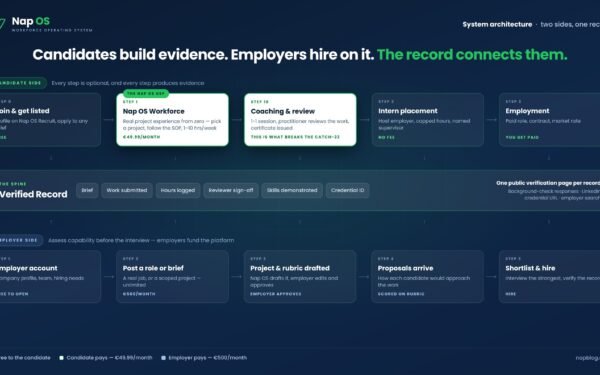
Instead of asking graduates to spend months polishing documents, Nap OS focuses on helping individuals build evidence through real-world projects.
Rather than saying:
“I know SEO.”
Candidates demonstrate:
“I increased organic traffic by 42% for a local business.”
Instead of saying:
“I have leadership skills.”
They can show:
“I coordinated a six-person project delivered on time with documented stakeholder feedback.”
The distinction matters.
Employers trust evidence.
Career services need to evolve
University career centres perform important work.
However, many remain constrained by traditional models.
CV clinics.
Interview preparation.
Career fairs.
These services remain valuable, but graduates increasingly need continuous project-based learning integrated into their education.
Imagine if every student graduated with:
- A verified portfolio.
- Employer feedback.
- Project evidence.
- Industry references.
- Documented competencies.
- Digital proof of work completed.
Career coaching would become supplementary rather than essential.
A workforce operating system instead of fragmented support
Today’s graduate journey is fragmented.
One platform for learning.
Another for recruitment.
Another for networking.
Another for portfolios.
Another for coaching.
Another for verification.
Nap OS argues that workforce development should function more like an operating system.
One place where learning, projects, evidence, employer collaboration and career progression are connected.
Instead of asking graduates to assemble dozens of disconnected services, the system itself should continuously generate employability.
The future isn’t better career advice
The future is better workforce infrastructure.
The question should not be:
“How do we help graduates market themselves better?”
The question should be:
“How do we ensure every graduate leaves education with meaningful, verified work experience?”
If society solves that challenge, career coaching will return to its original purpose: helping people make strategic career decisions—not helping them overcome structural failures in the transition from education to employment.
That is the future Nap OS is working toward.
Because access to meaningful work should not depend on who can afford another coaching session.
It should be built into the education-to-employment journey itself.
Mail to palani@napblog.com a story and how personalised and verified work experience can be build from job seekers perspective.