8 min read
A degree tells an employer what a student studied.
A CV tells an employer what a candidate says they can do.
But when a graduate enters their first serious job search, employers frequently want something else: evidence that the candidate can apply what they have learned.
That creates one of the most persistent problems in graduate employment.
Students need experience to compete for jobs. But getting experience usually requires an employer, internship provider or placement programme to select them first.
This is particularly difficult for international students, career changers and graduates entering competitive professional fields. They may have the education, motivation and theoretical knowledge, but comparatively little local evidence of execution.
Ireland already recognises the importance of structured work experience. The government’s Work Placement Experience Programme, for example, is structured around six months of work and training experience, while work placement is already a compulsory component of many third-level programmes.
But there is a fundamental constraint with conventional placement:
someone has to provide the placement.
What happens when thousands of students need experience but there are not enough traditional placements available?
That is the problem Nap OS is attempting to approach differently.
The Placement Problem Is Also a Capacity Problem
Traditional placement is valuable precisely because it exposes a student to work.
The student has deadlines.
There are deliverables.
Someone reviews their output.
The student learns professional communication.
Mistakes produce feedback.
Theory is tested against execution.
Research surfaced for this article similarly highlights real-world skill application, résumé development, professional networking and soft-skill development among the potential benefits of structured placements.
The problem is not whether these experiences are valuable.
The problem is how they are distributed.
A conventional internship begins with selection.
Perhaps 500 people apply.
Fifty reach the next stage.
Ten are interviewed.
One gets the opportunity.
For the successful candidate, the system works.
But what happens to the other 499?
They are often told to strengthen their CV, network more, improve their interview technique and continue applying.
Yet the missing ingredient may still be the same:
evidence of relevant work.
That creates a circular problem.
You need experience to become competitive for the opportunity that would give you experience.
Nap OS was designed around breaking that loop.
What If Project Experience Did Not Start With Selection?
Consider a different model.
Instead of asking:
“Which students should we allow to gain experience?”
ask:
“How can every motivated student start building evidence?”
That changes the architecture completely.
Nap OS is based on an open-door principle.
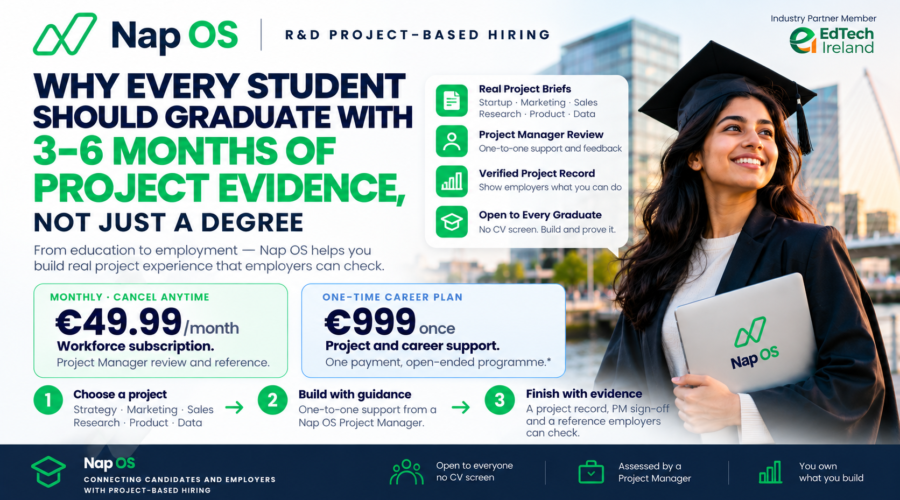
A participant chooses a relevant project brief.
The brief defines a problem, expected deliverables and acceptance criteria.
The participant builds.
A Project Manager reviews the work.
The participant receives feedback.
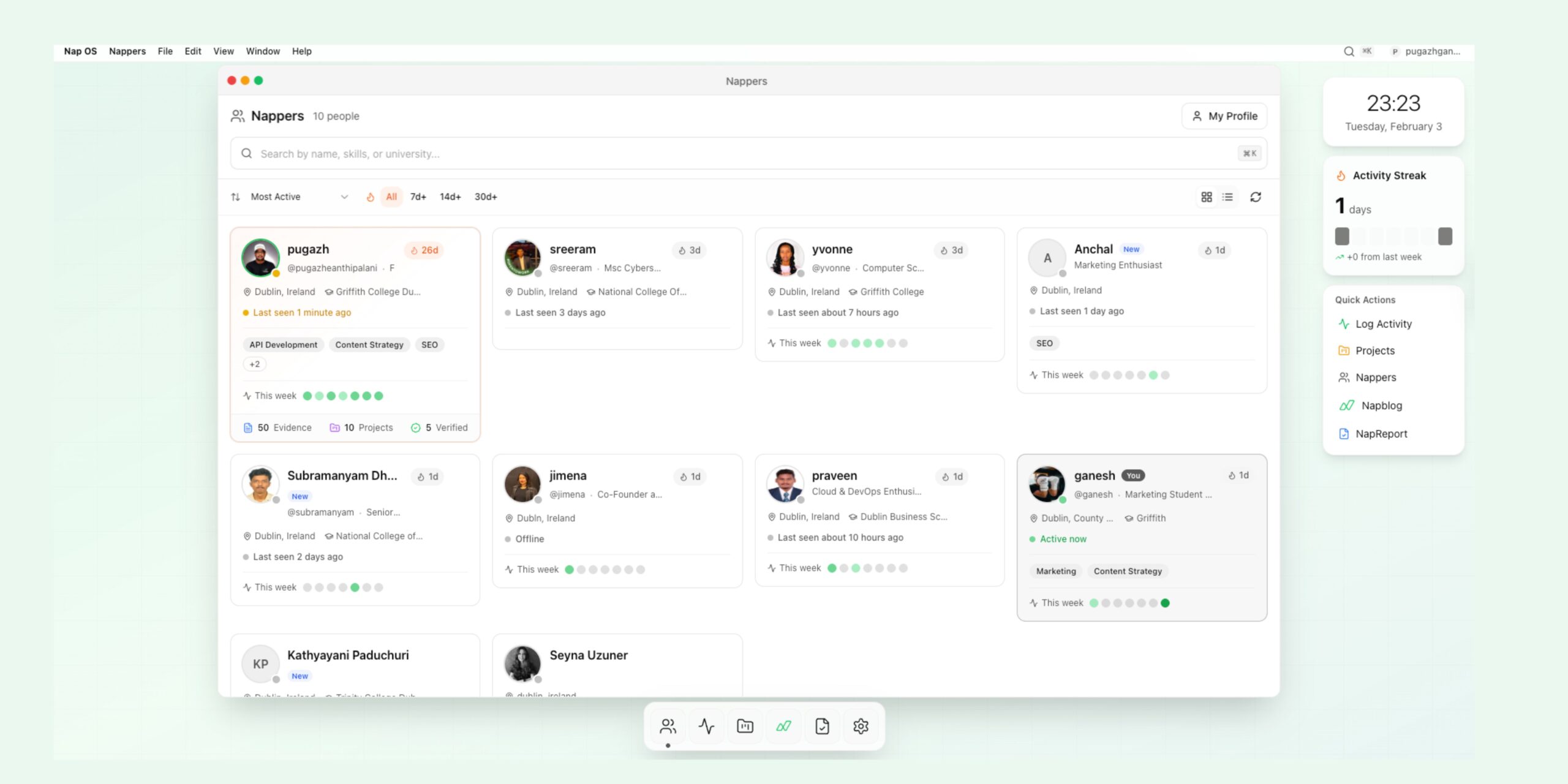
The resulting work becomes part of a project record that can be discussed and shown to employers.
The starting point is therefore not an employer saying yes.
It is the candidate deciding to start.
That distinction matters.
Nap OS’s existing product positioning describes the conventional graduate experience problem as a “permission gap”: internships, placements and graduate programmes generally require someone to choose the candidate first.
Project-based experience can invert that relationship.
Build first. Be evaluated on what you build.
Why 3–6 Months Matters?
One isolated project can demonstrate a skill.
A sustained body of projects can demonstrate something more interesting.
Imagine a student completing structured projects for three to six months.
Month one might establish basic execution.
Month two can introduce more difficult deliverables.
Month three can require the candidate to incorporate feedback and improve their work.
Additional months can build increasing complexity, independence and specialisation.
By the end, the candidate has more than a certificate saying they attended something.
They can potentially show a sequence:
Brief → Work → Feedback → Revision → Completion → Evidence.
That history can tell an employer considerably more about a candidate than another generic sentence saying:
“Highly motivated graduate with excellent communication skills.”
The candidate can instead discuss what they were asked to solve, what they produced, which tools they used, where their first attempt failed, what feedback they received and how the final result improved.
That is a much richer interview conversation.
It is important, however, to distinguish this from conventional employment.
A Nap OS project is not automatically equivalent to holding a three- or six-month employee position. Project participation should be represented accurately as project-based experience and evidence of completed work.
The objective is not to manufacture employment history.
It is to make capability visible.
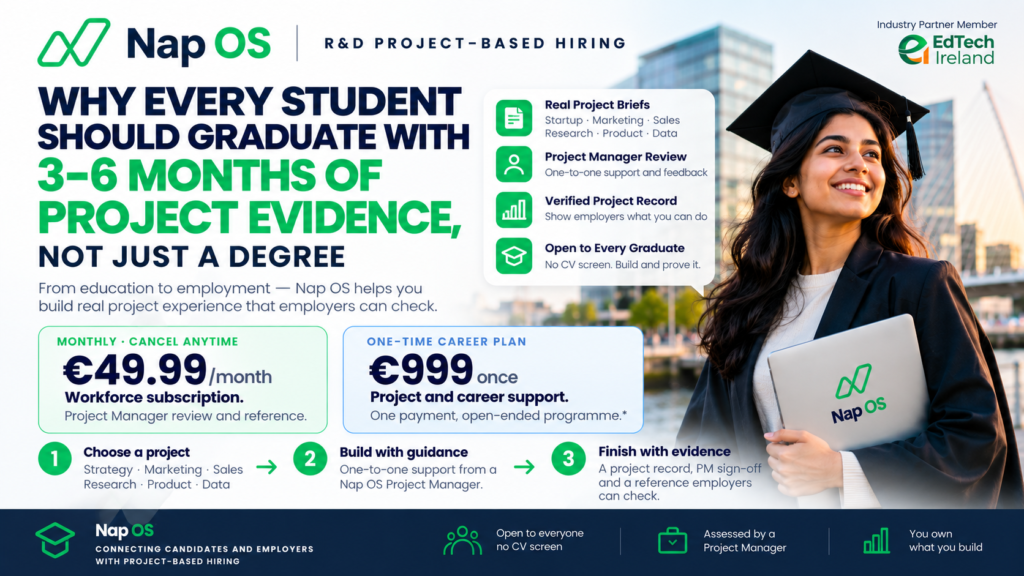
From Mandatory Placement to Universal Project Evidence
This leads to a bigger possibility for universities.
What if every programme did not necessarily need to guarantee every student a conventional employer placement, but every student was expected to graduate with a substantial period of externally structured project evidence?
Traditional employer placements could remain extremely valuable.
Internships could remain valuable.
Government programmes could remain valuable.
But project-based experience could become an additional pathway rather than pretending one model can serve everyone.
The research supplied for this article notes that work placement has already become compulsory within many third-level programmes.
The next evolution could be:
No student graduates without evidence of execution.
That is a different objective from:
Every student must secure the same type of placement.
One focuses on the mechanism.
The other focuses on the outcome.
Nap OS is interested in the outcome.
The University Does Not Need to Invent Hundreds of Projects
There is another scalability problem.
If a university wants every student to build external project experience, somebody has to create the projects, define deliverables, answer questions, review submissions and maintain records.
That is significant operational work.
It becomes even harder across multiple disciplines.
Nap OS can operate as infrastructure between education and employment.
A university provides the academic foundation.
Nap OS provides structured R&D project briefs and Project Manager review.
Candidates execute.
Employers can inspect relevant evidence when evaluating candidates.
This does not replace university education.
It does not replace internships.
And it does not replace employers.
It fills a specific space between learning and being hired.
That distinction is central to the product.
Six Domains, One Principle
The Nap OS model can initially concentrate on six areas:
Strategy · Marketing · Sales · Research · Product · Data
The individual projects will differ, but the underlying architecture remains consistent.
A strategy participant needs to investigate a problem and make defensible recommendations.
A marketing participant needs to turn objectives into campaigns, content, acquisition plans or analysis.
A sales participant needs to demonstrate research, targeting, communication and commercial thinking.
A research participant needs to define questions, collect information, evaluate sources and communicate findings.
A product participant needs to understand users, problems, requirements and prioritisation.
A data participant needs to transform information into analysis and decisions.
The common denominator is not classroom knowledge.
It is:
Can you produce something that can be reviewed?
AI Makes This More Important, Not Less
There is also an unavoidable question in 2026.
If AI can write reports, analyse information, generate presentations, improve CVs and help prepare candidates for interviews, why do students need another education or career platform?
Because AI creates an even greater need to distinguish between generated output and demonstrated capability.
AI can help someone perform a task.
But employers increasingly need to understand how the person thinks, how they validate information, how they make decisions, how they respond to feedback and what responsibility they take for the final output.
Nap OS should therefore not position itself against AI.
Candidates should learn to work intelligently with modern tools.
The differentiator is the human review layer.
AI can help you build. A Project Manager can ask you to defend what you built.
That becomes increasingly valuable as generating polished-looking work becomes easier.
What Employers Get
The model also needs to solve a problem for employers.
Recruitment is largely an exercise in reducing uncertainty.
A CV is evidence, but it is self-reported.
An interview provides information, but candidates prepare heavily for interviews.
Qualifications provide valuable signals, but two people with the same qualification can perform very differently.
Project evidence gives an employer another signal.
Instead of only asking:
“Tell me about a time when…”
an employer can potentially ask:
“Show me what you built.”
Then:
Why did you make this decision?
What alternatives did you consider?
What feedback did you receive?
What changed between the first and final version?
What would you do differently?
That conversation moves recruitment closer to capability.
Nap OS Is Not Selling a Job
This distinction is essential.
Nap OS should not promise that completing projects guarantees employment.
No legitimate project platform can control an employer’s hiring decision.
The candidate still has to apply.
The candidate still has to interview.
The employer still decides.
The value of Nap OS is the infrastructure before that decision: structured project briefs, execution, Project Manager review, feedback, evidence and career support.
Ireland’s existing WPEP similarly demonstrates that structured work-experience initiatives can have defined durations and training components; the government programme is a six-month work-and-training experience model.
Nap OS is a different product and should not be presented as equivalent to WPEP. But the existence of such programmes reinforces the broader principle that structured experience between education and employment has an important role.
A New Graduation Standard
For years, the standard graduation question has effectively been:
Did you get the degree?
The next question should be:
What can you show?
Imagine graduates leaving university with:
a qualification;
three to six months of structured project activity;
multiple completed deliverables;
documented feedback;
a portfolio;
a Project Manager reference where appropriate;
and the ability to explain their work confidently to an employer.
That does not guarantee employment.
But it gives the graduate something substantially more concrete to take into the employment market.
And unlike a scarce internship, project-based infrastructure has the potential to expand without requiring every student to win an employer selection process before they can begin.
From Permission to Proof
The long-term opportunity for Nap OS is therefore larger than another career-support subscription.
It is to help build a new layer of infrastructure between education and employment.
Universities teach.
AI assists.
Nap OS provides projects and human review.
Recruiters identify potential matches.
Employers hire.
Candidates build the evidence that connects those systems.
The vision can be expressed in one sentence:
Every graduate should have the opportunity to build 3–6 months of demonstrable project evidence before entering the employment market.
Not fake employment.
Not a guaranteed job.
Not another certificate for watching videos.
Work they can show.
Feedback they can discuss.
Projects they can defend.
Evidence an employer can evaluate.
That is the shift from permission-based experience to proof-based employability.
And that is the product Nap OS is building.
No work experience?
Don’t wait for permission to start building it.