8 min read
First, a disclosure, because everything below should be read with it in view. Napblog Limited has been accepted onto New Frontiers Phase 1 and is preparing a Phase 2 application for the January 2027 intake. The roadmap published on 13 October promises a refreshed New Frontiers with an enhanced stipend. I have an interest in this going well. Take the praise with that in mind, and the criticism as costing me something.
Now the thing itself.
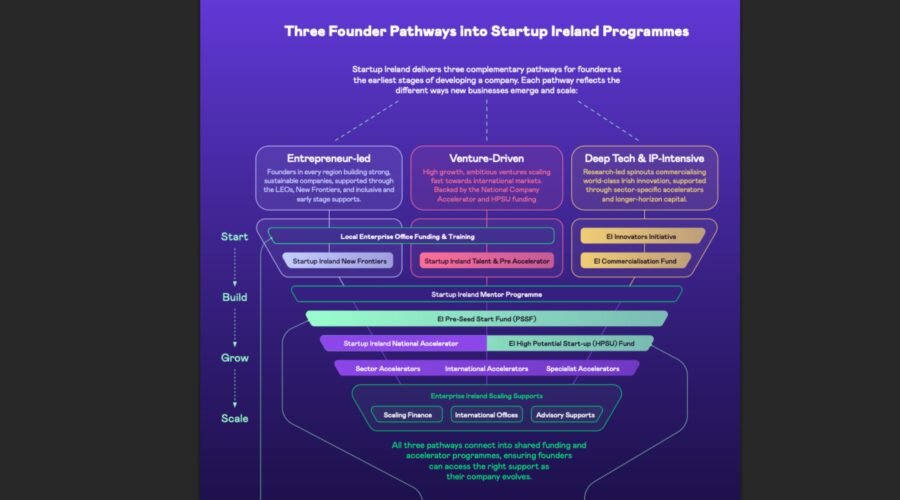
On 13 October, Enterprise Ireland launched Startup Ireland, a cross-government initiative with a 2026–2030 roadmap. The headline numbers: back 10,000 new entrepreneurs, support 1,000 new startups through equity investment, invest €150 million in direct early-stage funding, a €21 million National Accelerator Programme, and increase by 20% the number of startups reaching €1 million in turnover. Thirty-five per cent of supported startups to be women-led, with forty per cent participation from under-represented groups. A National Startup Hub beside Enterprise Ireland’s new Dublin headquarters. An AI Accelerator delivered by Dogpatch Labs, twelve weeks, non-equity, ten companies, with partners including NVIDIA, Google, Microsoft, OpenAI, Anthropic and Stripe, and over €1 million in available technology credits.
It is a serious document, built on serious groundwork — a 2024 OECD report on incubation and acceleration in Ireland, the Draghi report on European competitiveness, and a 2025 Founders Listening Tour that spoke to more than 500 entrepreneurs. Ireland currently sits 18th on the Global Innovation Index, and the roadmap is candid that human capital and research intensity are where the ground is softest.
I want to point at one number in it that I have not seen anyone else discuss.
Ten thousand in, one thousand out
Read the two ambitions together. Back 10,000 entrepreneurs. Create 1,000 startups.
That ratio is not a failure. It is an honest and probably accurate description of how early-stage entrepreneurship works. Most people who seriously explore starting a company do not start one, and the overwhelming majority of those who don’t have made a sensible decision rather than a cowardly one. A programme that put 10,000 people in and got 10,000 companies out would be a programme that had stopped filtering.
But it leaves a question the roadmap does not answer, and it is the question I think about most.
What happens to the other nine thousand?
They will have spent months on a pre-accelerator, a Talent Accelerator, a regional validation programme. They will have interviewed customers, built something rough, modelled a market, pitched it, and had an experienced person tell them where it was weak. Many will have done more genuine commercial work in that period than they did in three years of employment. And at the end, the ones who conclude — correctly — that this particular idea should not become a company will walk away with nothing they can show anybody.
No record. No reference. Nothing an employer can check. A gap on a CV and a story they will tell badly in an interview, because “I spent six months validating a business that I then decided not to start” sounds like failure to everyone except the handful of people who know it is usually the most expensive form of judgement a person can acquire.
That is a waste, and it is exactly the waste Nap OS was built to stop in a different domain.
The same shape as the employment problem
Our whole argument about work experience is this: the thing employers value most is proof you can do the work, the proof requires a context in which to do it, and the context is gated by the proof. Employers rank completed work placement second of all hiring factors, behind only degree discipline — ahead of grades — and placements are precisely the thing the market supplies least of.
Entrepreneurial capability has the same shape. It is acquired by doing, it is enormously valuable to employers — a person who has validated a business, however small, knows things about customers and cash that most employees never learn — and there is no mechanism anywhere for recording that it happened.
Startup Ireland’s own challenge table names this almost exactly. Under Risk mitigation and education it calls for “training and guidance to help founders manage economic and geopolitical risks and overcome fear of failure through entrepreneurial education.”
Fear of failure is the right diagnosis. But fear of failure is not cured by a workshop about fear of failure. It is cured by having already done a small version of the thing and survived being judged on it. You stop being afraid of a cold customer call after the fourth one, not after the seminar. And it is cured faster still if the attempt leaves a record, because then the downside of trying and stopping is no longer nothing to show for it.
Make the attempt itself legible and you lower the cost of attempting. That is not a philosophical claim; it is the entire reason a thousand of the ten thousand will be willing to go on, and more would if the other nine thousand’s outcome were less bleak.
What the Talent Accelerator quietly concedes
The single most interesting line in the announcement is the description of the Talent Accelerator: a programme for experienced individuals that are pre-company and pre-idea stage, to validate opportunities, form companies and progress to pre-seed investment.
Read that again. Enterprise Ireland has formally built a programme for people who are not yet founders and do not yet have an idea.
That is a conceptual shift and it deserves credit. It concedes that the pipeline does not start with a company, or even with a plan — it starts with a capable person and a structured way to find out whether they have something. It is the same move we make with work experience: do not wait for the role to exist before building the evidence.
It also implies an obvious piece of infrastructure that nobody has built. If you are selecting experienced individuals who are pre-idea, how do you select them? On a CV, which measures where they have been rather than what they can do. On an interview, which measures interview technique. On a referral, which measures network.
Or on evidence of having taken an ambiguous brief, made the judgement calls inside it, produced something finished, and been assessed on it by someone who does that work for a living. Which is the thing we make.
What Nap OS Incubate actually is, at its real size
Here is ours, stated small, because the fastest way to lose credibility in a week like this is to pretend to be a national programme.
Nap OS Incubate is a €49.99 a month rolling subscription. Startup and Entrepreneurship is one of our five project domains. A member takes a brief — ten tasks over a fortnight, criteria published before they start — and gets a weekly one-to-one call, written feedback inside seven days, and on completion a record stating what they did and what it was judged against. They can pause the subscription for exams or a holiday and restart it. They own everything they build, permanently, whether they ever pay us or not.
That is the whole product. It is not accredited, it is not a qualification, and it does not make anyone a founder. We have two hundred active members and we have been doing this since January.
What it is good at is the narrow thing: turning an attempt into something that exists afterwards.
Where the two meet
If I had one suggestion to make to the people building this, it would be about the nine thousand, and it has two halves.
An on-ramp. Before a regional pre-accelerator or a Talent Accelerator, there is a large population of people who suspect they might want to do this and have no way to test the suspicion cheaply. A fortnight of structured, reviewed project work is a far better filter than an application form, for both sides, and it costs the programme nothing.
An off-ramp that isn’t a cliff. Every participant who concludes their idea should not become a company should leave with a record of what they did, assessed against criteria, that an employer can check. Not a certificate of attendance — a record of work. The nine thousand are not a write-off; they are nine thousand people who have just acquired commercial judgement at the State’s expense and have no way to prove it. Making that provable is cheap, and it would make the ten-thousand number mean something beyond footfall.
The honest counterweight
Two things give me pause, and I would rather say them now than after a decision.
Coordination is not capability. The OECD diagnosed fragmentation, and Startup Ireland answers it with a hub, a platform, a single front door and a mentor network. All good. But a better-signposted system still requires people who can do the work. The hardest constraint in a startup is not finding the right form; it is finding someone who can build the thing, sell the thing, or tell you honestly that the thing is wrong. Nothing in a roadmap manufactures those people. They are made by doing the work under someone who knows better — which is slow, human and expensive, and exactly what the ecosystem is least able to buy.
And I cannot see myself in the entry criteria. The roadmap targets women-led startups at 35% and under-represented founders at 40%, and that is right. But the person I was eight years ago — arrived from Chennai with a master’s, no Irish work history, no network, no runway — would not have reached a Talent Accelerator, because reaching one requires the kind of standing that the first two years here systematically deny you. If 1,000 new startups are going to come from the full talent in this country, the on-ramp has to start further back than the roadmap currently starts.
Ten thousand people are about to be encouraged to try. Nine thousand of them will decide not to proceed, and most will be right.
The measure of this programme, five years out, will not only be the thousand companies. It will be whether the nine thousand came out better off than they went in — and whether anyone can tell.
Start free: os.napblog.com
Pugazheanthi Palani is Founder and CEO of Napblog Limited, trading as Nap OS, a licensed employment agency (EA 5651) at 77 Camden Street Lower, Dublin 2. Napblog Limited has been accepted onto New Frontiers Phase 1 and intends to apply to Phase 2. Fees cover project briefs, Project Manager review and career support — not recruitment or job placement — and employment is not guaranteed. Figures: Startup Ireland Roadmap and Enterprise Ireland announcement, 13 October 2026; UL Careers Early Careers Employer Survey 2026 (269 employers).