7 min read
It started with one verified project
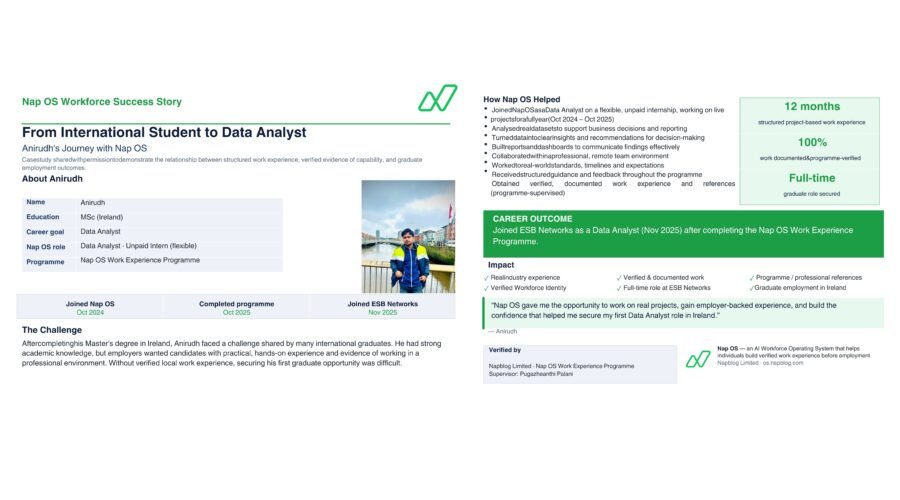
In October 2024, Anirudh was a recent MSc graduate in Ireland with a strong academic record and a familiar problem. Every application for a data role came back with the same quiet rejection: employers wanted candidates with practical, local experience he had never been given the chance to build. He had the qualification. He did not have the proof.
Twelve months later, that had changed. Through the Nap OS Work Experience Programme, Anirudh completed a year of structured, project-based data analysis work — analysing real datasets, building reports and dashboards, and delivering to real-world standards and timelines. Every piece of that work was documented and programme-verified. In November 2025, he secured a full-time Data Analyst role at ESB Networks.
He is not the only one. Syed, an MSc Data Analytics graduate from the National College of Ireland, joined Nap OS as a Technical Support Analyst intern, handled 80–100 support cases a week for enterprise clients across EMEA, and left with a documented track record, a certificate and references. Shortly after, he joined ServiceNow.
Two people. Two verified journeys. Two full-time roles at well-known Irish employers. The question this article asks is simple: if the model works for one, can it work for a thousand? And specifically — could Nap OS help 1,000 or more people become work-ready, employable Data Analysts?
The problem Nap OS was built to solve
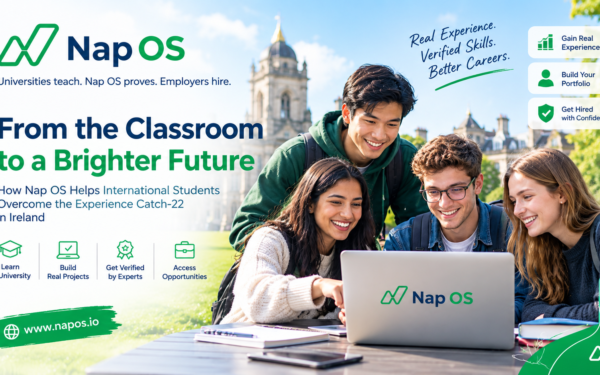
Ireland has become one of Europe’s leading destinations for international education. In 2024/25, international student enrolment reached a record of roughly 44,500 — a fourth consecutive year of growth. These are capable, ambitious people, many of them in data, analytics and computing disciplines that the economy urgently needs.
Yet a structural gap sits between graduating and getting hired. A degree proves someone can learn; it does not prove they can do. In a market where hundreds of qualified graduates compete for each opening, “can learn” is table stakes. The candidate who gets the call is the one who can show they have already done the work somewhere.
For the international graduate, the gap has extra teeth. Employers want local, verifiable experience — but without a first role, you cannot earn that experience or the references that unlock it. It is a genuine Catch-22: you need the job to get the experience, and the experience to get the job. The result is capable people locked out of the labour market, and an economy that loses skilled talent it worked hard to attract.
Data analysis makes this especially visible. It is one of the fastest-growing, most in-demand skill areas across Irish employers — from financial services and energy to technology and the public sector. Demand is high; the supply of proven, work-ready analysts is not. The bottleneck is not talent. It is trusted evidence of capability.
The Nap OS model: turn real work into verified proof
Nap OS is an AI Workforce Operating System. Underneath the name, the idea is straightforward and it goes straight at the thing that hurts.
Instead of asking graduates to compete on qualifications alone, Nap OS lets them manufacture the proof directly — completing real, employer-relevant projects before anyone has offered them a job, so that when they apply, they are no longer saying “I could do this.” They are saying “here is the work I have already done.”
The mechanism has two stakeholders and one shared record. The product itself develops, evaluates and verifies the work. The employer hires on the resulting evidence. There is no third-party layer in between. Everything a person builds — projects, deliverables, evaluations, references — is documented and attached to a trusted Verified Workforce Identity: a portable record an employer can inspect and believe, because it is anchored to real deliverables rather than self-reported claims.
For a Data Analyst specifically, this is a natural fit. Analytical work produces tangible artefacts — cleaned datasets, queries, dashboards, reports, recommendations — that are easy to review and hard to fake. The output is the proof. That is exactly what Anirudh and Syed walked away with: not a certificate of attendance, but a verifiable body of real work.
How it scales to 1,000+ analysts
Helping one person is a story. Helping a thousand is a system. Scaling Nap OS to 1,000+ Data Analysts rests on the fact that the model is built as a repeatable loop rather than a one-off intervention.
A continuous cohort engine. Rather than a single programme with a start and end, Nap OS runs as an ongoing pipeline: new members join, are matched to real analytical projects, build verified experience, and move toward employment — while the next cohort begins. Every September’s intake of international graduates becomes a new cohort. The programme does not need to be reinvented each time; it needs to be fed.
Project supply as the fuel. The scaling constraint is not people who want experience — it is a steady supply of real projects for them to do. This is where employer and university partnerships matter. Companies with data backlogs, SMEs that cannot afford a full-time analyst, and research groups all generate work that becomes verified experience for a member. The more project supply, the more analysts the system can develop at once.
AI does the heavy lifting. The reason this can scale without a proportional army of human assessors is that the product performs the evaluation. AI parses project briefs into required skills, matches members to suitable work, and evaluates deliverables against the brief — always anchored to the real artefact an employer can inspect. Humans are not removed from the loop; the employer provides the ultimate validation by hiring on the evidence. That design is what lets one platform support hundreds of concurrent analysts rather than a handful.
A demand-driven curriculum. Because Nap OS reads live labour-market demand, the projects members work on mirror what employers are actually hiring for — SQL, turning data into decisions, dashboarding, stakeholder communication. As demand shifts, so does the work. Analysts are built toward the roles that exist, not the roles that existed five years ago.
The flywheel. Each successful placement is not just an individual win. It becomes a signal that feeds back into the system: which verified capabilities led to employment, which employers value which evidence, which projects produced the strongest analysts. Every graduate who gets hired makes the next person’s path a little clearer, and every employer who hires on proof makes the evidence more trusted. That compounding is how a model that helped two people becomes one that can help a thousand.
From anecdotes to an evidence library
The strategic asset Nap OS is quietly building is not testimonials — it is documented outcomes. Anirudh and Syed are the first two of what can become a library of graduate outcome case studies, each following the same verifiable chain: education → structured work → documented evidence → programme verification → employment.
Fifty such documented outcomes are far more persuasive than the sentence “we helped fifty people get jobs.” A thousand would be evidence of a repeatable workforce development model — the kind of proof that universities, employers, Enterprise Ireland and investors can understand in a minute. It shifts the conversation from “here is what we believe Nap OS could do” to “here is what it has already done, at scale, with names and dates.”
Why this matters for Ireland
Scaled to 1,000+ Data Analysts, Nap OS stops being a hiring tool and starts being workforce infrastructure. For individuals, it is a route past the “no experience” wall and into meaningful careers. For employers, it is access to work-ready, locally-experienced talent they can hire on proof, cutting the cost and risk of a mis-hire. For universities, it strengthens graduate outcomes and industry engagement. And for Ireland, it means retaining skilled international talent the country invested in attracting — turning a large, overlooked pool into productive, employed contributors to the economy.
There is a national logic here too. Ireland has built a globally recognised higher-education ecosystem. The next opportunity is to build the workforce infrastructure that connects education to employment — and to do it first.
An honest note on what it takes
None of this is automatic. Scaling to 1,000 analysts depends on real things: a reliable supply of genuine projects, employer partners willing to hire on evidence, university collaborations to grow the pipeline, and continued investment in the platform’s AI so evaluation stays trustworthy at volume. Outcomes will always vary with individual skill, opportunity and employer decisions — no programme can promise a job.
But the core thesis has already been tested on real people. Anirudh is at ESB Networks. Syed is at ServiceNow. Both arrived at those roles the same way: they built verified, documented Irish work experience before anyone hired them, and then walked in holding proof.
The market keeps asking graduates for one thing and refusing to help them get it: evidence. Nap OS exists to give it to them — one verified project at a time, and, before long, a thousand.
Share you story and CV to palani@napblog.com – start building personalised first Irish local employer verified work experience to get targeted job, systematically.