6 min read
Every generation experiences a technological shift that fundamentally changes how people work.
The personal computer transformed productivity. The internet connected information. Cloud computing enabled global collaboration. Artificial intelligence is now reshaping how knowledge is created and decisions are made.
Yet one of society’s most important systems has changed very little.
The journey from education to employment.
Despite advances in technology, millions of people still navigate their careers through disconnected systems—CVs, job boards, certificates, interviews, and fragmented portfolios. Universities educate talented graduates, employers seek capable people, and governments invest heavily in workforce development, yet the transition between learning and meaningful work remains inefficient.
At the same time, entrepreneurship is becoming an increasingly important driver of economic growth. More people are building businesses, freelancing, joining startups, and creating independent careers. Traditional career pathways are evolving into dynamic journeys where continuous learning, practical experience, and adaptability matter more than ever.
These changes raise an important question.
What if workforce development had its own operating system?
That question became the foundation of Nap OS.
The Workforce Challenge
Across the world, individuals invest years in education and professional development. They earn degrees, complete certifications, and acquire theoretical knowledge. However, one challenge consistently remains.
Demonstrating capability.
Employers rarely hire based solely on potential. They look for evidence of execution, problem-solving, teamwork, communication, and practical experience.
At the same time, employers face their own challenges.
Recruitment has become increasingly complex. Traditional hiring processes often rely on CVs, interviews, and references that provide only a partial picture of an individual’s ability. Hiring mistakes are expensive, while identifying exceptional talent early has become a competitive advantage.
The gap between education and employment is therefore not simply a skills gap.
It is an evidence gap.
Individuals need opportunities to build trusted evidence of their capabilities, while employers need better ways to identify work-ready talent.
From Recruitment to Workforce Development
Most career technology focuses on one stage of the employment journey.
Job boards help people search for jobs.
Applicant Tracking Systems help employers manage recruitment.
Professional networking platforms help people build online profiles.
Learning platforms provide courses.
Each solves an individual problem.
Very few connect the entire journey.
Nap OS approaches workforce development differently.
Instead of beginning when someone starts applying for jobs, it begins much earlier.
It focuses on helping individuals continuously develop practical experience, document meaningful work, verify achievements, and build trusted career capital before employment decisions are made.
The objective is simple.
Create a workforce that is continuously learning, building, and demonstrating capability.
An Operating System Rather Than Another Platform
The name Nap OS reflects a broader vision.
Operating systems coordinate multiple applications into a unified environment.
Similarly, workforce development involves many interconnected activities.
Learning.
Projects.
Mentoring.
Collaboration.
Reflection.
Recruitment.
Entrepreneurship.
Professional growth.
Rather than treating these as isolated experiences, Nap OS aims to provide the underlying infrastructure that connects them together.
Individuals can develop evidence-based portfolios through real work, organisations can engage with emerging talent earlier, and universities can strengthen the connection between education and industry.
The platform is designed to create continuity rather than fragmentation.
Ireland as the Starting Point
Ireland has become one of Europe’s leading technology ecosystems.
Global technology companies operate alongside world-class universities, research institutions, startup communities, and government-backed innovation programmes.
It provides a unique environment where education, entrepreneurship, and international talent intersect.
For Nap OS, Ireland represents more than a location.
It represents an opportunity to build workforce innovation within an ecosystem that values research, collaboration, and global ambition.
The company’s journey has been shaped through engagement with universities, startups, employers, mentors, and entrepreneurs who collectively contribute to strengthening Ireland’s innovation economy.
Building from Ireland also provides access to a diverse international workforce.
Students, graduates, professionals, and founders from around the world choose Ireland as a place to study, work, and innovate.
Designing workforce technology within such an international environment naturally creates products intended for global adoption.
Workforce Development in the Age of Artificial Intelligence
Artificial intelligence is changing the nature of work.
Routine tasks are increasingly automated.
Knowledge becomes instantly accessible.
Decision-making becomes augmented by intelligent systems.
However, human capability remains central.
Communication.
Creativity.
Leadership.
Collaboration.
Execution.
These qualities cannot simply be inferred from a document.
They need to be demonstrated through experience.
Nap OS embraces artificial intelligence as an enabler rather than a replacement.
AI can reduce administrative work, personalise development pathways, assist career planning, and improve workforce matching.
At the same time, verified human contribution becomes increasingly valuable.
As AI-generated content becomes commonplace, trusted evidence of real-world execution becomes a differentiator.
Supporting an Entrepreneurial Economy
Workforce development is no longer limited to preparing people for employment.
Increasingly, people create their own opportunities.
Freelancers.
Consultants.
Startup founders.
Independent professionals.
Portfolio careers.
The entrepreneurial economy continues to expand as technology lowers barriers to starting new ventures.
Future workforce infrastructure must therefore support entrepreneurship alongside employment.
Individuals should be able to build experience while exploring business ideas.
They should be able to collaborate across disciplines.
They should be able to demonstrate capability regardless of whether they ultimately become employees or founders.
Nap OS is designed with this broader perspective.
Workforce development and entrepreneurship are complementary, not competing pathways.
Universities as Innovation Partners
Higher education institutions remain among the world’s most important creators of knowledge and talent.
Yet employers increasingly seek graduates who combine academic achievement with practical experience.
Closer collaboration between universities and industry creates benefits for everyone.
Students gain meaningful work experience.
Employers access emerging talent.
Universities strengthen graduate outcomes.
Innovation ecosystems become more connected.
Nap OS believes technology can support these relationships by providing better infrastructure for experiential learning, project collaboration, and workforce verification.
Rather than replacing existing educational systems, technology should strengthen the connection between learning and professional practice.
Building Career Capital
Traditional career development often focuses on accumulating qualifications.
Future career development may increasingly focus on accumulating verified evidence.
Projects completed.
Problems solved.
Teams supported.
Skills demonstrated.
Impact delivered.
This collection of trusted experiences forms what can be described as career capital.
Career capital extends beyond academic transcripts and job titles.
It represents an evolving record of demonstrated capability.
As careers become less linear, continuously building career capital becomes increasingly valuable.
Nap OS aims to make this process more structured, measurable, and accessible.
Creating Shared Value
Strong workforce systems benefit multiple stakeholders simultaneously.
Individuals improve employability and career progression.
Employers reduce hiring risk.
Universities strengthen graduate success.
Governments enhance workforce participation and innovation capacity.
Entrepreneurs access talent more effectively.
Rather than optimising for a single participant, Nap OS seeks to create shared value across the broader workforce ecosystem.
This systems-based perspective recognises that workforce development is not solely an educational challenge or a recruitment challenge.
It is an economic challenge.
Looking Ahead
The future of work will likely become increasingly continuous rather than transactional.
Learning will continue throughout careers.
Projects will increasingly complement traditional employment.
Entrepreneurship will become more accessible.
Artificial intelligence will reshape how people create value.
Workforce infrastructure must evolve accordingly.
Operating systems transformed personal computing by bringing fragmented applications together into unified environments.
A similar transformation may now be possible for workforce development.
The ambition behind Nap OS is not simply to build another recruitment platform or career application.
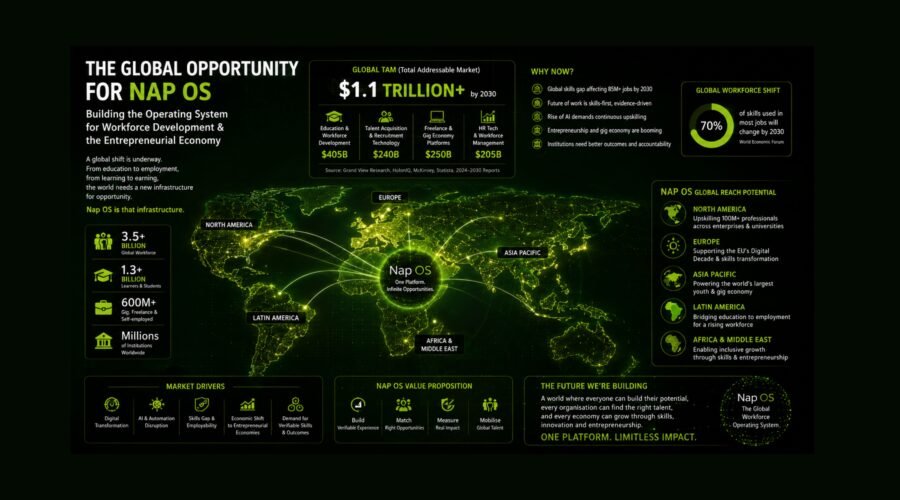
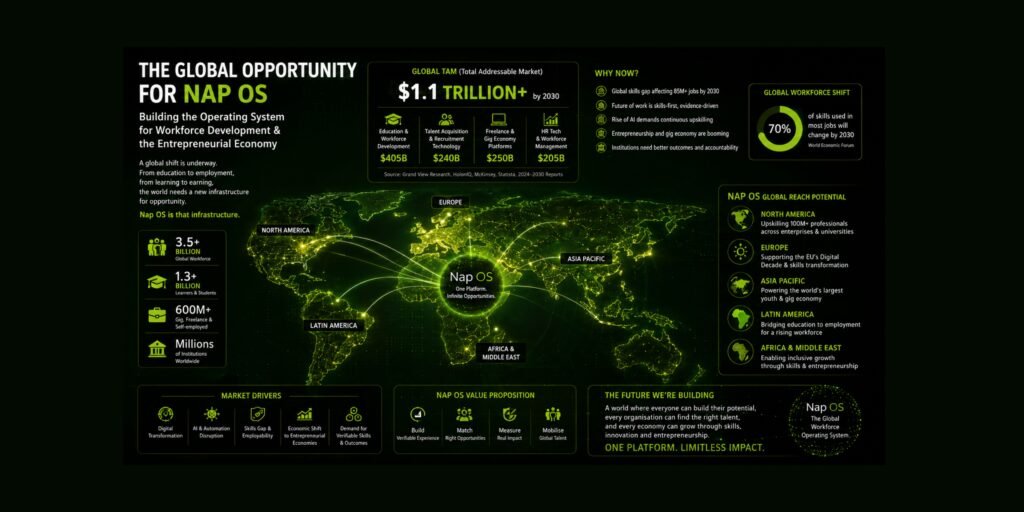
It is to contribute towards a future where education, employment, entrepreneurship, and lifelong learning are better connected through trusted digital infrastructure.
Built from Ireland, Designed for the World
Innovation often begins by solving local challenges before expanding globally.
Ireland has repeatedly demonstrated its ability to build internationally recognised technology companies through collaboration between universities, entrepreneurs, researchers, investors, and public institutions.
Nap OS seeks to contribute to that tradition.
Built from Ireland with global ambition, its vision is to create an operating system that helps individuals build trusted career capital, supports organisations in developing work-ready talent, and strengthens the connection between education, workforce development, and entrepreneurship.
The future economy will depend not only on technological innovation, but on how effectively societies enable people to develop, demonstrate, and deploy their capabilities.
Building that infrastructure is a long-term challenge.
It is also one of the most important opportunities of the next generation.
Nap OS believes the future of workforce development is not another platform. It is an operating system.