7 min read
Governments around the world invest billions each year in education, employment services, skills development, innovation, entrepreneurship and economic development. Although these investments take many different forms, they are all intended to achieve a common objective: helping people develop the skills and opportunities needed to participate in a productive, resilient economy.
As labour markets continue to evolve, governments face increasingly complex challenges. Technological change, artificial intelligence, demographic shifts, changing employer expectations and evolving workforce demands require education and employment systems to adapt more quickly than ever before.
The question is no longer simply how to educate people. It is how to help individuals continuously build relevant capabilities throughout their lives while enabling employers to identify and recruit talent with greater confidence.
This is where workforce capability platforms may have an important role to play.
Governments Invest in Outcomes, Not Technology
Governments do not typically invest in technology simply because it is innovative. Instead, they invest in programmes, partnerships and infrastructure that contribute to measurable public outcomes.
Examples include:
- improving graduate employment
- reducing unemployment
- increasing labour market participation
- supporting lifelong learning
- strengthening workforce productivity
- encouraging entrepreneurship
- improving national competitiveness
- supporting regional economic development
Technology becomes valuable when it helps achieve these broader objectives.
For this reason, the long-term success of any workforce platform is unlikely to depend on the sophistication of its software alone. Its value will ultimately be determined by whether it can demonstrate meaningful improvements in workforce outcomes through robust evidence and sustained impact.
The Challenge Facing Workforce Systems
Many countries already possess strong institutions that support workforce development.
These include:
- universities
- colleges
- apprenticeship programmes
- public employment services
- innovation agencies
- enterprise supports
- entrepreneurship programmes
- industry partnerships
- skills development initiatives
Each plays an important role.
However, these systems are often designed to solve specific parts of the workforce journey rather than supporting individuals continuously throughout their careers.
A student may graduate with strong academic knowledge but limited practical experience.
An unemployed individual may complete several training programmes yet struggle to demonstrate their capabilities to employers.
A graduate entering the workforce may possess technical skills but have limited evidence of applying those skills in real-world situations.
Entrepreneurs frequently develop valuable capabilities through building businesses, yet these experiences are not always recognised in traditional recruitment processes.
While each system delivers value independently, there can be gaps between education, employment and entrepreneurship.
Bridging these transitions represents an opportunity for innovation.
From Qualifications to Demonstrated Capability
Traditional recruitment has often relied heavily on qualifications, previous job titles and years of experience.
These indicators remain important.
However, employers increasingly seek evidence of practical capability.
Questions commonly asked during recruitment include:
- Can this individual solve real problems?
- Can they collaborate effectively?
- Have they completed meaningful projects?
- Can they adapt to changing environments?
- Do they possess practical workplace skills?
Increasingly, employers are looking beyond qualifications alone and seeking evidence of demonstrated capability.
Workforce platforms have the potential to support this transition by enabling individuals to build verified portfolios of practical work completed through projects, collaboration, mentoring and continuous learning.
Rather than replacing formal education, such platforms can complement existing qualifications by providing additional evidence of applied skills and experience.
A Continuous Workforce Journey
One possible vision for the future is a more connected workforce ecosystem.
Imagine an individual who begins building practical projects while studying.
Throughout university they develop a portfolio demonstrating real capability.
After graduation they continue strengthening their skills through new projects, professional development and mentoring.
Employers review verified evidence of completed work rather than relying solely on a CV.
Later in their career they establish their own business, mentor younger professionals and eventually recruit graduates through the same ecosystem.
Rather than viewing education, employment and entrepreneurship as separate stages, workforce development becomes a continuous lifelong journey.
Technology alone cannot create this future.
However, thoughtfully designed workforce infrastructure could help support it.
Why Evidence Matters
For any workforce platform to become relevant to national policy, evidence is essential.
Good intentions are not enough.
Governments, universities, employers and public agencies require confidence that programmes produce measurable benefits before committing significant resources.
This means demonstrating outcomes through:
- independent evaluation
- longitudinal research
- transparent reporting
- measurable workforce indicators
- collaboration with educational institutions
- employer feedback
- continuous improvement
Evidence should answer questions such as:
- Are more graduates securing meaningful employment?
- Are workforce transitions becoming faster?
- Are employers making more confident hiring decisions?
- Are participants developing stronger practical capabilities?
- Are businesses benefiting from improved access to skilled talent?
Only through consistent measurement over many years can meaningful conclusions be drawn.
Potential Contributions to National Workforce Strategies
If a workforce platform consistently demonstrated positive outcomes through independent evidence over an extended period, it could contribute to a number of existing public policy priorities.
These may include:
Graduate Employability
Helping students build practical experience before graduation may improve confidence when entering the labour market.
Project-based learning, mentoring and verified portfolios can complement academic achievement by providing additional evidence of workplace readiness.
Workforce Participation
Individuals returning to employment after career breaks or periods of unemployment often face challenges demonstrating current capability.
Practical project work may help individuals rebuild confidence while creating recent evidence of their skills.
Hiring Efficiency
Recruitment remains costly for employers.
Providing richer evidence of candidate capability may support better-informed hiring decisions and potentially reduce recruitment risks.
Lifelong Learning
Learning increasingly continues throughout an individual’s career.
Platforms supporting continuous development may encourage professionals to regularly update their skills as industries evolve.
Entrepreneurship
Entrepreneurs frequently develop valuable leadership, commercial and technical capabilities.
Recognising these experiences as part of broader workforce development may strengthen innovation ecosystems while supporting business creation.
Connecting Existing Ecosystems
One of the greatest opportunities may not lie in replacing existing institutions but in connecting them more effectively.
Universities, employers, innovation centres, enterprise agencies, public employment services and professional mentors each contribute valuable expertise.
A shared workforce capability infrastructure could potentially strengthen collaboration across these organisations while allowing individuals to move more seamlessly between education, employment and entrepreneurship.
Instead of operating as isolated systems, each stakeholder contributes to a broader workforce ecosystem focused on long-term capability development.
The Role of Artificial Intelligence
Artificial intelligence is transforming many aspects of work.
However, AI should be viewed as an enabling technology rather than the primary objective.
The true value of AI lies in how it helps individuals and organisations make better decisions.
Within workforce development, AI may support:
- personalised learning recommendations
- project matching
- skills analysis
- capability assessment
- mentoring support
- portfolio organisation
- workforce insights
These capabilities become meaningful only when they improve real-world outcomes for individuals and employers.
Technology should always serve people rather than becoming the focus itself.
A Long-Term Perspective
Meaningful workforce transformation does not happen within a single year.
Education systems evolve gradually.
Labour markets change over decades.
Public policy requires sustained evidence before large-scale adoption.
Any organisation seeking to contribute meaningfully to national workforce development should therefore adopt a long-term perspective.
Success should be measured not only by platform growth but also by tangible improvements in people’s careers, employer confidence and workforce resilience.
Building this kind of trust requires patience, collaboration and continuous learning.
The Opportunity for Nap OS
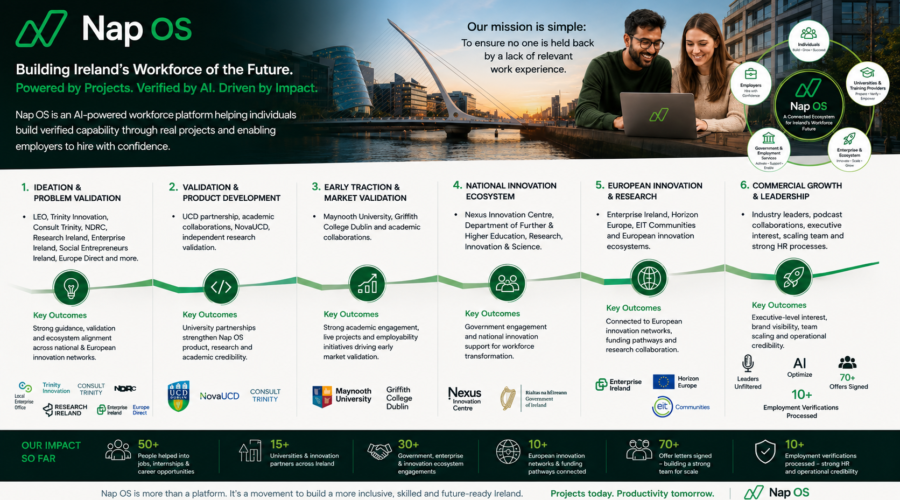
Nap OS is being developed with the ambition of contributing to this broader vision.
Rather than attempting to replace universities, employers or public employment services, its goal is to complement them by helping individuals build practical capability through personalised projects, verified portfolios, mentoring and continuous workforce development.
The long-term aspiration is to support a more connected workforce ecosystem where learning extends beyond formal education and practical capability can be demonstrated throughout an individual’s career.
Whether this vision ultimately succeeds will depend not on ambitious ideas alone, but on measurable outcomes, independent evidence and meaningful collaboration with education providers, employers, government agencies and innovation partners.
Looking Ahead
The future of workforce development is unlikely to depend on a single organisation or technology.
Instead, it will require collaboration between governments, educational institutions, employers, entrepreneurs, researchers and technology providers.
If platforms such as Nap OS can consistently demonstrate that they improve workforce capability, strengthen employability, support lifelong learning and create measurable public value over many years, they may become valuable partners within national workforce strategies.
The opportunity is therefore larger than building another recruitment platform or education technology product.
It is about contributing to workforce infrastructure that helps individuals continuously develop their capabilities, enables employers to recruit with greater confidence and supports governments in achieving long-term economic and social objectives.
Ultimately, governments are not seeking technology for its own sake. They are seeking better outcomes for their citizens. Any platform that can demonstrate sustained, evidence-based contributions to those outcomes has the potential to become an important part of the future workforce ecosystem.
Editorial note: This article presents a long-term vision and discusses potential future contributions of workforce capability platforms. It should not be interpreted as a claim that Nap OS has already achieved these national-level outcomes. Realising this vision would require ongoing research, independent evaluation, collaboration across multiple stakeholders and evidence gathered over many years.