5 min read
Skilled professionals across Europe are running into a wall that has little to do with talent or ambition. It’s a documentation problem. As countries tighten and formalize their work-permit systems, the gap between what a candidate has actually done in their career and what immigration officials need to see on paper has become the single biggest reason strong applicants get turned away. Nowhere is this clearer than in France, where a recent wave of immigration reform has quietly reshaped what it takes for a skilled worker to legally take up employment.
Two Systems, One Common Obstacle
Unlike some countries that publish a single national list of in-demand occupations, France operates two separate and quite different legal pathways for skilled migration. The first, now formally called the “Talent” residence permit (previously known as Passeport Talent, renamed under a 2025 decree), is aimed at skilled and graduate professionals — including those in sales, marketing, technology, and management. The second, the standard Salarié permit tied to the “Métiers en Tension” shortage-occupation list, applies to roles in officially listed shortage occupations, which are currently concentrated in construction, hospitality, care work, catering, and agriculture.
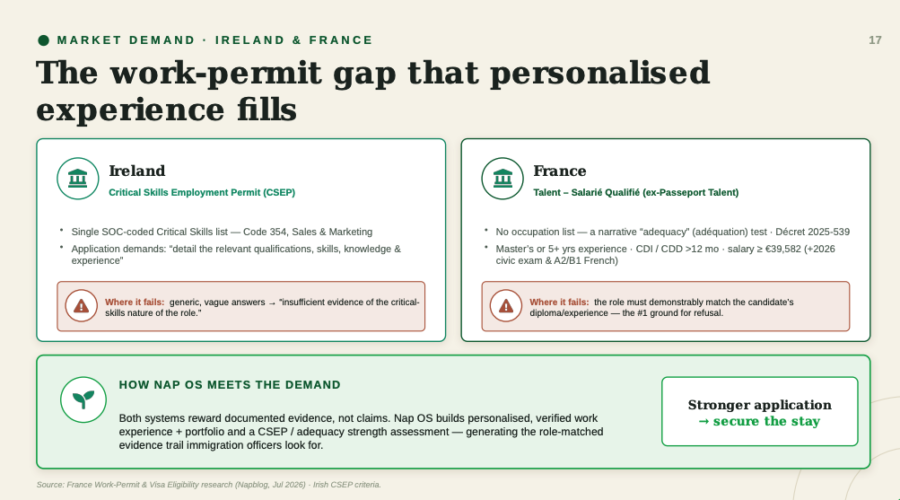
For professionals working in sales, marketing, or other B2B/SaaS-style roles, the shortage-occupation list offers little help, since those job titles rarely appear on it. That leaves the Talent route as the realistic option — and the Talent route does not work like a checklist. Instead of matching a candidate against a fixed list of approved job titles, French authorities apply what is known as an “adequacy” test: a case-by-case judgment of whether a candidate’s qualifications and professional background genuinely correspond to the role they’ve been hired to do.
This is where things get difficult. The adequacy test typically requires either a master’s-level qualification (or equivalent), or at least five years of comparable professional experience, combined with a permanent or long-term contract and a salary that clears a defined threshold. But the qualification and the contract are almost never the deciding factor. The real point of failure is the match itself — whether an officer reviewing the file can see a clear, demonstrable line between what the candidate has actually done professionally and the responsibilities of the role they’re being sponsored for. A mismatch here is consistently cited as the most common reason these applications are refused.
Why “Adequacy” Is Harder Than It Sounds
The difficulty with an adequacy-based system, compared to a fixed occupation-code list, is that there’s no bright-line checklist to satisfy. Two candidates with identical job titles and salaries can receive completely different outcomes depending on how well their file demonstrates a genuine, substantiated connection between past experience and the new role. Immigration officers are looking for specifics: job descriptions that use precise, consistent language, measurable deliverables and KPIs from previous roles, and a documented history that credibly supports the claim that this person is qualified for this job, not just any job in a related field.
This creates a real structural problem for otherwise strong candidates. Someone may have years of genuinely relevant experience, but if that experience was never formally documented, tracked, or framed in a way that maps cleanly onto their target role, the immigration file simply won’t reflect reality. It’s not that the person lacks the underlying capability — it’s that the paper trail doesn’t exist in a form that satisfies the test. For career-changers, self-taught professionals, and people whose prior work was informal, freelance, or spread across small companies without rigorous documentation practices, this gap is especially common.
Where Structured Experience-Building Comes In
This is precisely the gap that a structured, well-documented experience-building program is designed to close — not by inventing qualifications, but by giving candidates the opportunity to generate real, verifiable work product that maps directly onto the role they’re pursuing. A well-run structured internship or applied-project model gives a candidate the chance to produce actual deliverables, work under real business constraints, and build a documented portfolio with clear KPIs and outcomes — the same kind of evidentiary trail that immigration officers are specifically trained to look for when applying the adequacy test.
This is a meaningfully different approach from generic CV-writing or interview coaching. The point isn’t to make an application look better on paper; it’s to give candidates real, substantive experience that legitimately strengthens their profile, so that what appears on paper is an accurate reflection of what they can actually do. For a marketing or sales professional targeting a Talent visa, for example, that might mean a structured project producing real campaign strategy work, measurable performance data, and documented outcomes — the kind of concrete evidence that a narrative CV alone often can’t provide.
Nap OS has built its approach around exactly this idea: helping candidates develop genuine, verifiable professional experience through structured internships and applied portfolio work, so that when they do apply for a European work permit, their documentation reflects real capability rather than an aspirational job title. This isn’t a shortcut around the adequacy test — it’s a way of meeting it honestly, by ensuring candidates have something substantive and well-documented to show.
A Widening Gap, Not a Shrinking One
It’s also worth noting that this isn’t a static problem. France’s 2026 civic and language requirements — a civic knowledge exam plus A2-level French for multi-year residence cards, and B1-level French plus the same civic exam for ten-year resident cards — add a second layer of scrutiny on top of the initial adequacy test, meaning the bar for a well-documented, defensible application is rising over time rather than easing. Candidates who treat their permit application as a one-time paperwork exercise, rather than an ongoing process of building a genuinely strong professional profile, are likely to find the system less forgiving with each passing year.
Compared to a system like Ireland’s Critical Skills Occupations List, where eligibility is coded against specific job titles, France’s model puts a much heavier burden on the individual to prove, narratively and evidentially, that they belong in the role they’re applying for. That’s a harder standard to meet with generic advice or last-minute CV polishing. It rewards candidates who have taken the time — well before they file an application — to build real, demonstrable experience aligned with their target role.
Getting Started
For professionals who are considering a European work permit application, particularly through France’s Talent route, the most useful thing to do early is take an honest look at whether their current documented experience would actually satisfy an adequacy reviewer — not whether it should, but whether it does, on paper, today. Where there’s a gap, structured experience-building offers a legitimate way to close it before an application is filed, rather than discovering the shortfall after a refusal.
Candidates who want a clearer picture of where they stand, and whether a structured internship or portfolio-building track could strengthen their case, are welcome to share their situation and CV with Nap OS at palani@napblog.com. This isn’t a guarantee of any outcome, and it isn’t a substitute for qualified immigration legal advice — but it is a starting point for building the kind of real, well-documented professional experience that France’s adequacy test is specifically designed to look for.