6 min read
There is a persistent problem in how the world measures professional capability. A certificate says someone completed a course. A CV says someone held a job title for a certain number of months. Neither actually answers the question an employer, a client, or an immigration officer is really asking: what did this person actually do, and can anyone confirm it happened? Nap OS was built around closing that gap — not by teaching more courses, but by generating a continuous, documented record of real work, completed on real projects, for real organizations.
What the work actually looks like
Rather than assigning simulated exercises or hypothetical case studies, Nap OS routes contributors into live business tasks with defined objectives and real stakeholders. On any given week, that might include market research and lead-list building, an audit of a client’s Google Ads account, preparation work for an account-based marketing campaign, CRM management inside HubSpot, directory and citation-building for local SEO, workflow documentation, content writing, website builds, or automation work using tools like n8n. These aren’t abstractions — they are tasks tied to specific businesses, specific deliverables, and specific outcomes.
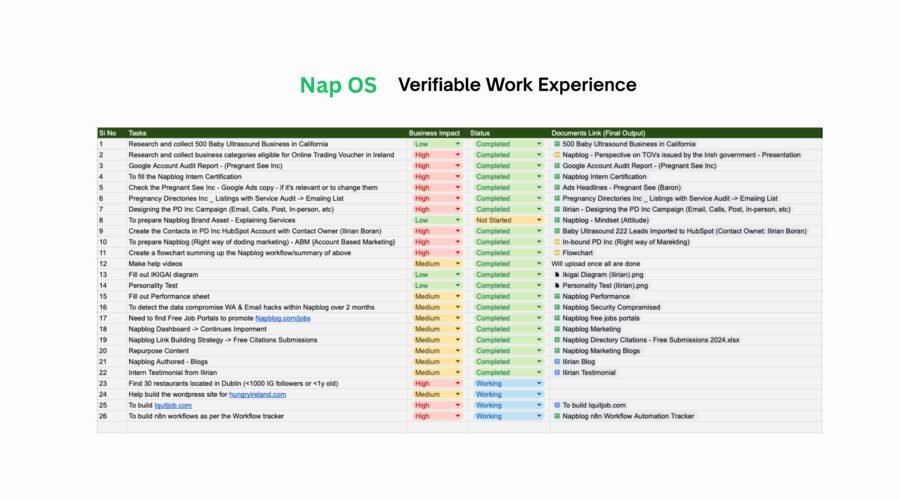
What distinguishes this from a typical internship or bootcamp is the structure wrapped around each task. Every item on the Nap OS workflow tracker carries a defined business objective, an assigned priority level reflecting its actual importance to the business, a live status (not started, in progress, or completed), and a linked deliverable — a document, spreadsheet, presentation, or live asset that shows the finished output. Looking at an actual Nap OS tracker, this pattern holds consistently: a Google Ads audit for a client is logged with its own report and presentation; a HubSpot contact-import project is tied to a specific contact owner and a specific set of imported leads; a campaign design task links directly to the campaign materials it produced. Nothing sits as a vague bullet point on a resume — everything traces back to a specific artifact that either exists or doesn’t.
Why that matters
The reason this is meaningfully different from a course completion is straightforward: it can be independently checked. Anyone reviewing a Nap OS record can ask what task was assigned, who completed it, when it happened, what the final output was, and whether it addressed a genuine business need — and get a concrete answer for each. That is a fundamentally different kind of evidence than a line reading “completed digital marketing course.” A course completion tells you someone sat through material. A Nap OS record tells you someone produced a specific, checkable piece of work under real conditions, with a real deadline and a real audience for the result.
This is also where Nap OS occupies a genuinely different space from the two systems people usually rely on to judge professional readiness. Traditional education is built to verify learning — did the person absorb the material well enough to pass an assessment. Traditional recruitment relies on employment history — did the person hold a job title for a period of time, information that is often thin, hard to verify quickly, and disconnected from what the person actually did day to day. Nap OS is aimed at a third thing entirely: verifying execution. Not what someone learned, and not what title they held, but what they actually built, audited, wrote, or delivered, with evidence attached.
Toward a structured evidence record
The strongest version of this idea goes a step further than a status tracker. Each completed project can be converted into a structured evidence record — a short, standardized summary that captures the organization involved, the duration of the work, the business problem being solved, the specific tasks completed, the deliverables produced, the skills demonstrated, who verified the work (a mentor, the business owner, and Nap OS itself), and the underlying evidence, whether that’s documents, screenshots, a final report, or measurable performance improvements. A single audit of a client’s advertising account, for instance, can be documented not just as “completed,” but as a discrete record showing the problem it addressed, the analysis performed, the recommendations delivered, and the skills — platform expertise, data analysis, client communication — it demonstrated along the way.
Done consistently across dozens of contributors and hundreds of tasks, this produces something considerably more useful than a single certificate or reference letter. It becomes a portfolio: a running, verifiable record of execution across market research, paid media, CRM operations, content, automation, and client-facing communication, each entry independently checkable against a real deliverable.
Being precise about what this evidence can do
It’s worth being direct about the limits of this, particularly for anyone considering how a Nap OS record might factor into a work permit application. This kind of evidence documents genuine, verifiable professional capability — real tasks, completed for real organizations, with real outputs attached. What it is not is a guarantee of any immigration outcome. Work permit and visa decisions are governed entirely by each country’s own immigration laws and eligibility rules, and no third-party record, however well-documented, can substitute for meeting those requirements or for qualified immigration legal advice.
The more accurate way to describe the value here is that a Nap OS record gives an applicant something concrete and specific to include alongside their application where it’s relevant and permitted — evidence of what they’ve actually done, rather than only a job title or a course name. Whether and how that evidence is weighed is up to the immigration authority reviewing the case, not to Nap OS. Framing it that way is both more honest and, frankly, more durable: it holds up under scrutiny in a way that a claim like “this will strengthen your application” simply doesn’t.
What this looks like at scale
The interesting question is what happens when this approach is standardized and run across a large number of contributors rather than a handful. If project assignment, deliverable tracking, mentor sign-off, skill mapping, business-owner feedback, and evidence storage are all handled consistently, the result isn’t a bigger version of an online course platform — it’s something closer to a professional execution record, built one verified project at a time. That’s a different value proposition than most training platforms offer, because it centers on demonstrated output rather than time spent studying. A recruiter, a client, or an applicant themselves can look at the record and see, task by task, what was actually delivered.
For contributors, this also changes what accumulates over time. Instead of a resume line reading “marketing intern, six months,” there’s a growing set of specific, dated, independently verifiable projects — an ads audit here, a CRM migration there, a set of directory citations built for local SEO, a workflow automation shipped in n8n — each with its own evidence trail. That’s a fundamentally different kind of professional record, and one that gets more valuable the longer it runs and the more consistently it’s documented.
Getting involved
For anyone interested in understanding what a structured, verifiable work record could look like for their own career — including where genuine professional evidence might be relevant to include in other applications, where appropriate — sharing your background and CV with Nap OS at palani@napblog.com is the starting point. It doesn’t promise any particular outcome, but it does offer a clear, honest way to start building a documented record of real work.