7 min read
The job market is broken. Not in a temporary, cyclical way — but in a structural way that no amount of degree inflation or CV polishing can fix. For years, students and early-career professionals have followed the same tired playbook: attend university, collect credentials, submit applications, and hope that somewhere along the way an employer will take a chance on them. The results have been underwhelming at best and devastating at worst. Enter Internship-as-a-Service (IaaS) — and more specifically, Nap OS, the platform quietly rewriting the rules of how talent meets opportunity.
The University-to-Cashflow Crisis Is Real
Ireland’s graduates — and graduates worldwide — are caught in a paradox. They complete degrees that cost significant time and money, only to discover that employers want experience before they’ll offer a role, yet no one will offer a role without experience first. This catch-22 has created what Napblog Limited describes as the “university-to-cashflow crisis”: a structural lag between academic output and practical economic contribution.
The statistics tell a sobering story. Graduate unemployment and underemployment have risen steadily across Europe, with Ireland seeing a growing proportion of degree-holders working in roles that don’t match their qualification level. Meanwhile, small and medium-sized enterprises (SMEs) — the backbone of the Irish economy — consistently cite talent acquisition and skills gaps as their top operational challenges. The gap between supply and demand isn’t a people problem; it’s a systems problem. And systems problems require systems solutions.
What Is Internship-as-a-Service?
Internship-as-a-Service is a model that strips out the bureaucracy, rigidity, and gatekeeping traditionally associated with internships and replaces them with flexible, project-based, execution-focused engagements. Rather than asking a student to spend six months making coffee and attending meetings they weren’t invited to contribute to, IaaS connects talent with real commercial work — structured as micro-projects with defined deliverables, timelines, and verifiable outcomes.
The shift this represents is profound. Traditional internships were credential-adjacent — a line on a CV that said you showed up somewhere for a period of time. IaaS internships are execution-based — evidence that you did something measurable, contributed to something real, and developed a capability that can be demonstrated to the next employer or client. In an era where AI-driven recruitment systems are increasingly filtering applications by portfolio evidence rather than academic prestige, this distinction matters enormously.
IaaS also solves a calendar problem. Academic internship programs are typically constrained by semester schedules, requiring students to take formal breaks from study or to compress meaningful work into eight-week windows. Internship-as-a-Service decouples the experience from the academic calendar entirely, allowing students to engage with real projects at their own pace, during evenings and weekends, across multiple concurrent engagements if they choose. The result is a dramatically more accessible and productive form of early-career development.
Nap OS: Execution Infrastructure as a Service
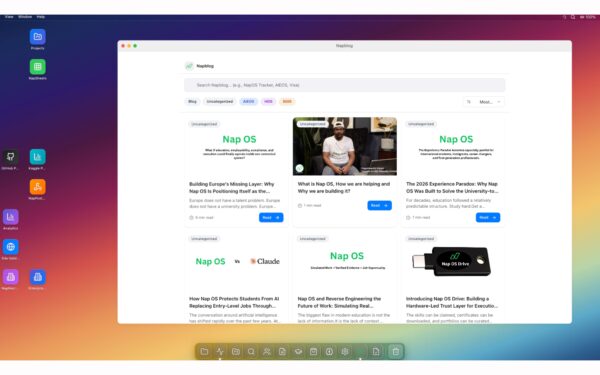
Nap OS, developed by Dublin-based Napblog Limited, doesn’t just list project opportunities — it delivers what the company calls Execution Infrastructure as a Service (EIaaS). This means the platform actively manages the work alongside the candidate, creating a structured environment where daily contributions are tracked, verified, and transformed into portfolio evidence that is meaningful to employers and clients alike.
Where traditional job boards ask candidates to present themselves — essentially putting the burden of proof entirely on the applicant — Nap OS creates the conditions for candidates to demonstrate themselves. The platform simulates real-world project environments, providing the scaffolding, tooling, and oversight that mirrors what a professional team would offer, without requiring the candidate to already be employed by one. This is a fundamentally different value proposition, and it explains why Nap OS has positioned itself not as a recruitment tool but as a talent delivery engine.
The direct connection to commercial Research and Development (R&D) projects for SMEs and startups is a key differentiator. Nap OS candidates aren’t working on artificial assignments designed to simulate business challenges — they are working on actual business challenges faced by actual companies. This creates a double benefit: the candidate builds verified, real-world portfolio evidence, while the SME gains access to motivated, capable talent on project-specific terms without the commitment and overhead of a full-time hire.
Why Nap OS Stands Tall Among Competitors
The workforce technology space is undeniably competitive. LinkedIn dominates professional networking and job discovery. Gig platforms like Fiverr and Upwork serve the freelance economy. Traditional graduate recruitment platforms operate in virtually every major market. So why does Nap OS stand out?
The answer lies in specificity and integration. LinkedIn is a network — it connects you to opportunities, but it doesn’t help you execute them or build verifiable evidence of capability. Gig platforms commoditise skill output, rewarding speed and low cost rather than deep development. Graduate recruitment platforms are largely credential-screening tools, prioritising institutional reputation over demonstrated ability. None of these serve the growing cohort of students and early-career professionals who need a bridge between education and employment — a structured environment where they can work on real things, get real feedback, and produce real evidence of what they can do.
Nap OS fills precisely this gap. Its AI-economy focus — explicitly designed to help students build practical capabilities rather than simply credential-hunt — is timed well with a broader market shift. As AI tools automate more routine cognitive tasks, the premium on demonstrable execution skills, creative problem-solving, and real-world project management is rising. Employers increasingly want to see what you’ve done, not just what institution granted you a certificate. Nap OS is building the infrastructure that makes this possible at scale.
The Future of Work Is Execution-Based
The broader trajectory here is clear. The hiring market is moving from credential-based selection to execution-based selection. AI-powered applicant tracking systems are becoming better at evaluating portfolio depth, project specificity, and measurable outcomes than they are at parsing the prestige of degree-granting institutions. Companies that used to require a specific university credential for entry-level roles are quietly dropping those requirements as they discover that demonstrated capability — wherever it was developed — is a better predictor of job performance.
This shift creates both a massive opportunity and a genuine urgency. Students who understand this transition and invest in building execution-based portfolios through platforms like Nap OS will be dramatically better positioned than peers who continue to rely solely on academic credentials. The window of competitive advantage for early adopters is real and it is closing as the model scales.
For SMEs and startups, the opportunity is equally significant. Access to motivated, capable early-career talent on flexible, project-specific terms — without the administrative burden, fixed costs, and long-term commitment of traditional hiring — represents a meaningful change in how small companies can approach growth-stage challenges. R&D capacity is no longer exclusively the domain of large corporations with graduate recruitment programmes and dedicated innovation labs. Nap OS makes it available to every ambitious small business in Ireland and beyond.
Dublin as a Hub for Talent Innovation
It is no coincidence that Nap OS was built in Dublin. Ireland’s capital sits at a unique intersection of world-class university output, a thriving startup ecosystem, and a significant concentration of global technology companies. The talent density is high, but the structural mismatch between graduate output and practical early-career opportunity has long been a friction point. Dublin graduates compete for a relatively small number of prestigious graduate schemes while a vast layer of SME and startup opportunity goes underserved.
Nap OS is addressing this specifically and deliberately. By creating a verified, execution-based bridge between Dublin’s student population and the commercial R&D needs of its startup and SME ecosystem, Napblog Limited is doing something genuinely novel: turning the talent surplus into a structured, deployable, portfolio-generating resource. That’s not just good for individual students or individual businesses — it’s good for the broader innovation economy of a city and country that has consistently punched above its weight on the global stage.
What This Means for You
Whether you are a student navigating the uncertain space between final year and your first professional role, a recent graduate frustrated by the experience paradox, or an SME founder looking for affordable access to skilled project talent, the Internship-as-a-Service model deserves serious attention. The traditional routes are not broken because the people using them are flawed — they are broken because the systems were built for a world that no longer exists.
Nap OS represents a concrete, operational answer to a structural problem that has frustrated students, employers, and policymakers for the better part of a decade. It doesn’t ask you to wait for the system to fix itself. It builds the infrastructure for you to move forward now — with real work, real evidence, and real momentum toward a career that doesn’t begin with hoping someone will take a chance on you, but with demonstrating, clearly and verifiably, that you are already worth that chance.
The future of work is execution-based. Nap OS is building the bridge. The question is whether you’re ready to cross it.