7 min read
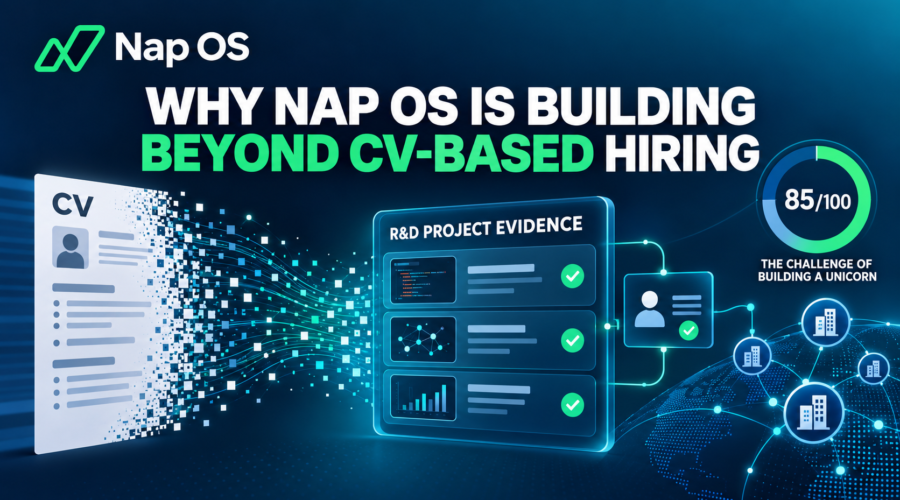
Nap OS is not trying to abolish the CV tomorrow. We are building the layer that a CV has always lacked: direct, reviewable evidence of how a person approaches a relevant problem, makes decisions, responds to feedback and finishes work. Our vision is to move hiring from CV-first judgement toward R&D project-based hiring, where a candidate can support career claims with a structured project record, human Project Manager review and evidence an employer can inspect. The ambition is substantial, and so is the difficulty. Our internal strategic assessment puts the challenge of operating this model and scaling it toward a billion-dollar company at 85 out of 100. The remaining 15 points represent an opening, not a statistical promise. They explain why the opportunity is still worth pursuing.
The CV Is Useful but Incomplete
A CV remains useful because it is compact, familiar and portable. Employers can quickly review education, roles and career history, while candidates can communicate a professional narrative in a standard format. The problem begins when the CV is treated as sufficient proof. It is normally self-reported, compressed and optimised for screening. It can say that someone knows SQL, customer research or product strategy without showing the decisions, revisions and outputs behind that claim. It can also disadvantage graduates, international candidates and career changers whose capability is stronger than their local employment history. Nap OS therefore sees the CV as an index into deeper evidence, not the final evidence itself.
The broader market is already moving toward skills-first hiring. LinkedIn’s own research argues that employers should look beyond pedigree and use skills more directly in matching talent to opportunity.[1] The European Commission’s Union of Skills similarly focuses on helping people build, update and move skills across Europe while making it easier for businesses to find talent.[2] Nap OS pushes that direction one step further. A listed skill should be connected to a task, an output, a review and an explanation of how the work was completed.
What R&D Project-Based Hiring Changes
R&D project-based hiring gives a candidate a relevant business problem before the hiring decision is complete. The candidate works from a brief, produces evidence, receives feedback and improves the result. An employer can then consider not only what the candidate says, but how the candidate frames ambiguity, uses tools, communicates trade-offs and responds to review. This does not require employers to replace every interview, background check or CV. It creates a stronger pre-hire signal that can sit beside them. For early-career talent, this matters because the project creates a legitimate way to demonstrate readiness without pretending that a simulation is employment.
The letters R&D describe the character of the brief: research, experimentation, analysis and development around a real organisational question. They do not automatically mean that every project qualifies for an Irish R&D tax credit. Revenue applies specific tests to qualifying activities and expenditure, and eligibility depends on the facts of the company and work.[3] Nap OS should never sell a project on the assumption that tax relief will fund it. The commercial value must come from better evidence, better learning and better talent decisions.
Why This Vision Matters More in the AI Era
Generative AI makes it easier to produce polished applications, portfolios and interview answers. That makes human judgement less optional, not more. Employers increasingly need to know what the candidate actually decided, what AI contributed, whether the work can be explained and whether the output survived review. Nap OS can record process, iterations and reviewer feedback rather than evaluating only the final presentation. Its strongest proposition is not that AI can score everyone automatically. It is that technology can organise evidence while accountable humans assess context, reasoning and quality.
That distinction is also important for trust and regulation. The European Commission classifies AI systems used in recruitment as high-risk under the AI Act, with requirements that include risk controls, suitable data, information for users and human oversight.[4] Ireland’s Data Protection Commission also explains that individuals have rights around automated decision-making and profiling under GDPR.[5] A transparent, human-in-the-loop model can become a competitive advantage, but only if Nap OS designs governance, consent, explainability and appeal into the product from the beginning.
Why the Difficulty Score Is 85 out of 100
The 85-point score is a strategic framework, not an actuarial forecast. It represents five barriers that must be solved together. A company can survive one of them and still fail because of another.
| Barrier | Points | Why it is difficult |
| Cold start across candidates and employers | 20 | Projects attract candidates, but employers want proven talent and candidates want credible projects. |
| Human review and delivery economics | 18 | Quality review creates trust, but reviewer time can constrain margin and speed. |
| Enterprise workflow and procurement | 17 | Employers already use ATS, HRIS, interviews, agencies and compliance processes. |
| Verification regulation and data trust | 15 | Evidence must be authentic, explainable, private where necessary and open to human challenge. |
| Capital internationalisation and focus | 15 | Global scale requires repeatable acquisition, localisation, integrations and disciplined capital use. |
The Cold Start and Human Review Problems
The marketplace problem is circular. Strong candidates want reputable briefs and visible outcomes. Employers want a reliable supply of candidates before investing time in briefs or integrations. Universities want evidence that the system improves outcomes before buying seats. Nap OS cannot solve this by launching an empty marketplace and waiting for network effects. It must operate as a managed system first: curate briefs, support candidates, verify outputs and create repeatable employer case studies. Only after density exists in selected domains should more of the marketplace be opened and automated.
Human Project Manager review is both the premium and the bottleneck. It justifies payment because a generic AI response cannot provide accountable professional judgement or a credible reference. Yet every hour of review creates delivery cost. Nap OS must standardise briefs, rubrics, evidence capture and escalation so one reviewer can support a larger cohort without reducing quality. The critical operating metrics are candidates per reviewer, review time per milestone, completion rate, subscription retention and gross margin. Without them, the company risks becoming an excellent but labour-intensive career service rather than a scalable technology platform.
What Creates the 15 Point Chance of Winning
The remaining 15 points are not a claim that Nap OS has a measured 15 percent probability of becoming a unicorn. Unicorn outcomes are too rare and dependent on financing, timing and execution for that precision. The score describes five strategic advantages worth three points each: a severe global problem, a shift toward skills-first hiring, a differentiated evidence and trust layer, founder-market fit built from lived experience, and an early ecosystem spanning students, project contributors, universities, employers and recruitment.
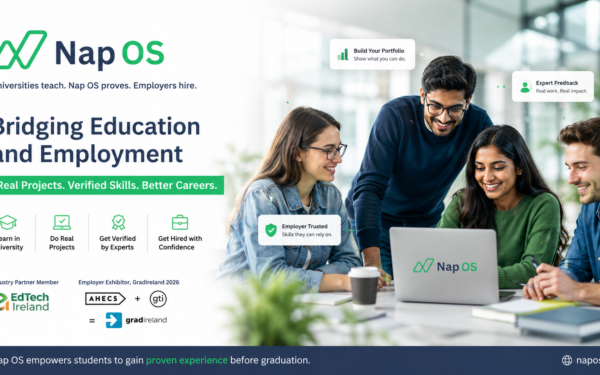
Nap OS has not reached those 15 points through an idea alone. It has been built through repeated collaboration. The company reports that more than 200 students and jobseekers have contributed to R&D work and that more than 50 candidates later moved into outside employment. These are internal operating figures, not an audited causal study, so the next stage is to connect each outcome to verified cohort data. Nap OS has also developed a free self-directed route and paid human-review model, gained an Irish employment-agency licence, joined the EdTech Ireland network and entered employer and university conversations. Its participation at the 2026 gradireland fair adds a concentrated channel for customer discovery and conversion. Each achievement reduces one piece of uncertainty, even though none proves unicorn potential on its own.
The product architecture can become defensible if it accumulates structured proof that competitors cannot quickly recreate: employer-authenticated briefs, assessment rubrics, timestamped work histories, human review records, AI-use disclosure, longitudinal skill development and evidence of what employers actually accept. Nap OS already describes portfolio evidence, process transparency, reviewer access and controlled sharing as product capabilities.[6] The moat will not be the number of features. It will be the quality, integrity and usefulness of the evidence network.
What Must Be Proven Next
The next phase should convert activity into investor-grade evidence. Candidate reach must become a measured funnel from conversation to registration, project start, paid review, completion and renewal. Employer interest must become written briefs, pilots, usage and revenue. International website traffic must become repeatable country-level acquisition and paid conversion. The monthly plan must show retention, while the one-time service must be reported separately so service revenue does not disguise software economics. Enterprise Ireland explicitly supports innovative startups with international growth potential, which makes deliberate export evidence more important than passive global traffic.[7]
Nap OS must also remain precise about what it sells. Candidates can use the system to build evidence themselves. Paid plans purchase structured human review, verification and career support; they do not purchase a job. Employment is not guaranteed. This distinction protects trust, aligns with the company’s regulated recruitment responsibilities and makes the value proposition clearer. Employers are not being asked to believe another profile. They are being invited to inspect how the profile was earned.
The Long Term Vision
A unicorn cannot be manufactured by declaring a large market. Nap OS would have to become infrastructure used repeatedly by candidates, employers, universities and workforce partners across countries. That requires recurring revenue, high retention, trustworthy outcomes, software margins and a system that integrates with existing hiring rather than demanding that employers abandon it overnight. The responsible ambition is therefore not to promise that CVs will disappear. It is to make unsupported claims less decisive by attaching them to evidence.
Our 85 out of 100 difficulty score is a warning against complacency. Our 15-point opening is a reason to continue. Nap OS can win if it proves that project evidence improves decisions, if human review can scale economically, if employers return, and if international growth is deliberate. The future of hiring will still contain CVs, interviews and judgement. Nap OS’s vision is to ensure that candidates also arrive with something stronger: work that can be examined, reasoning that can be questioned and evidence that can be verified. That is the shift from hiring a story to evaluating capability.