6 min read
A university degree tells an employer what a student studied. A transcript tells them how well they studied it. Neither tells the employer whether that student can actually contribute to a real team, on a real deadline, with real stakes. Closing that gap — between classroom learning and workplace readiness — is one of the defining problems in education-to-employment right now, and two platforms, Nap OS and Riipen, have both built serious answers to it. They start from different places and serve different primary audiences, but they are ultimately pointed at the same destination: a world where young people graduate with proof, not just paper.
Riipen: Proof Through Institutional Partnership
Riipen’s model is built around the classroom. It connects colleges, universities, and workforce development providers with businesses and non-profits that have real projects needing real work. A professor embeds an employer-designed project directly into a course; students complete it as coursework; the employer gets a deliverable and the student gets a credited, resume-ready experience with an organization outside their school. Riipen reports serving hundreds of thousands of learners across hundreds of institutional partners, with millions of hours of applied learning delivered through this model.
The elegance of this approach is structural. Because the project lives inside a course, participation doesn’t depend on a student’s individual hustle to find an internship, cold-email a founder, or navigate an unfamiliar hiring process alone — the opportunity is already built into their degree. That matters enormously for equity. A first-generation student or someone juggling a part-time job doesn’t need spare time or a professional network to get real-world exposure; the experiential learning is scheduled, supervised, and assessed like any other class.
Riipen’s primary buyer reflects this design: it sells to educational institutions and workforce programs first, with businesses as project partners, rather than selling directly to individual learners. The product’s core value is access at scale — making experiential learning a default part of post-secondary education rather than a privilege reserved for students who already have the time, confidence, or connections to seek it out on their own.
Nap OS: Proof Through Individual Momentum
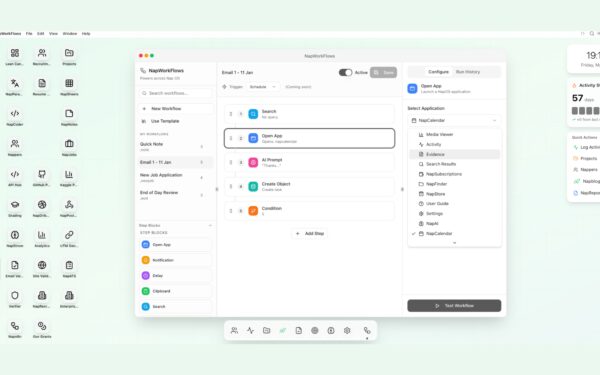
Nap OS starts from an almost opposite vantage point. Rather than embedding experience into a curriculum an institution controls, it puts the tools directly into an individual’s hands, regardless of whether their school offers anything like Riipen at all. Log into Nap OS and you don’t see a course catalogue — you see a personal operating system: a portfolio being built in real time, a work-experience pipeline, a project manager, a gap analysis engine scoring technical skill, industry exposure, problem-solving, and consistency, and an AI coach nudging the user toward their next concrete task. Nothing is scored until the user has actually shipped something — a certificate earned, a project completed, hours logged against a real domain of work.
That structure makes Nap OS’s core proposition self-directed proof. A learner doesn’t wait for their university to strike a partnership with the right employer; they open the platform, pick up real work, and start compounding evidence — a shipped outcome here, a manager’s reference there, a portfolio page that shows rather than tells. The primary buyer today is the individual learner or job seeker, not the institution, which means the product has to earn engagement day by day rather than being handed a captive classroom of students. Its bet is that motivated people, given the right tools and structure, will build their own track record faster and more flexibly than any single course could provide — and that this track record, compounding over months, becomes a career rather than a transcript line.
Why Both Are Right for Their Audience
It’s tempting to frame this as competition for the same market, but the more useful framing is that these are two different entry points into experiential learning, built for two different circumstances a learner might be in.
Picture a second-year student enrolled at one of Riipen’s 760-plus partner institutions. Their professor has embedded a live client project into the semester’s coursework. They don’t have to search for the opportunity, negotiate access, or wonder if it’s legitimate — it’s already part of their degree, supervised by faculty, and assessed alongside their other coursework. By the end of term, they’ve worked with a real organization on a real brief, with the safety net of academic structure around them the whole time.
Now picture a recent graduate whose university never offered anything like that — or someone years out of school, changing careers, with no institutional relationship to lean on at all. Riipen’s model, built around institutional partnerships, isn’t something they can simply opt into on their own. Nap OS meets them exactly here: no professor required, no course enrollment, no waiting for a partnership to exist. They open the platform, pick up real project work, and start building a portfolio and reference base from wherever they’re standing, on their own timeline.
Both outcomes are genuinely valuable, and both solve real access problems — Riipen for the student whose opportunity should come standard with their education, Nap OS for the learner who needs a path that doesn’t depend on their school having built one.
The One Point of Overlap
Where the two platforms do converge is in the underlying conviction that experience earned by doing real work for real organizations is worth more than experience described in a classroom. Riipen delivers that conviction through structured, faculty-supervised projects embedded in a curriculum. Nap OS delivers it through a self-serve system of real work, portfolio-building, and AI-guided progression that an individual drives themselves.
Reasonable people could disagree about which route produces stronger outcomes, and the honest answer is that it likely depends on what the learner already has access to. A student at a well-resourced institution with strong employer partnerships may get more out of Riipen’s built-in structure. A learner without that institutional backing — or one who has already graduated — may find Nap OS’s self-directed model the only realistic path to the same kind of proof.
A Complementary Future
The more interesting possibility is that these models don’t have to remain separate. An institution using Riipen to embed real projects into its courses could just as easily encourage students to use a system like Nap OS to keep building after the semester ends — turning a single course project into a continuously growing portfolio, gap analysis, and work history that persists well beyond graduation. Riipen supplies the structured, credentialed entry point; Nap OS supplies the ongoing, self-directed momentum that keeps compounding after the course is over. Neither approach makes the other redundant. One is strongest at guaranteeing access within an institution; the other is strongest at sustaining momentum for the individual, whether or not an institution is involved at all.
The Core Difference, in a Sentence
If there’s one distinction worth holding onto, it’s this: Riipen embeds, Nap OS empowers. Riipen’s message to a student is “your degree already includes this,” which is a powerful promise for anyone lucky enough to attend a partner institution. Nap OS’s message is “you don’t need to wait for anyone to give you this,” which speaks directly to everyone else — the learner without the right university, the graduate who’s already left campus, the career-changer starting from scratch.
Conclusion
Neither platform needs to win at the other’s expense. Riipen has built a genuinely strong model for scaling experiential learning through institutions, giving hundreds of thousands of students structured, faculty-supported access to real industry work as a standard part of their education.
Nap OS has built an equally strong model for individuals who need to generate that same kind of proof on their own terms, without depending on their school to make it happen. They occupy adjacent layers of the same problem — closing the gap between education and employment — and the strongest outcome for learners may well be a future where a Riipen-embedded project becomes the first entry in a Nap OS portfolio that keeps growing long after graduation.