6 min read
Graduating is easy compared to what comes after. The transition from lecture halls to a functioning career is where most young professionals and international job seekers hit their first real wall — not because they lack ability, but because nobody taught them how to translate a degree into an employer’s language. Two platforms, QBay Career and Nap OS, have each built a response to that wall, approaching it from different angles: one through guided, human-delivered career services, the other through a self-directed system for generating verifiable work experience. Looking at both side by side is useful less as a comparison of which is “better” and more as a map of the different kinds of support a job seeker might need at different points in their journey.
QBay Career: Guided Transition Through Structured Coaching
QBay Career positions itself as a campus-to-corporate finishing programme built around close, human-led guidance rather than self-serve tools. Founded in London in 2021, the company describes operations across more than two dozen countries and a community it puts at over 110,000 students, with a stated focus on helping graduates, career-changers, and internationally mobile professionals become “job ready” for a specific target market.
Its flagship offering, the 90-Day Career Finishing Programme, is built around the idea that many capable candidates are held back not by a skills gap but by a presentation gap — an unpolished CV, a LinkedIn profile that doesn’t read well to recruiters or applicant tracking systems, interview habits that don’t match the expectations of the country they’re applying in, or simply not knowing how the local job market works.
Around that core programme, QBay lists a wide menu of services: personalised career strategy calls, mock interviews framed around real employer scenarios, ATS-optimised CVs and cover letters, LinkedIn profile builds, statement-of-purpose guidance, and — for candidates targeting the UK healthcare sector specifically — dedicated support with NHS and HSC applications.
The company also states that its team handles job application submissions on a candidate’s behalf, positioning this as a way to free up the candidate’s time to focus on interview preparation and networking rather than the mechanical work of applying. QBay describes itself as UK government accredited and points to a Trustpilot rating as evidence of candidate satisfaction. Its primary buyer is the individual job seeker, often someone navigating an unfamiliar national job market — international students, immigrants, or career-changers — who is paying for structured, hands-on human support rather than a self-service platform.
Nap OS: Self-Directed Proof Through Real Work
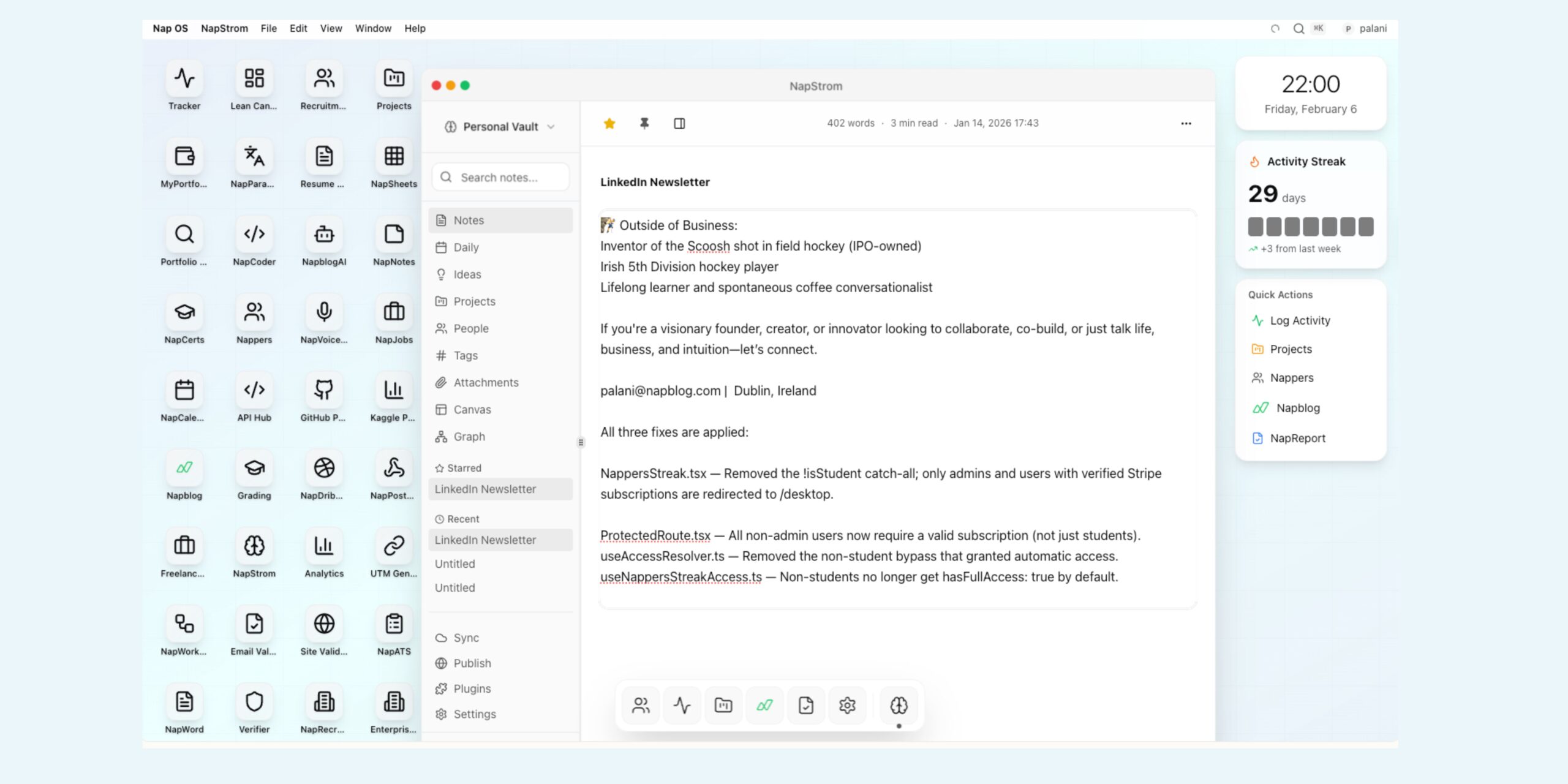
Nap OS starts from a different premise. Rather than a coached, service-delivered programme, it’s a system the user drives themselves: a portfolio that builds automatically as work is completed, a work-experience pipeline connecting learners to real projects, a project manager, an AI coach nudging the next best action, and a gap analysis engine that scores technical skill, industry exposure, problem-solving, consistency, and communication based on actual logged activity rather than self-reported claims. Nothing on the dashboard moves until the user has shipped something concrete — a completed project, a logged work experience, a certificate earned.
Where QBay’s value proposition centers on presentation and access — polishing the candidate’s materials and, in some cases, executing the application process on their behalf — Nap OS’s value proposition centers on substance-building: giving a candidate something real to put in that polished CV in the first place. A beautifully written cover letter is only as strong as the experience it describes, and Nap OS’s core bet is that verified projects, real internships, and a growing portfolio give a candidate durable material to draw on across every application they ever submit, rather than a single finishing programme tied to one job search cycle.
Why Both Serve a Real Need
It’s worth resisting the urge to treat this as one platform being the “right” choice and the other redundant, because they’re addressing different parts of the same problem. Picture a graduate who already has strong project experience, a solid portfolio, and clear technical ability, but has never applied for a job outside their home country and doesn’t know how UK recruiters read a CV, what an ATS filters for, or how interview norms differ from what they’re used to. QBay’s stated model — coaching, localisation, application support — speaks directly to that presentation and market-navigation gap.
Now picture a different candidate: someone with a degree but genuinely thin work history, no completed projects, and nothing yet to put in a CV regardless of how well it’s formatted. For that person, coaching on presentation alone won’t manufacture experience that doesn’t exist yet. Nap OS’s model — real work, real projects, a growing portfolio — is built for exactly that earlier-stage problem: generating the substance a CV needs before it can be polished.
Most job seekers, in reality, sit somewhere between these two needs at different points in their search. Recognising that both problems are real, and that they call for different kinds of support, is more useful than assuming one platform should replace the other.
Where the Two Naturally Meet
The overlap between QBay and Nap OS sits in the “readiness” concept both companies use to describe their offering. QBay talks about turning candidates into “job-ready professionals” through coaching and presentation; Nap OS talks about “career readiness” as a score generated from real completed work. Both are effectively trying to answer the same employer-facing question — is this candidate prepared to perform in a role — but from opposite ends of the funnel. QBay works on how a candidate is presented and how their applications are executed. Nap OS works on what a candidate actually has to present. Neither addresses the other’s core focus by itself, which is precisely what makes the two potentially additive rather than redundant.
A Complementary Future
The clearest version of that complementarity would be a candidate who arrives at QBay’s coaching programme already carrying a Nap OS portfolio: verified projects, logged work experience, a gap analysis showing exactly which skills are strong and which are still developing, and references from real project work. Instead of QBay’s coaches starting from a blank CV and a vague list of the candidate’s claimed skills, they’d be working from a documented body of real output — making the CV-building, interview-prep, and application-strategy work QBay describes considerably more concrete. Nap OS supplies the raw material; QBay’s stated coaching model is about shaping and positioning that material for a specific market and employer set. One platform’s described strength is upstream of the other’s.
The Core Difference, in a Sentence
If there’s a single line to hold onto: QBay Career, by its own description, coaches candidates on how to present and pursue opportunities within a specific market; Nap OS gives candidates something real to present in the first place. QBay’s pitch is built around guided navigation — knowing where to apply, how to be read favourably by recruiters and ATS systems, and how to interview well in an unfamiliar market. Nap OS’s pitch is built around self-directed substance — accumulating verified experience that exists independently of any single job search or country.
Conclusion
Both platforms are responding to the same underlying reality: a degree alone rarely prepares someone for the practical mechanics of landing a job, whether that gap is about market navigation, application execution, interview readiness, or simply not yet having real work experience to point to. QBay Career has built its offering around structured, human-delivered coaching and market-specific guidance for candidates moving into a new country or industry.
Nap OS has built its offering around a self-directed system for generating and verifying the real work experience that any coaching or application strategy ultimately depends on. Approached this way, the two aren’t competing for the same slice of a candidate’s needs — they sit at different stages of the same journey, and a candidate equipped with both a documented portfolio of real work and market-specific coaching on how to present it is better positioned than one relying on either alone.