6 min read
Somewhere between finishing school and building a career, something in the system quietly stopped working. Millions of capable people graduate into a hiring market that can’t see their potential, employers spend months and small fortunes trying to find talent they can trust, universities are judged on outcomes they have little power to influence, and governments pour money into skills programmes that never quite close the gap. None of this is a coincidence. It’s the predictable result of a system that was designed for a slower, simpler world and never rebuilt for this one, where education, employment and entrepreneurship still operate as three disconnected industries instead of one continuous journey.
A System Built for a World That No Longer Exists
For decades, the pathway from education to employment to entrepreneurship has run on the same basic assumptions: a degree signals readiness, a CV signals capability, and a job title signals experience. Those assumptions are breaking down in real time. Education rarely maps cleanly to job readiness anymore, so graduates leave university without a clear sense of what employers actually need from them. Hiring remains stubbornly CV-based rather than capability-based, which means the people making hiring decisions are often working from the least reliable signal available to them. Real work experience, the single most valuable currency in any career, stays locked behind a paradox that punishes early-stage talent for not yet having it. And entrepreneurship, for all the energy poured into it, is still supported through unstructured, inconsistent programmes that rarely follow a founder from idea to traction. Four different failure points, one connected system.
Four Groups, One Shared Frustration
Pull back far enough and it becomes clear this isn’t just an individual’s problem. It’s a structural inefficiency that touches everyone with a stake in how talent moves through the economy. Individuals are asked to compete in a labour market without the real-world experience that market demands, guided by career advice that is often generic and disconnected from actual industry need, and measured by a CV format that was never built to capture what they can truly do. Employers, meanwhile, are drowning in applications but starving for signal. Recruitment has become expensive and slow precisely because screening tools filter for keywords and credentials rather than demonstrated skill, leaving hiring managers with poor visibility into who can actually perform.
Universities sit under mounting pressure to prove graduate outcomes while operating employability systems that were designed for a different labour market, with limited integration into the employers who will eventually hire their students and few tools to personalise career support at scale. Governments face perhaps the widest version of the same problem: persistent youth unemployment, a growing mismatch between the skills being taught and the skills being demanded, and workforce budgets that are difficult to deploy effectively because the underlying infrastructure for skills policy simply isn’t built for continuous, data-driven execution. Four stakeholders, four symptoms, one root cause.
From CV-Based Hiring to Verified Capability
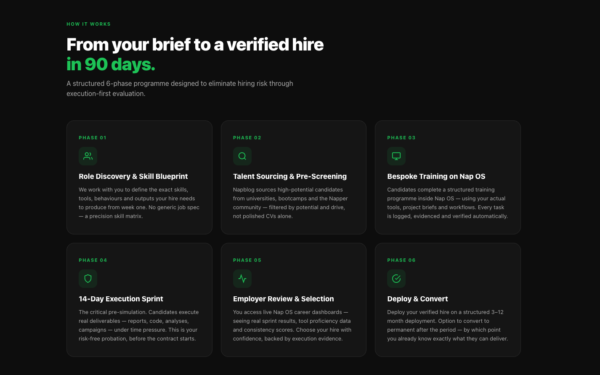
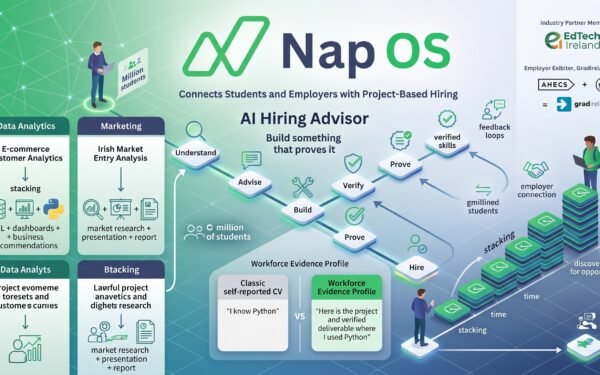
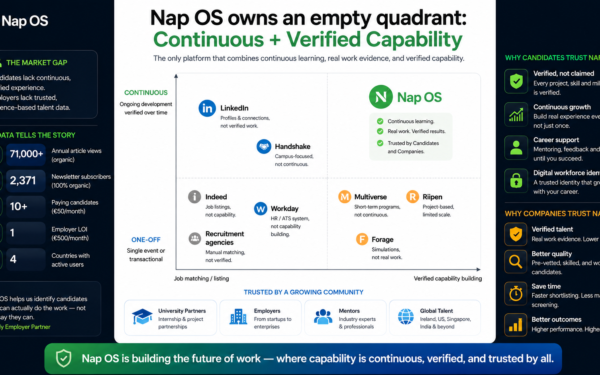
This is the core insight behind Nap OS: the old model of static, one-off education, fragmented career tools and CV-based hiring cannot be patched, it has to be replaced with something continuous. Instead of a single credential earned once and relied upon for decades, capability needs to be developed, verified and updated constantly. Instead of a document that lists where someone has been, hiring needs a profile that shows what someone can actually do, backed by real evidence rather than self-reported claims. And instead of treating career development, employment and entrepreneurship as three separate journeys handled by three separate industries, they need to function as one continuous pathway that a person can move through and return to at any stage of their working life.
Nap OS: One Infrastructure, Three Systems
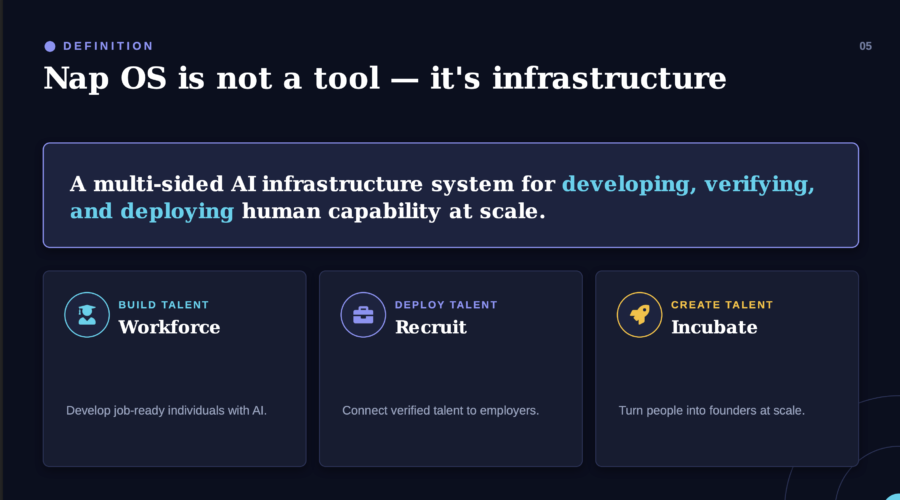
Nap OS is built on that idea. It isn’t a single app or a single product, it’s positioned as infrastructure: a multi-sided, AI-native system for developing, verifying and deploying human capability at scale. Underneath that infrastructure sit three connected systems, each addressing a different side of the same broken pipeline, and each designed to feed data and outcomes back into the others rather than operating in isolation.
Workforce is the supply side of the system, built to develop job-ready individuals through AI-driven career profiling, skills-gap analysis, personalised learning paths, AI-generated work experience and a structured digital identity that replaces a static CV. Its purpose is straightforward but ambitious: turn a degree holder into a verified capability profile, something an employer can actually trust. Recruit is the demand side, giving employers, recruiters, HR teams and universities access to that verified talent through AI-driven matching, skills-based search and a candidate verification layer, replacing keyword-based CV filtering with genuine capability-based hiring and, in the process, cutting the cost and noise out of recruitment.
Incubate is the creation side of the system, aimed at turning talent into founders through an AI startup coach, an idea validation engine, a business model builder, an MVP roadmap generator and a funding-readiness system. Where entrepreneurship support has historically been unstructured and inconsistent, Incubate gives aspiring founders, students, accelerators and universities a structured venture-creation pipeline instead of an ad hoc collection of mentorship and events. Together, Workforce, Recruit and Incubate aren’t three separate products bolted together, they’re three expressions of a single operating system for careers and ventures.
A Closed Loop That Compounds
What makes this more than a set of tools is the loop it creates. Individuals develop skills through Workforce, get hired through Recruit, build ventures or gain deeper experience through Incubate, and then re-enter the ecosystem at a higher level, feeding fresh data and outcomes back into the system that supports the next generation of talent behind them. Every cycle compounds: more verified skills, more real outcomes, more signal for employers, more evidence for universities, and more usable data for governments trying to design effective skills policy. It’s the same underlying idea that makes any good piece of infrastructure valuable, the system gets stronger and more useful the more it’s used, rather than simply being consumed and discarded.
Why This Matters Now
Nap OS sits at the intersection of five markets that are already converging on their own: HRTech, EdTech, workforce development, recruitment technology and entrepreneurship platforms are all being pulled, independently, toward AI-driven talent infrastructure. That convergence is exactly why a fragmented, patchwork approach to fixing employability no longer makes sense, because the tools being built to fix hiring, education and entrepreneurship are increasingly the same underlying AI systems. Early signals already point to real demand: paying Workforce users on a monthly subscription, active conversations with technology companies interested in verified, capability-first talent, and early partnership discussions with education and workforce organisations. None of this replaces the scale still to be built, but it validates the core premise: people, employers, universities and governments are all working around the same broken system, and they’re ready for something that actually connects the dots.
That validation is also shaping how Nap OS plans to scale. The go-to-market path moves in four phases, starting with individual adoption of the Workforce product through content-driven acquisition and organic growth, before expanding into institutional pilots with universities, small employers and workforce agencies. From there, the Recruit platform scales into a broader employer network, creating the marketplace effects that make capability-based hiring genuinely useful at volume, before the final phase extends into government programmes and larger institutional contracts, including international expansion. It’s a deliberately sequenced build: prove value with individuals first, then institutions, then the wider ecosystem.
The Bottom Line
The old pathway of education leading to employment leading, occasionally, to entrepreneurship was never really one pathway at all, it was three disconnected systems held together by outdated assumptions about degrees, CVs and career ladders. Each broken link forced individuals, employers, universities and governments to build workarounds instead of solutions. Nap OS is a bet that those three systems can be rebuilt as one continuous, AI-native infrastructure layer, one that develops real capability, verifies it, and deploys it, again and again, for everyone who has a stake in getting talent right. Fixing the system doesn’t mean patching the CV, it means replacing the infrastructure underneath it.