6 min read
For decades, the journey from education to employment to entrepreneurship has been treated as three separate problems, solved by three separate industries. EdTech companies focus on learning. Recruitment platforms focus on matching candidates to jobs. Startup accelerators focus on turning ideas into ventures. Each sector has optimized its own slice of the pipeline, yet the overall system remains fragmented, inefficient, and disconnected from the way people actually build careers.
Nap OS, built by Napblog Limited, starts from a different premise: that identity, learning, hiring, and venture creation are not separate stages at all, but a single continuous loop that should be powered by one connected operating system. That reframing is what allows Nap OS to claim a business category of its own, rather than competing inside any existing one.
The Fragmentation Problem
The traditional path from classroom to career is full of broken handoffs. Education rarely maps cleanly to job readiness, leaving graduates with credentials that employers struggle to interpret. Hiring itself remains largely CV-based rather than capability-based, forcing recruiters to guess at real-world skill from a document that was never designed to prove it. Meaningful work experience is often inaccessible to early-stage talent, who need that experience most but have the least means of acquiring it. And entrepreneurship support, where it exists at all, tends to be unstructured and inconsistent, available mainly to those who already have access to networks, mentors, or capital.
These failures don’t just hurt individuals. Employers absorb high recruitment costs and struggle with low signal in a sea of similar-looking resumes. Universities face growing pressure over graduate outcomes while lacking the tools to personalize career preparation at scale. Governments contend with youth unemployment and skills mismatches that resist top-down policy fixes. Each of these stakeholders is trying to solve a piece of the same underlying problem using disconnected tools, which means the inefficiency simply gets pushed from one part of the system to another instead of being resolved.
The Core Insight: From CV-Based Hiring to Continuous Capability
Nap OS is built on a simple but consequential insight: the old model of static, one-off education followed by CV-based hiring and fragmented career tools is being replaced by something fundamentally different. In the new model, skill development is AI-personalised rather than generic, professional profiles are verified and experience-based rather than self-reported, employability is treated as a continuous system rather than a series of disconnected events, and there is a genuine pathway that integrates the journey from workforce participant to founder. This shift from static credentials to continuous, verified capability is what separates Nap OS from a typical EdTech or HRTech product. It isn’t digitizing one step of the old process; it’s replacing the underlying logic of the process itself.
Not a Tool, an Operating System
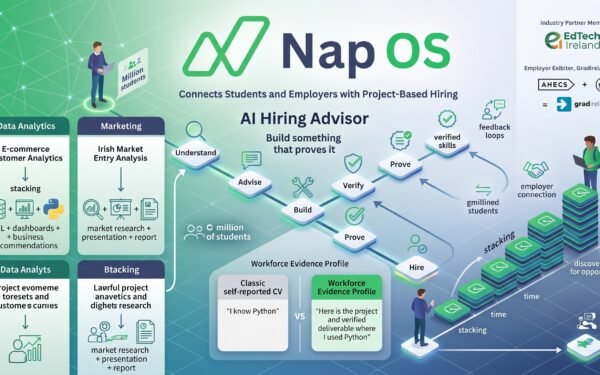
The language Nap OS uses to describe itself is deliberate. It positions itself not as a tool but as an operating system, a multi-sided AI infrastructure layer for developing, verifying, and deploying human capability at scale. That framing matters because tools solve isolated tasks, while operating systems coordinate many functions under one continuous architecture. Nap OS organizes its offering around three core functions that map to the build, deploy, and create stages of a person’s professional life: building talent through its Workforce product, deploying talent through its Recruit product, and creating talent through its Incubate product. Each of these operates as its own system, but all three are woven into a single connected architecture rather than existing as standalone apps.
Workforce: Building Job-Ready Individuals
The Workforce product targets students, graduates, job seekers, and career switchers, with the goal of developing job-ready individuals through AI. Rather than producing another certificate or diploma, its output is a verified, job-ready digital identity. It accomplishes this through AI career profiling, skills gap analysis, personalised learning paths, AI-generated work experience, a portfolio builder, interview simulation, and a broader career intelligence engine. The effect is a transformation in how capability is represented: instead of a “degree holder” whose actual abilities are unknown to an employer, the individual becomes a “verified capability profile” whose skills, projects, and progress are documented and trackable over time.
Recruit: Hiring on Capability, Not CVs
The Recruit product flips the traditional hiring funnel by giving employers, recruiters, HR teams, universities, and talent agencies direct access to verified talent instead of a pile of resumes. Its output is faster hiring with a higher signal-to-noise ratio, achieved through AI talent matching, skills-based search, portfolio-first hiring, a candidate verification layer, talent pipelines, and an employer dashboard. In effect, Recruit replaces CV filtering with capability-based hiring, closing the gap between what a candidate claims and what they can actually demonstrate.
Incubate: Entrepreneurship at Scale
The third pillar, Incubate, is where Nap OS pushes beyond what most career platforms attempt. Rather than stopping at employment, it is designed to enable entrepreneurship at scale for aspiring founders, students, accelerators, universities, and innovation hubs. Its output is a structured venture-creation pipeline supported by an AI startup coach, an idea validation engine, a business model builder, an MVP roadmap generator, a funding readiness system, mentor matching, and a venture tracking dashboard with founder progress signals. This turns learners and employees into founders, closing the loop between capability development and value creation.
The Closed-Loop System Logic
What makes this architecture more than the sum of its parts is the way the three systems feed into each other. In the Nap OS model, individuals develop skills through Workforce, get hired through Recruit, and then build startups or gain further experience through Incubate, before re-entering the ecosystem at a higher level. Each cycle through this loop compounds: more skills, more outcomes, and more data feed back into the system, continually strengthening the next generation of talent moving through it. This is fundamentally different from a linear pipeline where a person exits the system once they get a job or launch a venture. Instead, every outcome becomes new input, and the platform itself becomes more valuable to every participant with each cycle completed.
A Genuinely Multi-Sided Platform
Because the system spans identity, learning, hiring, and venture creation, it naturally serves five distinct stakeholder groups on one platform: individuals seeking career development and entrepreneurship support, employers seeking talent acquisition and skills intelligence, universities seeking better graduate outcomes and employer engagement, governments seeking workforce development and skills policy execution, and ecosystem partners such as accelerators, training providers, and recruitment firms. Few platforms manage to be genuinely useful to all five groups simultaneously, since most tools are built for one side of the market. Nap OS’s architecture is what allows it to serve all of them from a single connected data layer.
Why This Adds Up to a New Category
Individually, AI career coaching, skills-based hiring, and startup incubation each already exist as categories. What doesn’t exist elsewhere is a single continuous system where a verified digital identity built during learning becomes the same identity used for hiring, and the same identity that carries forward into venture creation, with data and outcomes flowing between all three stages rather than resetting at each transition.
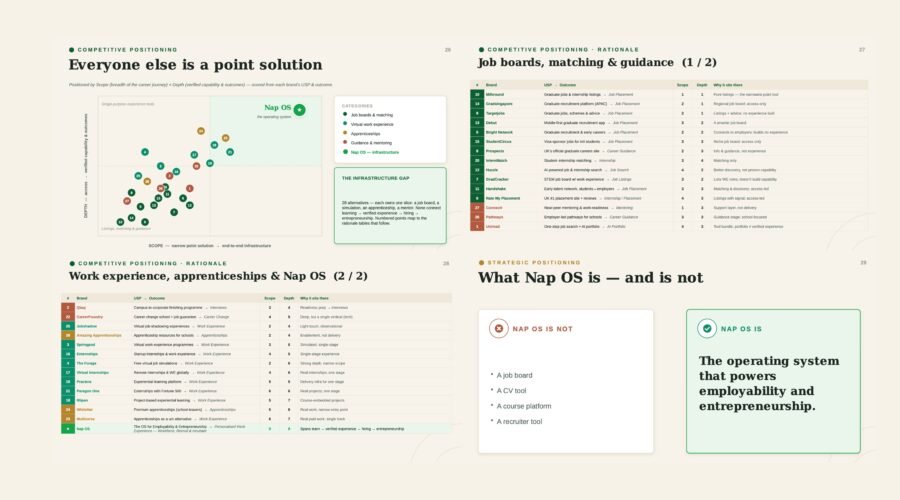
That continuity, reinforced by a closed feedback loop and a genuinely multi-sided stakeholder model, is what allows Nap OS to describe itself as infrastructure rather than a point solution. Nap OS’s early traction, including paying Workforce subscribers, active B2B conversations with technology companies, and a growing organic content and audience engine, suggests real-world demand for this connected approach. Whether that demand scales into a defensible category leader will depend on execution, but the underlying thesis, that identity, learning, hiring, and venture creation belong in one system rather than three, addresses a structural gap that fragmented tools have never fully closed.