8 min read
Ireland has built something extraordinary. The next question is who will build its future.
Ireland has spent decades establishing itself as one of the world’s most important locations for biopharmaceutical manufacturing, life sciences and advanced healthcare production.
But there is a question that deserves much more attention:
What happens over the next 20 years?
The next generation of biomanufacturing will not simply be an extension of today’s industry.
It will increasingly involve advanced biologics, cell and gene therapies, continuous manufacturing, process intensification, automation, artificial intelligence, digital twins, advanced analytics, synthetic biology, quality-by-design, computational biology and increasingly sophisticated research-to-manufacturing workflows.
The technology is changing.
The facilities are changing.
The research is changing.
The workforce must change with them.
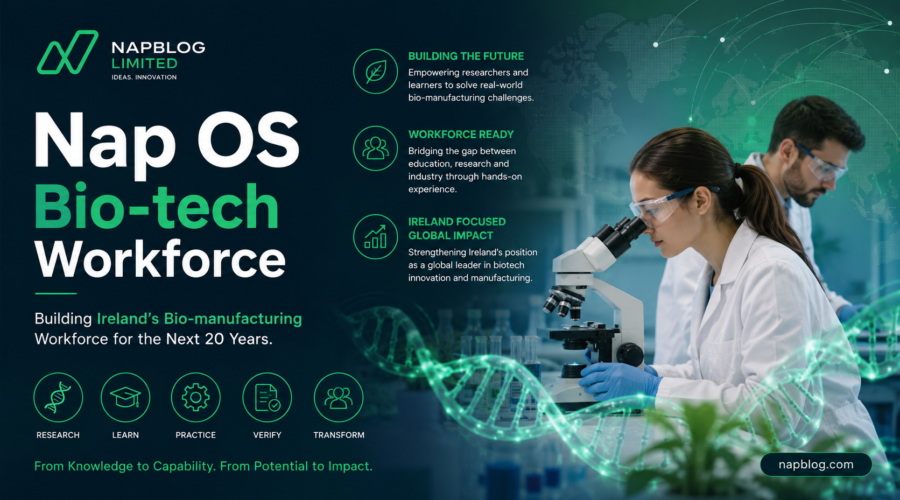
This is why we are starting BioTeach by Nap OS R&D.
Our ambition is straightforward:
To help build the research, skills, project experience and workforce infrastructure required for Ireland to remain a global biomanufacturing leader for the next 20 years.
BioTeach begins with a simple observation.
Ireland does not only need more people with qualifications.
Ireland needs more people who can demonstrate that they can apply those qualifications to real problems.
The problem starts long before someone enters a biomanufacturing facility
A young researcher can spend years studying biotechnology.
They can complete a bachelor’s degree.
Then a master’s.
Perhaps a PhD.
They can publish papers.
Attend conferences.
Complete laboratory modules.
Build theoretical knowledge.
And yet, when they approach industry, they can still encounter a familiar question:
“What practical experience do you have?”
This is not unique to biotechnology.
It is the same experience paradox that led us to build Nap OS.
People are asked to demonstrate experience before they have been given enough opportunities to acquire it.
In biotechnology, however, the problem can become even more complex.
The industry is highly specialised.
A researcher may understand molecular biology but have limited exposure to bioprocessing.
Someone may understand fermentation but have little experience with downstream processing.
Someone may understand cell culture but have never worked with manufacturing documentation, validation, quality systems or regulatory requirements.
Someone may be excellent academically but have never experienced the constraints of commercial production.
The gap between knowing and doing can therefore become enormous.
BioTeach is being created to work on that gap.
Why BioTeach is part of Nap OS R&D
Nap OS began with a workforce-transition problem:
How can people build credible evidence of capability before they have a conventional employment history?
We have been developing that idea through real projects, internships, university collaborations and workforce programmes.
Over time, we realised that the same infrastructure could be applied much more deeply to specialised industries.
Biotechnology is one of those industries.
BioTeach therefore is not intended to be simply another educational content platform.
It is an R&D and workforce-development initiative within the Nap OS ecosystem.
The objective is to connect:
Research → Learning → Projects → Collaboration → Evidence → Industry
That sequence matters.
We don’t believe that watching another lecture is enough.
We don’t believe that collecting another certificate is enough.
And we don’t believe that a CV containing dozens of keywords necessarily demonstrates industrial capability.
People learn deeply when they have to apply knowledge to something real.
That is the principle we want BioTeach to explore.
The next 20 years will require a different workforce
Biomanufacturing is becoming increasingly multidisciplinary.
The scientist of the future may need to understand more than a single discipline.
They may need to collaborate with engineers, data scientists, automation specialists, quality professionals, regulatory experts and manufacturing teams.
A bioprocess engineer may increasingly interact with machine-learning systems.
A laboratory scientist may work with increasingly automated platforms.
A manufacturing team may rely on real-time process analytics.
A quality professional may need to understand increasingly complex digital systems.
A researcher may need to communicate across disciplines that traditionally operated separately.
This creates an opportunity.
Instead of thinking about biotechnology education as a linear pathway from degree → job, we should start thinking about it as an ecosystem.
Research → experimentation → project → evidence → collaboration → industry → continuous learning.
BioTeach is designed around this ecosystem mindset.
We want to learn from researchers, not just teach them
The name BioTeach might initially sound like a traditional education initiative.
That is deliberately incomplete.
Our intention is not to build a platform where one side teaches and another side passively consumes information.
We want researchers, scientists, engineers, academics, students, industry professionals and founders to contribute to the ecosystem.
A researcher might explain an emerging technology.
An engineer might describe a manufacturing challenge.
An academic might discuss a new research direction.
An industry professional might explain what actually happens inside a commercial production environment.
A student might turn that knowledge into a project.
Another researcher might challenge the assumptions.
A company might eventually identify talent through the evidence created.
That creates a much richer learning model.
Teach. Research. Build. Validate. Share. Repeat.
The missing layer between education and industry
Universities are exceptionally good at creating knowledge.
Industry is exceptionally good at deploying knowledge at scale.
But there is a transition layer between them.
That transition layer is where many people struggle.
A student can learn biochemistry.
A company needs someone who can operate within a complex biomanufacturing environment.
A PhD researcher can conduct sophisticated research.
A company may need someone who can translate research into a process, product or manufacturing workflow.
A graduate can understand a concept.
An employer needs evidence that the person can apply it under real constraints.
This is where we believe project-based experience becomes important.
BioTeach will explore ways to create structured opportunities for people to work on meaningful problems, collaborate across disciplines and document what they actually contributed.
The outcome should not merely be:
“I studied biomanufacturing.”
It should become:
“Here is the problem I worked on, here is what I did, here is the evidence, here is what I learned, and here is what I can now demonstrate.”
That is a fundamentally different signal.
Ireland is the starting point
Our starting point is Ireland.
That is intentional.
Ireland has an extraordinary concentration of biopharmaceutical companies, manufacturing operations, research institutions, universities, technology companies and supporting infrastructure.
That creates a unique environment for experimentation.
But being a global manufacturing location is not enough.
A country needs to continually renew its talent base.
The workforce supporting today’s facilities cannot simply be assumed to be sufficient for tomorrow’s technologies.
Ireland therefore has an opportunity to think ahead.
Not just:
“How do we fill today’s vacancies?”
But:
“What capabilities will Ireland need in 2030, 2035 and 2045?”
That is the question BioTeach wants to explore.
We want to understand where emerging scientific and manufacturing disciplines are heading and begin developing the talent infrastructure before the skills gap becomes critical.
From Ireland to the world
Our ambition is Ireland-focused, but the problem is global.
Biomanufacturing is becoming increasingly important to healthcare systems and economies around the world.
The competition for specialised talent will therefore also become global.
Countries and regions that can combine:
- world-class research,
- advanced manufacturing,
- strong education,
- industry collaboration,
- entrepreneurial ecosystems,
- and highly capable talent
will have a significant strategic advantage.
We believe Ireland has the opportunity to remain one of those places.
But maintaining that position requires continuous investment in people.
BioTeach is one small attempt to contribute to that effort.
Our long-term ambition is to develop something that can connect researchers and learners with opportunities beyond geographical boundaries while keeping Ireland as a core centre of the initiative.
This is not about predicting the future
We are not launching BioTeach because we believe we already have all the answers.
Quite the opposite.
We are starting because we believe there are important questions that need to be investigated.
What skills will biomanufacturing require in 2035?
Which emerging technologies will fundamentally change manufacturing?
Where are the biggest workforce gaps?
How can universities and industry collaborate more effectively?
How can researchers gain meaningful industrial exposure?
How can project-based experience be verified?
How can AI accelerate scientific learning without replacing scientific judgement?
How can international talent participate in Ireland’s innovation ecosystem?
How can experienced researchers transfer knowledge to the next generation?
These are not questions that one company can answer alone.
They require researchers, universities, companies, engineers, policymakers, students and entrepreneurs.
BioTeach is intended to become a place where some of those conversations can begin.
From certificates to evidence
One of the biggest principles behind Nap OS is that evidence matters.
The future workforce will increasingly need to demonstrate not just what it knows, but what it can do.
For BioTeach, that means exploring a model where learning can produce tangible outputs.
A research review.
A process analysis.
A biomanufacturing case study.
A computational model.
A literature synthesis.
A process-development project.
A data-analysis exercise.
A manufacturing simulation.
A cross-disciplinary research collaboration.
These outputs can become evidence of capability.
The objective is not to lower the standards of scientific education.
It is to make learning more connected to application.
Why we are starting now
There is a strategic reason for starting BioTeach now.
The biotechnology sector is entering an era in which the boundaries between biology, engineering, computing, manufacturing and artificial intelligence are becoming increasingly interconnected.
If workforce development only responds after the technology arrives, the industry will always be behind.
We need to think ahead.
The next 20 years of biomanufacturing talent are being shaped today—in universities, laboratories, research groups, classrooms, startups and early-career communities.
That is where BioTeach wants to begin.
Not with a massive institution.
Not with a claim that we have solved the workforce problem.
But with a community.
A research and learning ecosystem.
A pipeline of projects.
A way for knowledge to move between people.
And eventually, a workforce infrastructure capable of connecting scientific potential with real industrial opportunity.
The 20-year ambition
Our ambition is simple to state but difficult to achieve:
Help Ireland build and retain the talent required to lead the next generation of biomanufacturing.
If we can help a student discover biotechnology, that matters.
If we can help a researcher gain industrial experience, that matters.
If we can help an engineer transition into biomanufacturing, that matters.
If we can help a university create stronger industry-connected projects, that matters.
If we can help an employer discover capable talent through evidence rather than assumptions, that matters.
And if, over the next 20 years, thousands of people are able to participate in the evolution of Ireland’s biomanufacturing ecosystem because they found their pathway through an initiative that started with BioTeach, that would matter enormously.
This is why we started.
BioTeach is not simply about teaching biology.
It is about building the bridge between biological knowledge and industrial capability.
It is about giving researchers somewhere to learn, contribute, collaborate and demonstrate what they can do.
And it is about asking a much bigger question:
What would Ireland’s biomanufacturing industry look like if we started building its workforce infrastructure 20 years before the next generation of demand arrives?
We want to find out.
BioTeach by Nap OS R&D.
Building Ireland’s Biomanufacturing Workforce for the Next 20 Years.