9 min read
Artificial intelligence is rapidly changing recruitment in Ireland.
CV screening, automated assessments, candidate matching, chatbots and AI-powered interviews are increasingly becoming part of the hiring journey. For employers, the attraction is understandable: recruitment teams face enormous application volumes, pressure to reduce time-to-hire and an increasing need to identify relevant skills quickly.
But there is a problem.
Candidates are not necessarily rejecting AI. They are rejecting recruitment processes they do not understand.
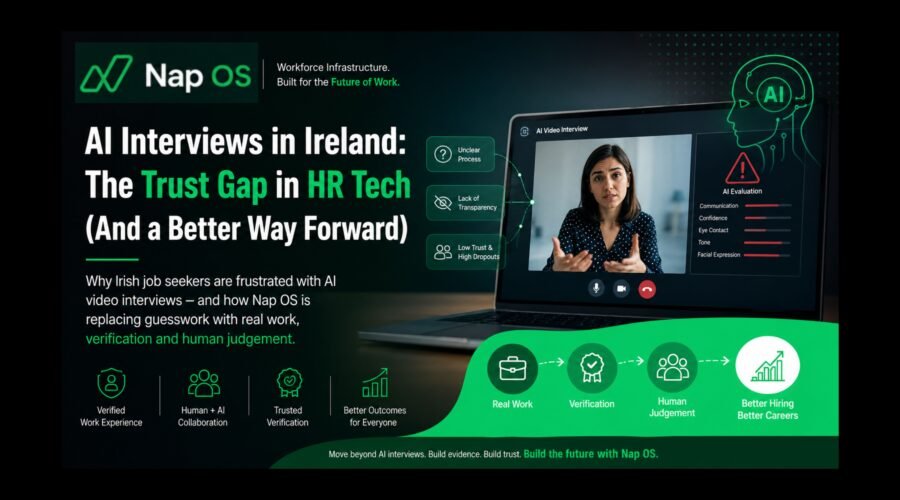
New research from Greenhouse highlights the scale of the issue. Its 2026 Candidate AI Interview Report, based on 2,950 active job seekers across the US, UK, Ireland, Germany and Australia, found that AI interviews are becoming a mainstream part of recruitment. In Ireland, 36% of job seekers surveyed said they had experienced an AI interview. Yet transparency remains extremely weak. Only 9% of Irish candidates who had completed an AI interview said they had been clearly told upfront that AI would be used, while non-disclosure was the leading reason cited by Irish candidates for abandoning an AI interview process, at 26%.
This creates a fundamental HR technology problem:
Recruitment technology is becoming more intelligent, but the candidate experience can become less human.
At Nap OS, we believe the answer is not to remove technology from recruitment.
It is to change what the technology is actually measuring.
The problem isn’t AI. It’s the black box.
Imagine being a job seeker.
You submit your CV.
You pass an initial screening stage.
Then you receive a link asking you to complete a video interview.
You prepare.
You turn on your camera.
A question appears.
You have a limited amount of time to think.
You answer.
Another question appears.
There may be no human interviewer.
You don’t know exactly what is being assessed.
You don’t know how your answer will be interpreted.
You don’t know whether your communication style, facial presentation, accent, pauses, language fluency or other characteristics could influence the assessment.
And after completing the interview, you may receive nothing more than:
“Thank you. We will be in touch.”
For a candidate, this can feel less like an interview and more like submitting yourself to an invisible scoring system.
That is where trust breaks down.
Greenhouse’s research shows that candidates want greater transparency around AI use, what it measures and how humans remain involved in decisions. Globally, only 19% of surveyed candidates said they wanted less AI in hiring; the majority were open to AI, but wanted safeguards including upfront disclosure, explanations of what AI measures and the option of a human interview.
The message is important:
Candidates are not anti-AI.
They want better AI.
Ireland’s candidates are already experiencing the transition
The issue is particularly relevant in Ireland because the country’s labour market is becoming increasingly technology-driven while employers are simultaneously dealing with significant competition for talent.
AI is also changing what employers expect from candidates.
A recent Irish Times report described how companies are increasingly testing candidates on their ability to use AI in practical situations. AI-related assessments are no longer restricted to software engineering positions; they are appearing in areas including consulting, strategy, research, legal, marketing and operations.
This development is not necessarily negative.
In fact, there is something very valuable about asking a candidate:
“Here is a real business problem. Show us how you would approach it.”
That can be much more meaningful than asking a candidate to provide rehearsed answers to generic interview questions.
The problem occurs when technology becomes the judge rather than the facilitator of evidence.
There is a profound difference.
A candidate is more than a video response
A five-minute video cannot fully represent someone’s professional capability.
Neither can a CV.
Neither can a degree.
Neither can a single interview.
A person might be excellent at:
- analysing problems;
- building software;
- designing campaigns;
- managing projects;
- communicating with customers;
- researching markets;
- working with AI;
- leading teams;
- learning quickly;
- adapting to uncertainty.
But none of these capabilities necessarily appear in a standard automated interview.
A candidate could be extremely capable but uncomfortable speaking to a camera.
Another candidate could be an excellent communicator in a real team environment but struggle with a timed, artificial video response.
A non-native English speaker might possess exceptional technical expertise while expressing themselves differently from someone who grew up speaking English.
A neurodivergent candidate may demonstrate their strongest abilities through actual work rather than conventional interview performance.
This does not mean every AI assessment is inherently discriminatory.
It means that the more weight an organisation places on a narrow automated signal, the more important it becomes to understand what that signal actually represents.
Is the system measuring capability?
Or is it measuring someone’s ability to perform well inside the system?
Those are not necessarily the same thing.
The recruitment industry has an evidence problem
There is another problem emerging at the same time.
Candidates now have access to generative AI.
They can use AI to rewrite CVs, generate cover letters, practise interviews and prepare answers.
Employers are responding with AI-powered screening and assessment tools.
This can create an arms race:
Candidate uses AI → employer uses AI → candidate uses more AI → employer introduces more automated assessment.
The result can be a recruitment environment where both sides are increasingly optimising for algorithms.
Recent reporting in Ireland has highlighted this growing tension, including concerns about candidates using AI-generated material and employers using automated systems to assess applicants.
But there is another way.
Instead of trying to determine whether someone sounds employable, employers can increasingly look at whether someone has demonstrated capability.
That is a very different model.
From AI interviews to verified work
This is where Nap OS takes a different approach.
We believe recruitment should move progressively from:
“Tell me what you can do.”
towards:
“Show me what you can do.”
And eventually:
“Show me what you have done, who evaluated it and how it relates to the work we need.”
That is the foundation of the Nap OS Workforce model.
Instead of making the interview the primary source of evidence, Nap OS can connect candidates to personalised work experience based on their skills, interests and market demand.
The candidate doesn’t simply answer a question.
They work on something.
They create something.
They solve something.
They deliver something.
And that creates evidence.
The Nap OS Workforce model
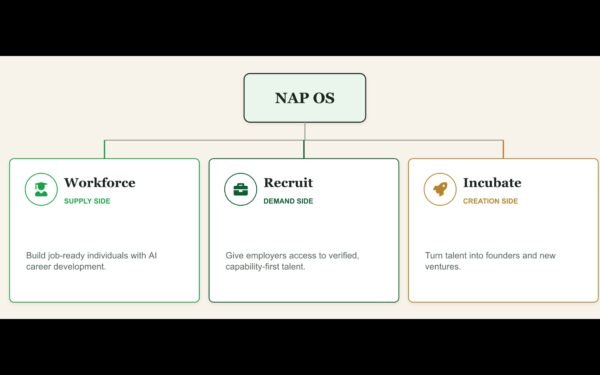
The system can be understood through six connected engines.
1. Market Intelligence Engine
What does the market actually need?
Nap OS analyses job descriptions and employer demand to identify skills, capabilities, roles and emerging requirements.
This creates a connection between what employers are asking for and what candidates are developing.
2. Career Gap Engine
What is this person missing?
The candidate’s current profile and evidence can be compared with market requirements.
Instead of simply saying:
“You don’t have enough experience.”
the system can identify:
“These are the specific capabilities and evidence you need to become more relevant for these roles.”
3. Personalised Learning Engine
What should the person develop next?
The identified gaps can become a personalised pathway involving learning resources, mentoring, coaching and practical development.
4. Work Experience Engine
Can the candidate actually do the work?
This is the critical layer.
Learning is connected to practical projects.
A candidate might work on:
- a marketing campaign;
- software development;
- market research;
- business analysis;
- AI implementation;
- product research;
- customer discovery;
- content creation;
- operational improvement.
The result is not merely a completed course.
It is a work product.
5. Verification & Reference Engine
Can someone credible verify it?
The work can be assessed by an employer, mentor or appropriate evaluator.
The candidate can then build a record of:
Project → Deliverable → Assessment → Verification → Reference.
This is far more meaningful than simply adding another keyword to a CV.
6. Recruitment Engine
Who needs this capability?
Verified evidence can then become part of the recruitment and matching process.
The employer doesn’t only see:
“Marketing graduate.”
They can potentially see:
Marketing graduate
- market research project
- campaign delivered
- employer assessment
- verified outcome
- relevant skills
- availability
- work-permission information where appropriate.
Now AI has a much better foundation on which to operate.
AI should discover evidence — not manufacture confidence
This distinction is central to the future of HR technology.
AI is extremely useful at processing large quantities of information.
It can identify patterns.
It can analyse job descriptions.
It can compare skills.
It can recommend opportunities.
It can help candidates prepare.
It can help recruiters organise information.
But AI should not magically transform weak evidence into false confidence.
If a candidate has never demonstrated a capability, the system should not pretend that they have.
If evidence is strong, the system should make that evidence easier to discover.
If evidence is incomplete, the system should identify the gap.
That creates a much healthier relationship between AI and recruitment.
The human should remain in the loop
The future isn’t:
Human → replaced by AI.
It should be:
Human + AI + Evidence.
AI can help analyse.
The candidate can demonstrate.
An employer or qualified evaluator can assess.
A human decision-maker can make the final recruitment decision.
That model provides something the current generation of AI interviews often lacks:
accountability.
Greenhouse’s research similarly highlights the importance candidates place on human involvement, transparency and clear explanations of how AI is being used.
Technology should make recruitment more informed.
It should not make responsibility disappear.
The candidate should also be evaluating the employer
There is another important shift happening.
Recruitment is not a one-way assessment.
The employer is evaluating the candidate.
But the candidate is also evaluating the employer.
This is one reason the quality of an AI interview matters.
If the first interaction someone has with a company is an opaque automated system that provides no explanation, no meaningful feedback and no human connection, the candidate may reasonably ask:
“Is this an organisation I actually want to work for?”
The Irish Times has reported that candidates’ experiences with AI are increasingly shaping recruitment, while Greenhouse’s research shows that poor AI experiences can damage employer perception and cause candidates to abandon hiring processes.
The candidate experience is therefore not a cosmetic HR issue.
It is part of employer reputation.
Ireland has an opportunity to build better workforce technology
Ireland has a strong technology ecosystem, a significant multinational presence and a large international workforce.
It also has thousands of students and graduates trying to make the transition from education into employment.
The question is not whether Ireland should use AI in recruitment.
AI is already here.
The question is:
What kind of recruitment infrastructure do we want to build?
One possibility is an increasingly automated funnel:
CV → AI screen → AI interview → automated ranking → rejection.
Another is:
Skills → personalised development → real work → verified evidence → AI-assisted matching → human hiring decision.
The second model is the direction Nap OS believes in.
The future of interviewing may be less about interviews
This may sound counterintuitive.
But the better recruitment becomes at understanding actual work, the less pressure we may need to place on a single interview.
Imagine an employer already knows:
- what a candidate has built;
- which projects they completed;
- what skills they demonstrated;
- who evaluated their work;
- how they responded to feedback;
- how they collaborated;
- what outcomes they achieved.
The interview can then become what it was always supposed to be:
a conversation.
Not an examination.
Not a performance for an algorithm.
Not a black-box scoring exercise.
A conversation between an employer and someone who has already demonstrated a meaningful amount of capability.
Nap OS believes recruitment should become evidence-led
AI is going to remain part of HR technology.
There is no going backwards.
But the next generation of workforce platforms should not simply automate the old recruitment process.
They should rethink the evidence on which recruitment is based.
At Nap OS, we believe that means moving beyond:
CVs → interviews → subjective impressions
towards:
Capabilities → personalised work → deliverables → verification → references → intelligent matching.
AI can then become an enabler rather than an invisible judge.
The goal isn’t to eliminate human judgement.
The goal is to give humans better evidence on which to exercise that judgement.
For job seekers in Ireland, that could mean something very important:
They no longer have to convince an algorithm that they are employable.
They can demonstrate what they can do.
And for employers, it means something equally important:
Instead of asking AI to predict who might be good at a job from limited signals, they can increasingly use technology to discover people who have already produced evidence of relevant capability.
The future of HR technology shouldn’t be AI judging people better.
It should be technology helping people prove themselves better.
That is the workforce infrastructure Nap OS is building.