5 min read
For more than a decade, two platforms have shaped modern careers in different ways.
LinkedIn became the world’s professional identity layer. It answers the question, “Who are you?”
Coursera transformed online education by making world-class learning accessible to millions. It answers the question, “What have you learned?”
Both platforms have fundamentally changed how people build careers.
Yet there is still one question neither platform fully answers:
“Can you actually do the work?”
That question has become the defining challenge of today’s job market.
This is where Nap OS fits—not as a replacement for LinkedIn or Coursera, but as the missing layer between learning and employment.
The Career Stack Is Incomplete
Today’s graduates typically follow a familiar path.
They earn a university degree.
They complete several online courses on Coursera.
They add certificates to their LinkedIn profile.
They polish their CV.
Then they apply for jobs.
Despite doing everything they were told, many receive the same response:
“We’re looking for someone with relevant experience.”
The problem isn’t a lack of education.
It isn’t a lack of ambition.
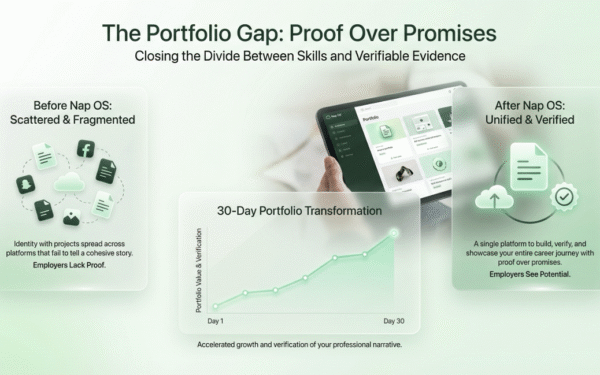
It’s the absence of verifiable evidence that they can perform in a real working environment.
Degrees demonstrate education.
Certificates demonstrate learning.
CVs describe experience.
But employers increasingly want proof.
LinkedIn Changed Professional Identity
LinkedIn revolutionized professional networking.
Before LinkedIn, professional identity lived in paper resumes.
Today, your profile showcases your education, work history, recommendations, skills, and network.
It has become the world’s professional directory.
Recruiters search it.
Companies hire through it.
Professionals build credibility on it.
But LinkedIn primarily relies on information supplied by users and their employers.
It is excellent at documenting where you’ve worked and what you’ve done.
It is less effective at verifying capability before someone gets their first opportunity.
For graduates, career changers, and aspiring founders, this creates a familiar challenge.
How do you demonstrate experience before someone hires you?
Coursera Democratized Learning
Coursera solved another important problem.
High-quality education was once limited by geography and cost.
Today, anyone with an internet connection can learn from leading universities and industry experts.
Millions of learners have gained new technical and professional skills through online education.
This is an extraordinary achievement.
Learning has never been more accessible.
However, education alone does not guarantee employability.
Completing a course in data science doesn’t automatically prove you can deliver a real analytics project.
Finishing a product management specialization doesn’t demonstrate that you’ve managed stakeholders or launched a product.
Certificates validate participation and assessment.
Employers often need evidence of execution.
The Gap Between Learning and Employment
This is where many talented individuals become stuck.
They know the theory.
They have completed courses.
They have built a professional profile.
Yet they lack opportunities to demonstrate practical capability.
This affects more than students.
Universities struggle to improve graduate employability.
Employers struggle to identify work-ready candidates.
Recruitment platforms seek stronger signals beyond credentials.
Governments invest heavily in workforce development but often lack measurable evidence of employment readiness.
Everyone is trying to solve the same problem from different directions.
The missing ingredient is verified experience.
Nap OS Adds the Missing Layer
Nap OS is designed to complement—not compete with—the existing career ecosystem.
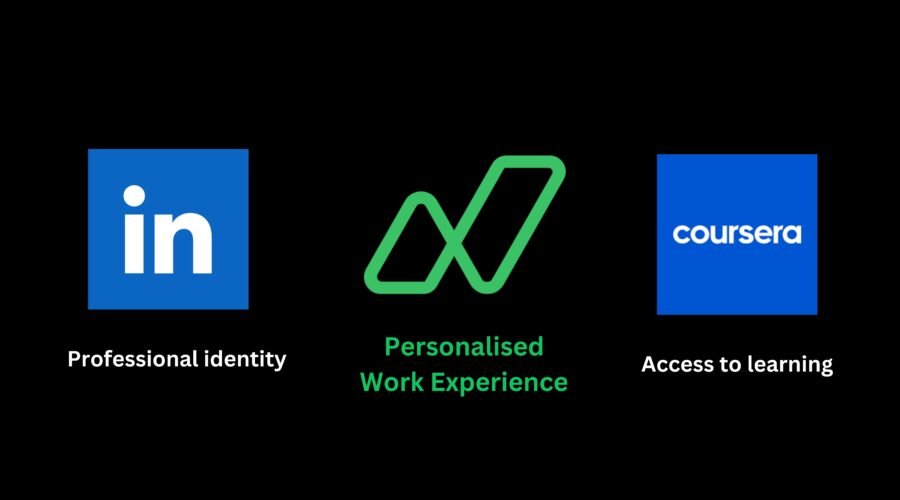
If LinkedIn is your professional identity…
And Coursera is your learning history…
Nap OS becomes your evidence of capability.
Instead of simply recording what you’ve studied, Nap OS enables individuals to participate in real projects that generate verifiable outcomes.
Rather than adding another certificate, participants build a portfolio of work completed in realistic environments.
Instead of listing skills, they demonstrate those skills through measurable contributions.
Instead of saying they can collaborate, solve problems, or communicate, they have documented examples supported by project outcomes and references.
The result is a richer, more complete professional profile.
A Better Journey for Learners
Imagine a student learning digital marketing.
Today the journey often looks like this:
Complete a Coursera specialization.
Add the certificate to LinkedIn.
Apply for marketing jobs.
With Nap OS, the journey becomes much stronger.
Complete the Coursera specialization.
Apply the knowledge on a real marketing project.
Receive structured feedback.
Build measurable campaign outcomes.
Earn verified references.
Create a portfolio demonstrating practical execution.
Share those achievements on LinkedIn.
Learning becomes action.
Action becomes evidence.
Evidence becomes employability.
Better Outcomes for Universities
Universities increasingly recognise that education alone is no longer enough.
Students expect institutions to help them secure meaningful employment.
Graduate employability influences reputation, rankings, student recruitment, and industry partnerships.
Nap OS complements existing academic programs by helping institutions integrate verified work experience alongside traditional learning.
Students don’t simply graduate with knowledge.
They graduate with documented evidence of applying that knowledge.
For universities, this creates stronger graduate outcomes without replacing their existing curriculum.
Better Hiring for Employers
Employers face a different challenge.
Recruitment is expensive.
CVs often look similar.
Certificates have become increasingly common.
Assessing real capability before hiring remains difficult.
Nap OS provides another signal.
Employers can review practical project work, evidence of collaboration, documented outcomes, and verified references alongside traditional credentials.
Hiring becomes less dependent on assumptions and more informed by demonstrated capability.
It doesn’t replace interviews or assessments.
It improves the quality of information available before those conversations begin.
Better Talent for Recruitment Platforms
Recruitment platforms continuously work to improve match quality.
The more accurate the information about candidates, the better the recommendations.
Traditional profiles rely heavily on education, employment history, and self-declared skills.
Nap OS introduces additional signals based on verified practical work.
That richer dataset can help recruitment platforms surface candidates who have demonstrated relevant capability, even when they have limited formal work history.
This is particularly valuable for graduates, career changers, and emerging professionals.
Building a Career Operating System
Careers are no longer built through a single institution or platform.
People learn from multiple providers.
Network on multiple platforms.
Work across different organisations.
Build portfolios in many places.
The future belongs to ecosystems rather than isolated products.
Nap OS is designed to connect these experiences.
It doesn’t ask users to abandon LinkedIn.
It doesn’t replace Coursera.
Instead, it strengthens the value of both.
Learning becomes practical.
Profiles become evidence-based.
Career journeys become measurable.
The Future Is Evidence
The labour market is evolving.
Artificial intelligence can generate resumes.
Certificates are becoming increasingly common.
Skills change rapidly.
As these trends continue, employers are likely to place even greater emphasis on demonstrated capability.
People who can show real work, real outcomes, and real references will stand out.
Education remains essential.
Professional networking remains essential.
Verified work experience is becoming equally important.
Together, these three pillars create a more complete picture of employability.
Complement, Don’t Replace
Technology rarely advances by replacing everything that came before.
Instead, it builds upon existing foundations.
LinkedIn transformed professional identity.
Coursera transformed access to learning.
Nap OS addresses the next challenge: transforming how people demonstrate readiness for work.
The future of careers is unlikely to depend on a single platform.
It will depend on connected systems that combine learning, professional identity, and verified experience.
That is where Nap OS belongs.
Not instead of LinkedIn.
Not instead of Coursera.
But alongside them—bridging the gap between learning, proving capability, and building meaningful careers.