7 min read
International education involves more than admission, travel and tuition. For students, the deeper ambition is often to turn learning into professional capability—and professional capability into meaningful work.
Napblog Limited is exploring how Nap OS could support that transition through a combination of workforce software, structured project experience and professional feedback. Part of this roadmap involves a question: could approved financial partnerships help students access these services alongside their wider education plans?
This is an opportunity under exploration, not an established financing arrangement. No lender approval, institutional endorsement, funding scheme, employment outcome or partnership should be inferred from this article.
Our ambition is to build the relationships, delivery standards and evidence required to test the model responsibly.
1. Looking beyond the tuition transaction
Education finance can help students access learning opportunities they could not otherwise afford. But access to education and readiness for employment are different challenges.
A student may graduate with subject knowledge yet struggle to explain how they would contribute to a project. Another may have completed substantial work but lack a clear record of their individual contribution.
Nap OS’s proposed role is to connect learning with evidence: structured briefs, documented decisions, feedback, revisions and portfolio outputs that students can explain to prospective employers.
The opportunity is not to sell another subscription simply because a student can borrow. It is to establish whether a clearly defined programme provides enough educational value to justify its price—and whether an authorised financing route could improve access.
Affordability must remain part of that assessment. Financing changes when students pay; it does not eliminate the cost.
2. An allied student product—not an assumed loan entitlement
Napblog is exploring how Nap OS could be considered an allied student product: a supplementary service supporting students’ educational and professional development.
The proposed offering could combine:
- Access to a project workspace.
- Defined business or research briefs.
- Milestone planning and progress documentation.
- Professional project-manager feedback.
- Individual contribution records.
- Portfolio preparation and reflective case studies.
Whether such a programme qualifies for financing would depend on the relevant lender, product, jurisdiction and borrower assessment.
Napblog would seek written decisions rather than relying on broad descriptions such as “education-related expenses.” Programme eligibility, vendor approval and individual loan sanction would remain separate questions.
A commercial referral partnership would also be distinct. Permission to introduce a service would not, by itself, make that service financeable.
3. How an approved funding pathway could work
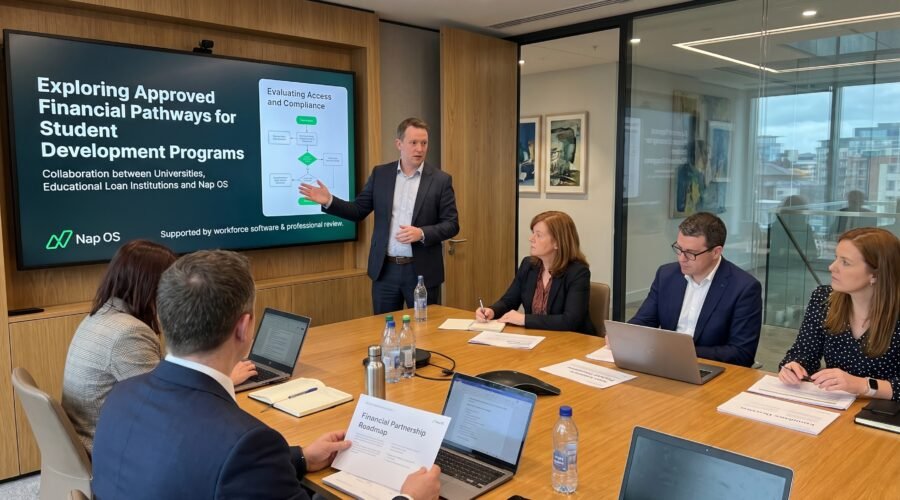
One possible model would connect an eligible student, an authorised lender, an educational institution where relevant, and Napblog as the programme provider.
The proposed sequence would be straightforward:
- The student receives a clear programme description and price.
- The student voluntarily chooses whether to participate.
- The lender assesses any request to include the fee within an approved education budget.
- Required documents and invoices are verified.
- Funds follow the lender’s approved disbursement process.
- Napblog delivers the contracted programme.
- Completion, complaints and refunds are handled through documented procedures.
Payment might go to an approved institution, directly to a provider, or through another permitted route. Napblog would not assume that a payment mechanism used for tuition automatically applies to an external subscription.
If an institution purchases access for a cohort, the contractual structure would be different again. Students should never pay twice for access already funded on their behalf.
4. Building international relationships around delivery
The international opportunity extends beyond referrals.
Napblog’s roadmap includes exploring relationships between institutions in students’ home countries, destination-country educators, professional reviewers and organisations with suitable project briefs.
A collaboration could begin before departure, continue during study and support the transition into applications and interviews.
For example, a student could complete an introductory project remotely, undertake more advanced work during their studies and develop a portfolio case study with professional feedback.
Such a model would require clear responsibilities. Partners would need to agree who supplies briefs, supervises work, assesses outputs, protects confidential information and supports students.
Cross-border service delivery, students consuming services abroad and establishing an overseas commercial presence are distinct forms of international activity. A sound growth strategy should distinguish them rather than treating every international relationship as the same transaction.wto
5. Complementing universities through cross-campus collaboration
Nap OS’s intended institutional role is complementary.
Universities would retain control over their curriculum, academic assessment, careers services and placement relationships. Napblog would seek to support defined activities where an external project framework or review process adds value.
Potential cross-university collaboration could include:
- Shared project themes with separate student contributions.
- Joint showcases of completed work.
- Professional feedback across disciplines.
- Collaborative research or business challenges.
- Common evidence templates, adapted to local requirements.
A student team might bring together business, computing and design perspectives. However, collaborative work would need to preserve individual accountability.
Participation would not automatically confer academic credit, qualification recognition or a placement. Those outcomes would require specific institutional agreement.
6. Distinguishing international payments from investment schemes
International finance can support educational activity, but different financial flows must be described accurately.
A student loan, a programme purchase, a grant, an institutional procurement contract and an equity investment are not interchangeable.
A cross-border payment for Nap OS would not automatically constitute foreign direct investment or activate a national investment incentive. International service supply and overseas commercial presence are distinct concepts; establishing a presence abroad involves different considerations from selling a service across borders.
Napblog may explore relevant enterprise, research, workforce-development or investment supports where eligibility genuinely exists. Each would need its own assessment, application and approval.
The roadmap is therefore to connect appropriate sources of funding to clearly defined services—not to imply that banking transactions unlock public schemes automatically.
7. Creating opportunities for Irish professionals
An important objective is to retain meaningful value creation in Ireland.
If demand develops, Napblog would seek to create paid opportunities for Irish-based employees, freelancers and founders who can contribute professional expertise.
Potential roles could include project design, programme management, technical review, quality assurance, student support and software development.
Founders and smaller businesses could potentially supply appropriate briefs or specialist feedback. That participation should have clear scope, compensation and confidentiality arrangements.
These are intended opportunities, not jobs already created.
Commercial sustainability would depend on whether programme revenue covers professional time, technology, support and acquisition costs. Software could make coordination more efficient, but it should not be used to disguise insufficient supervision or underpaid delivery.
8. Project-based hiring as a separate pathway
Nap OS also aims to explore how project evidence could improve hiring conversations.
A hiring authority may find it useful to see how a candidate interpreted a problem, handled feedback and explained a decision. The proposed portfolio would help make those contributions visible.
However, a learning project is not automatically a valid hiring assessment. Nor should students pay for the opportunity to perform unpaid recruitment work.
Where an organisation wants commercially useful output, or a project becomes part of candidate selection, the arrangements would need appropriate scrutiny.
The programme should clearly distinguish:
- Simulated learning exercises.
- Supervised educational projects.
- Live client work.
- Employer-hosted experience.
- Paid employment or freelance assignments.
Structured work-based learning has shown positive labour-market effects in research, but those findings do not establish that Nap OS itself improves employment outcomes. Its own effectiveness would need evaluation.ilo
9. Helping hiring authorities make better-informed decisions
Napblog’s proposed contribution is not to automate hiring authority.
It is to help candidates present clearer information and help reviewers ask better questions.
A portfolio could show the original brief, the student’s role, selected drafts, feedback and the final output. Where results are unavailable, students should explain limitations rather than invent impact.
Professional review would assess the work against defined criteria—not certify that an individual is guaranteed to succeed in a job.
Any future AI assistance should support organisation and explanation, with human oversight for consequential judgements. Employers would remain responsible for their recruitment decisions.
The aim is a more informative conversation between learning and employment, not a new black-box score.
10. Responsible partnerships require clear boundaries
Trust would depend on transparent commercial arrangements.
Any referral fee should be authorised at company level, documented and handled appropriately. It should not become an undisclosed personal payment to someone influencing a student’s financing decision.
Students should know that participation is optional, what they receive and how to cancel or complain. Marketing must distinguish a proposed partnership from a signed agreement, and a distribution agreement from financing approval.
Data sharing should be limited to what is necessary. Napblog would not need access to borrowers’ credit files, collateral details or loan balances to deliver project experience.
Professional confidentiality, accessibility and fair participation would need to be designed into the programme from the outset.
11. Proving the model before scaling it
Napblog’s roadmap should progress through evidence, not announcements.
An initial pilot would test programme suitability, delivery capacity and student demand. A subsequent channel pilot could assess whether approved communications produce suitable enquiries and voluntary purchases.
Measures would include:
- Participation and completion.
- Quality of individual work.
- Reviewer time per student.
- Refunds and complaints.
- Acquisition cost and delivery margin.
- Student and institutional feedback.
- Subsequent interviews, offers and employment, with clear limitations.
Employment outcomes would require defined follow-up periods and careful interpretation. A successful participant finding work would not establish that the programme caused that outcome.
The scale decision should depend on quality and economics together.
12. The roadmap Napblog is working towards
Nap OS’s ambition is to connect international education, practical experience and workforce development through a service that can be understood, assessed and improved.
Financial institutions could potentially support access. Universities could help establish educational relevance. Irish professionals could contribute paid expertise. Employers could offer feedback and, separately, consider suitable candidates.
None of those relationships should be presumed.
Napblog Limited’s task is to earn them through clear agreements, responsible delivery and measurable value.
The untapped opportunity is not merely financing workforce software. It is building a trustworthy bridge between an investment in education and a student’s ability to demonstrate what they can contribute—while developing sustainable professional opportunities in Ireland.