6 min read
The lesson is not that universities are failing. It is that positive national averages can coexist with difficult transitions for particular students.
A useful response must connect education, practical experience, employer understanding and targeted support.
The gap Nap OS aims to address
Consider a student applying for an entry-level marketing role.
Their CV might say:
“Skilled in market research, campaign planning, analytics and teamwork.”
Those statements become more useful when the student can explain:
- The business problem they investigated.
- The research they conducted.
- Their individual contribution to a team project.
- The decisions they made and why.
- The feedback they received.
- What they changed after that feedback.
- The results achieved—or the limitations of what they could measure.
Nap OS is positioned around this transition from activity to demonstrable work. Napblog’s published product offering includes structured execution paths, milestones, portfolio evidence, reviewer access and institutional reporting. These capabilities provide a foundation for a work-experience programme; they are not, on their own, proof of improved hiring outcomes.
Our proposed model is to connect those capabilities to a clear student journey:
Relevant brief → practical execution → professional feedback → documented contribution → application-ready portfolio.
What a Nap OS-supported work-experience programme could look like
A programme should start with defined learning outcomes and appropriate supervision—not simply access to software.
1. Start with a role-relevant brief
Students could work on an approved business, research or organisational challenge appropriate to their discipline and experience.
Examples might include a market-research study, a campaign measurement plan, a customer-journey assessment or an analysis of a defined dataset.
Each brief should specify the intended deliverables, timeline, available resources, review arrangements and assessment criteria.
Crucially, the programme must describe the experience accurately. A simulated brief is not a client engagement. A university project is not automatically an internship. Employer-hosted work, supervised project experience and simulations can all contribute to learning, but they should not be presented as equivalent.
2. Make the process visible
A finished presentation does not always show how a student reached their conclusions.
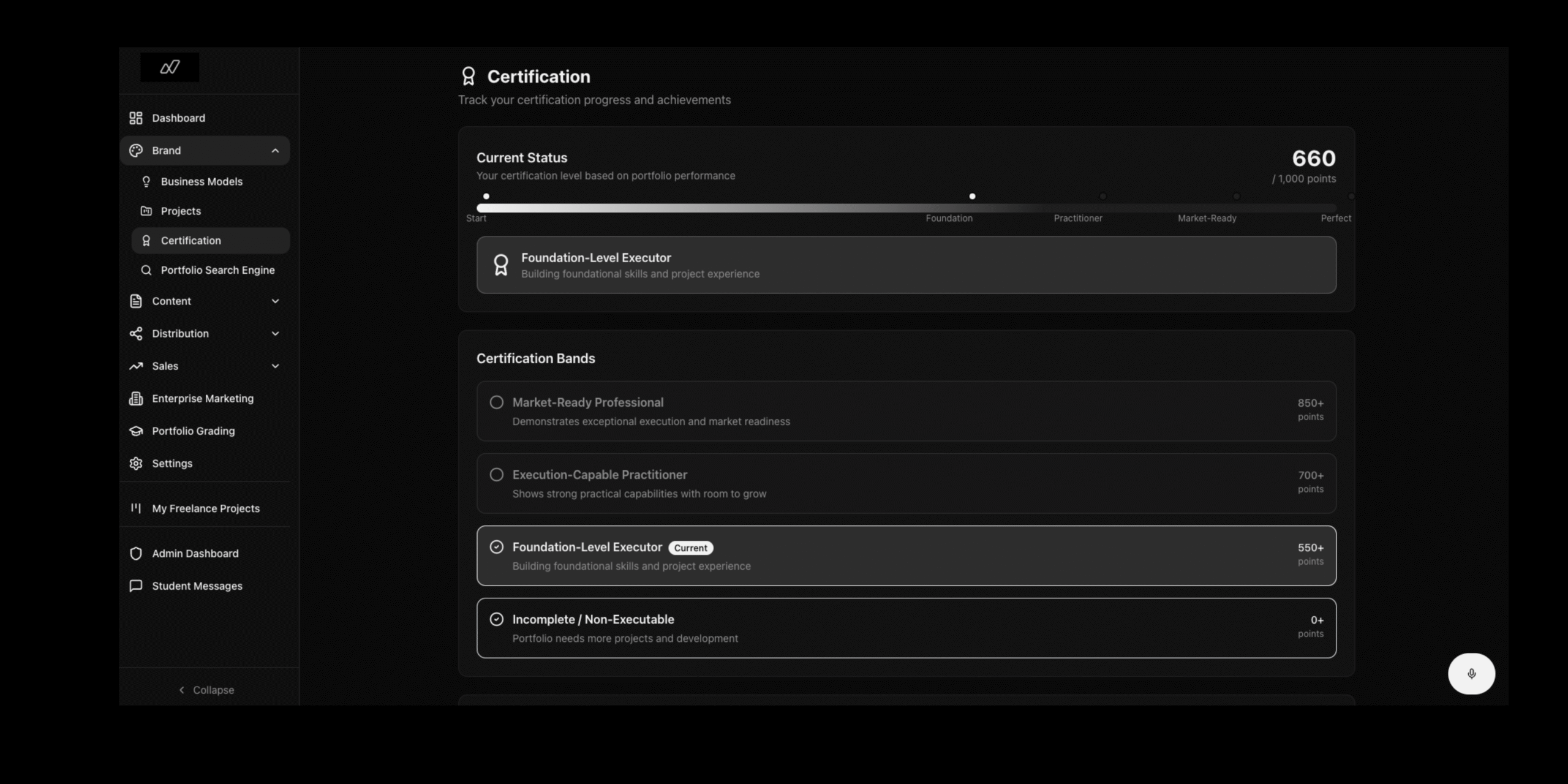
The proposed Nap OS approach would help students organise the work behind the output: research notes, drafts, decisions, revisions and supporting artefacts. Napblog’s published offering describes evidence linking, execution logs, timestamped proof and portfolio-building functions that could support this process.napblog
The objective is not to monitor every action. It is to preserve enough relevant context for a student to explain their contribution credibly.
3. Build in professional review
Students should have opportunities to receive feedback from an appropriate lecturer, project manager, mentor or employer representative, depending on the programme.
A reviewer might ask:
- Is the recommendation supported by the research?
- Can another person understand and use the deliverable?
- Has the student recognised important limitations?
- What changed following feedback?
- Can the student explain the work independently?
Nap OS lists mentor access, evidence comments and reviewer annotations among its capabilities. In a university programme, these should support professional judgement rather than replace it.napblog
4. Turn completed work into interview material
At the end of the programme, students should be able to produce a concise case study covering the problem, their contribution, their approach, feedback, outcomes and reflection.
That creates a practical starting point for a careers adviser: not just “What skills do you have?” but “Which example best demonstrates your suitability for this role?”
Complementing the placement office—not replacing it
Nap OS should sit alongside a university’s careers and placement services.
The proposed division of responsibility is clear:
| Area | University placement and careers team | Nap OS’s supporting role |
|---|---|---|
| Career direction | Advise on goals, options and recruitment pathways | Organise relevant project evidence |
| Employer engagement | Manage relationships and opportunity development | Help prepare evidence students can share |
| Placement readiness | Assess suitability and provide individual guidance | Surface agreed milestones and portfolio gaps |
| Application preparation | Coach students on CVs, applications and interviews | Supply concrete examples of completed work |
| Student support | Address individual circumstances and refer appropriately | Help identify incomplete work or review needs |
| Programme evaluation | Interpret outcomes and determine improvements | Support cohort progress and completion reporting |
Napblog’s institutional offering describes cohort tracking, portfolio completion reporting and self-paced or mentored-paced delivery. The opportunity is to use that structure to inform adviser conversations—not to turn a platform score into a hiring decision.napblog
A student with a polished portfolio may still need help identifying suitable employers. Another may have strong technical work but struggle to communicate it. A third may need specialist guidance unrelated to project quality.
The placement team remains essential.
How this could improve employment outcomes
The proposed mechanism is practical.
Students complete relevant work, receive feedback and develop clearer examples of their abilities. Careers teams use that evidence to tailor application and interview support. Employers receive more specific information about what a candidate can explain and demonstrate.
That could improve readiness and progression through recruitment. It must still be tested.
Nap OS cannot create employer vacancies, remove every recruitment barrier or guarantee an offer. Nor can a portfolio resolve immigration restrictions, housing pressures or wider labour-market conditions. The Journal’s reporting highlights why international graduates’ challenges should not be reduced to a simple lack of skills or effort.thejournal
Our aim should be to strengthen the parts of the transition that a structured programme can influence—while being honest about those it cannot.
Measuring the percentage improvement responsibly
“Improving employability” needs a defined meaning.
Programme completion, portfolio quality, interview invitations and employment are different outcomes. A credible pilot should report them separately.
An institution and Napblog Limited could agree measures such as:
- Programme completion among all enrolled participants.
- Portfolio quality against a published rubric.
- Application-to-interview conversion.
- Interview-to-offer conversion.
- Time to first relevant role.
- Employment and further-study destinations at a defined follow-up point.
- Relevance of employment to the graduate’s qualification or target career.
- Student, adviser and employer feedback.
For example, if a comparable cohort’s employment rate rose from 70% to 78%, that would be an eight-percentage-point increase—not simply an “8% improvement.” Even then, the difference would not establish that Nap OS caused it.
Evaluation should consider prior experience, discipline, participation patterns, labour-market conditions and response rates. Where feasible, a phased rollout or suitable comparison group would provide stronger evidence than testimonials alone.
The commitment should be to publish the measurement method alongside the result.
A partnership model built around clarity
A sensible starting point is a focused institutional pilot, rather than a university-wide promise.
That pilot could bring together:
- A defined student cohort and programme lead.
- Careers and placement staff.
- Approved briefs and reviewers.
- Clear workload, accessibility and participation arrangements.
- Agreed rules for confidential work and external sharing.
- Baseline measures and follow-up dates.
- A joint review of student outcomes and staff workload.
Any fees, payment arrangements, employment status or academic credit should be made explicit before students enrol. Participation should never be marketed as guaranteed employment.
The same standard applies to AI. Assistance with organising work or suggesting improvements should not become a substitute for students’ own contribution, explanation or assessment.
Our ambition at Napblog Limited
Napblog Limited’s published positioning for Nap OS centres on turning student execution into verifiable project records, with institutional workflows, portfolio tools and reporting.napblog
Our opportunity is to make that proposition useful to the people already supporting students: placement officers, careers advisers, lecturers, programme leaders and employer partners.
We are not proposing another dashboard as the answer to graduate unemployment.
We are proposing a more connected process: students gain structured experience, reviewers help them improve, careers teams help them communicate their contribution, and institutions measure what happens next.
The question is not only, “How many students completed the programme?”
It is, “Did students leave with stronger work, clearer evidence and better outcomes—and can we demonstrate the difference?”
That is the partnership Napblog Limited wants to build with university placement and careers teams.
University careers leaders, placement teams and programme directors interested in evaluating this approach can contact Napblog Limited to discuss a scoped pilot with agreed outcomes and measurement.