8 min read
There is something I have come to believe very strongly after spending years thinking about the relationship between education, work experience, employers and technology:
The future of hiring cannot be built around the CV alone.
The CV has become the default language of recruitment. Students write CVs. Graduates rewrite CVs. Universities teach students how to improve CVs. Recruiters screen CVs. Employers compare CVs.
And yet, the fundamental question remains:
What can this person actually do?
That is the question I believe project-based hiring answers better.
I am not saying the CV will disappear tomorrow. It will continue to exist. But I believe we are moving towards a world where evidence of work will increasingly matter more than a description of a person on a piece of paper.
This is the thinking behind Nap OS.
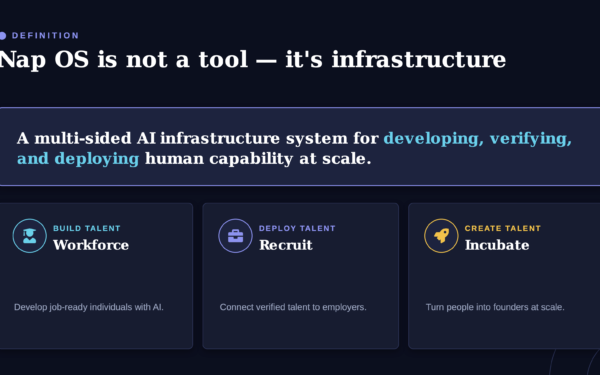
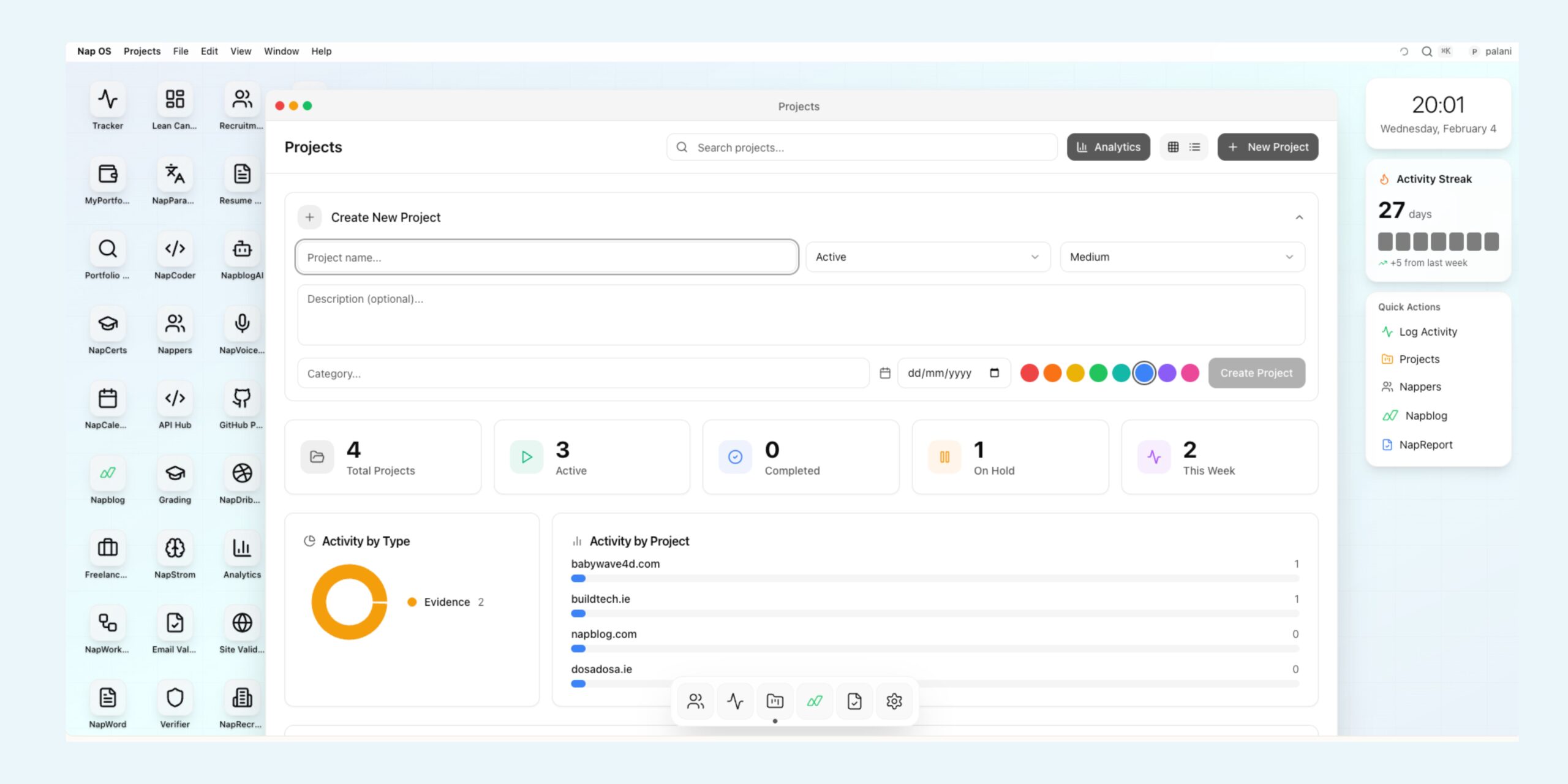
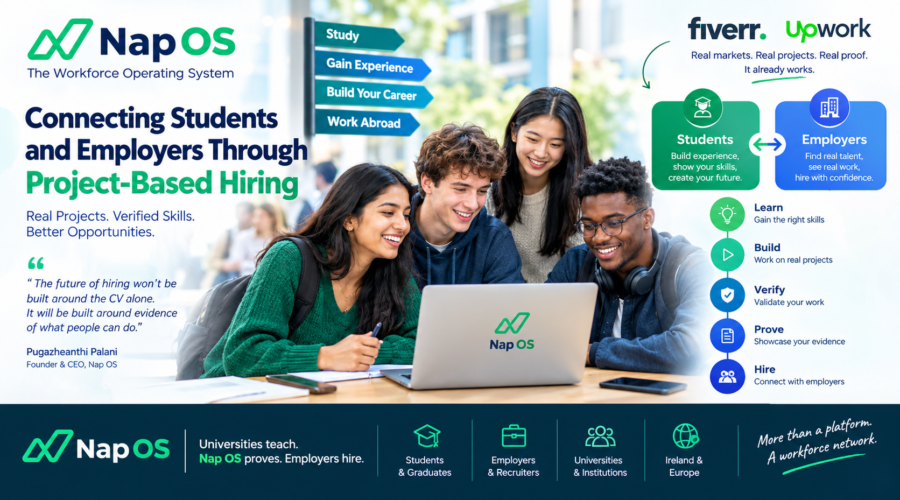
Nap OS is being built to connect students and employers through project-based hiring — turning skills into practical projects, projects into evidence, and evidence into employment opportunities.
Truth to be told: project-based hiring already works
I don’t think Nap OS invented project-based hiring.
That is actually the point.
The model has already been demonstrated at enormous scale by platforms such as Fiverr and Upwork.
Fiverr and Upwork built businesses around a fundamentally different proposition from traditional recruitment.
Instead of starting with:
“Send me your CV.”
The interaction can start with:
“I have a problem. Can you solve it?”
A business might need a logo.
A developer might need to build a website.
A company might need data cleaned and analysed.
A founder might need a presentation designed.
A business might need marketing content.
A client can define the requirement, look at relevant evidence, evaluate capability and decide whether to engage someone.
That is fundamentally different from asking someone to describe themselves on a CV and hoping that description accurately predicts future performance.
The market has already demonstrated that people are willing to buy outcomes, projects and skills.
For me, that is an important validation of the underlying philosophy behind Nap OS.
But I want to make an important distinction.
Fiverr and Upwork are not proof that every hiring decision should become a freelance transaction. They demonstrate something more fundamental:
There is a functioning market for matching people to work based on what they can deliver.
Nap OS takes that principle into a different problem:
How do we give students and early-career talent the opportunity to demonstrate what they can do before they have a conventional employment history?
That is where the opportunity becomes particularly interesting.
The student experience problem
Consider an international student arriving in Ireland.
They may have:
- a university degree;
- strong academic knowledge;
- technical skills;
- previous experience in another country;
- motivation;
- ambition;
- excellent communication skills.
But when they apply for their first opportunity in Ireland, they may still encounter the same question:
“Do you have local experience?”
And this creates the Catch-22.
You need experience to get the job.
But:
You need the job to get the experience.
I have spent a significant amount of time thinking about this problem.
My conclusion is that simply teaching students how to write better CVs does not solve it.
If the underlying problem is lack of evidence, making the description of the person more attractive does not necessarily create the missing evidence.
We need another mechanism.
That mechanism can be project-based work.
From “Tell me about yourself” to “Show me what you built”
Imagine two candidates.
Candidate A
Their CV says:
“Strong analytical skills, excellent Excel knowledge, passionate about data analytics and highly motivated.”
Candidate B
Their profile says:
“Completed a 20-hour customer segmentation project using Excel, SQL and Python. Built a customer dashboard, analysed 5,000 records, identified four customer segments and presented recommendations to a business reviewer.”
For me, the second candidate has something fundamentally different.
They have evidence.
The employer can ask:
- What was the problem?
- What data did you use?
- What did you build?
- What methodology did you use?
- What decisions did you make?
- What challenges did you encounter?
- What was your individual contribution?
- Who reviewed the work?
- What did you learn?
- What would you improve?
Suddenly, the hiring conversation changes.
The candidate is no longer only talking about potential.
They are talking about something they actually did.
This is the philosophy behind Nap OS
Nap OS is being built around a simple sequence:
Learn → Build → Verify → Prove → Hire
Education provides knowledge.
Projects provide application.
Verification provides credibility.
Evidence provides proof.
Employers provide opportunity.
The role of Nap OS is to connect those components.
I don’t see Nap OS simply as another job board.
I don’t want students to create another profile that becomes a digital version of their CV.
I want the profile to become a workforce evidence layer.
A student’s Nap OS Workforce profile should increasingly answer:
What can this person actually do?
Not simply:
Where did they study?
Not simply:
What does their CV say?
But:
What have they built, what problems have they solved, what skills have they demonstrated and what evidence exists?
Employers have problems too
There is another side to this equation.
We often talk about students struggling to get opportunities.
But employers also have a problem.
Hiring is fundamentally an uncertainty problem.
An employer doesn’t know exactly how someone will perform until they have evidence.
A CV reduces some uncertainty.
An interview reduces more.
References can reduce more.
But practical work can potentially reduce it further.
Imagine an employer needs someone with:
- Excel;
- data analysis;
- market research;
- communication;
- presentation skills.
Instead of simply advertising:
“Graduate Data Analyst — 2 years’ experience required”
the employer could potentially define a project:
Analyse this dataset, identify three commercially relevant insights and present your recommendations.
Now the candidate has an opportunity to demonstrate capability.
The employer has something tangible to evaluate.
And Nap OS can sit between the two.
Project-based hiring creates a third category
Traditional recruitment often creates two categories:
Employed
or
Not employed.
But real people are more complicated.
A student might have the skills but not the experience.
A graduate might have the education but not the opportunity.
A career changer might have transferable skills but no conventional CV history.
An international professional might have substantial experience but lack local market evidence.
Project-based hiring creates another possibility:
“Give me an opportunity to demonstrate capability.”
That opportunity might be a short project.
It might be a business challenge.
It might be research.
It might be a technical assignment.
It might be a marketing campaign.
It might be a data analysis exercise.
It might be a startup project.
It might be an employer-defined challenge.
The important thing is that the person produces something.
Why I believe this is especially important for students
Students are often told:
“Get experience.”
But nobody explains where that experience comes from.
Internships are limited.
Graduate jobs are competitive.
Part-time employment may not align with a student’s career.
Academic assignments are often invisible to employers.
Personal projects can be difficult to validate.
Nap OS is trying to connect these pieces.
A student studying business could work on a market research project.
A computer science student could build a software prototype.
A finance student could complete a financial modelling project.
A marketing student could develop a campaign analysis.
A cybersecurity student could complete a security assessment.
A design student could create a UX case study.
A student interested in entrepreneurship could work on a startup challenge.
The objective is not to create artificial work.
The objective is to create structured opportunities to demonstrate real capability.
From project to workforce evidence
This is where I believe technology becomes particularly powerful.
A project should not simply disappear after completion.
Nap OS can potentially structure the evidence around:
Project → Skills → Deliverables → Contribution → Verification → Portfolio
For example:
Project
Customer Segmentation Analysis
Duration
20 hours
Skills
SQL, Excel, Python, Data Analysis
Deliverables
Dashboard, analytical report and presentation
Contribution
Individual project
Verification
Reviewer assessment
Evidence
Completed project + outputs
Now an employer can see much more than a list of skills.
They can see the relationship between:
Skill → Application → Evidence
That is the foundation of project-based hiring.
Nap OS is not trying to eliminate the human recruiter
This is important.
I don’t believe technology should make hiring less human.
I believe technology should make the evidence reaching humans better.
The employer should still make the decision.
The hiring manager should still evaluate culture, communication, motivation and suitability.
The student should still tell their story.
But instead of starting with an enormous pile of CVs containing claims about skills, employers could increasingly receive structured evidence about what candidates have actually done.
That can make the human conversation more meaningful.
The bigger opportunity: students and employers learning from each other
For me, Nap OS is not simply about recruitment.
It is about building a feedback loop.
Students learn what employers actually need.
Employers discover emerging talent.
Students build projects around real problems.
Employers get access to potential talent earlier.
Universities can understand workforce requirements more clearly.
Students develop evidence before graduation.
Employers can potentially identify talent before traditional recruitment cycles.
That creates a much stronger ecosystem.
Education → Projects → Evidence → Employers → Employment
And eventually:
Employment → Experience → More Evidence → Career Growth
My personal belief as the founder
I started Nap OS because I don’t think we should accept the idea that someone is “inexperienced” simply because their CV does not contain the right employment history.
A student may be inexperienced at employment.
That does not mean they are inexperienced at learning.
It does not mean they are inexperienced at building.
It does not mean they are inexperienced at solving problems.
It does not mean they cannot become valuable to an employer.
The missing ingredient may simply be an opportunity to prove it.
That is the opportunity I see for Nap OS.
Fiverr and Upwork demonstrated that markets can connect people to opportunities around specific work and deliverables rather than relying exclusively on traditional employment histories.
Nap OS is taking inspiration from that fundamental principle and asking a different question:
Can we bring project-based hiring into the student and early-career workforce journey?
Can we allow students to build evidence before they have years of employment history?
Can employers define real projects instead of relying exclusively on generic job descriptions?
Can skills become visible through practical work?
Can projects become verified workforce evidence?
Can evidence create a better bridge between education and employment?
That is what Nap OS is trying to build.
The future I want to see
I don’t want the future of recruitment to be:
CV → Application → Rejection → More CVs
I want it to increasingly become:
Skill → Project → Evidence → Verification → Opportunity
A student shouldn’t have to wait for an employer to give them permission to demonstrate their potential.
An employer shouldn’t have to make every hiring decision based on claims written in a CV.
There should be a bridge.
Nap OS wants to build that bridge.
Because ultimately, hiring should not only be about asking someone:
“Where have you worked?”
It should also be about asking:
“What can you do?”
And even more importantly:
“Can you show me?”
That is the fundamental belief behind Nap OS project-based hiring.
Universities teach. Nap OS proves. Employers hire.
Learn → Build → Verify → Prove → Hire.
— Pugazheanthi Palani
Founder & CEO, Nap OS
Founder & CEO, Napblog