7 min read
Last September, I walked into the university cafeteria with a laptop, a student card, and a very clear idea of how the next year would unfold.
I would finish my master’s. Build my skills. Meet people. Apply for graduate roles. Get a job related to what I had studied.
Not necessarily my dream job. Just a beginning.
Something that would let me say, “This is what I came here to do.”
Now, I walk into the same cafeteria through the staff entrance.
I put my bag in a locker, tie my apron, check the counter, and ask whether we need more cups.
Some mornings, I serve students who are discussing the same assignment I submitted last year.
I know the brief. I remember the confusing part. I could probably tell them which section they should start earlier.
Instead, I ask:
“Would you like anything else with that?”
There is nothing wrong with that question.
But sometimes, after asking it for the twentieth time, I think about all the other questions I thought I would be answering by now.
“Are you still studying here?”
A student asked me that recently.
We had spoken before, when we were both waiting for coffee. Back then, I was complaining about a group presentation.
“No,” I said. “I finished.”
“Oh, congratulations! What are you doing now?”
I looked down at my apron.
“Working here at the moment.”
They smiled and said something kind. The conversation moved on.
It stayed with me longer than it stayed with them.
Not because they had embarrassed me. They hadn’t.
It was because I heard myself add those words again.
At the moment.
I use them a lot.
When relatives ask. When former classmates message. When someone from home wants to know how life is going.
“Working part-time at the university, at the moment.”
As though leaving out the last three words would mean I had stopped trying.
I am not ashamed of my job
I want to be clear about that.
This job pays my rent. It gives my week some structure. My colleagues make me laugh when an application rejection arrives during my break.
I have become better at staying calm when six things need doing at once.
I know how to handle a queue, a missing delivery, a card machine that stops working, and a customer who has five minutes before a lecture.
None of that is effortless.
Some days, I leave physically exhausted and genuinely pleased with how we handled the rush.
What I find difficult is not the work itself.
It is going home after a shift, opening my laptop, and trying to explain why I am ready for a different kind of work—when I have already spent a year doing projects that I thought would help explain exactly that.
There is a folder on my laptop called “Final”
Actually, there are several.
“Final.”
“Final revised.”
“Final submission.”
And, of course, “Final FINAL.”
Inside them are pieces of work I took seriously.
A market analysis. A research project. A presentation we rehearsed until we could deliver it without reading the slides.
A spreadsheet I rebuilt after discovering that one wrong assumption changed the entire recommendation.
I remember the work behind those files.
The late evenings. The disagreements with teammates. The moment something finally made sense.
But when I apply for a job, most of it becomes one line:
“Completed postgraduate project in…”
I keep rewriting the rest of that sentence.
Analysed. Developed. Investigated. Presented.
The words are accurate.
They still feel smaller than the work.
I thought the project would speak for itself
During the course, people would tell us to use examples from our assignments in interviews.
That made sense.
I had examples.
I could talk about changing an approach after feedback, finding a mistake in our data, or convincing the group to simplify a recommendation.
The problem was getting to the conversation where someone would ask.
An application form did not give me much room.
Sometimes there was a box for a portfolio link. Sometimes there wasn’t.
Even when I attached something, I did not know whether anyone opened it.
And I could understand why a stranger might hesitate.
They did not know the brief. They did not know which part was mine. They did not know how much guidance we had received.
To me, the project contained months of effort.
To them, it might have looked like another document.
The feedback I wanted was different
My lecturers helped me improve my academic work.
But after graduation, I wanted to ask a slightly different set of questions.
Would someone in this industry recognise this problem?
Is my analysis useful, or just well presented?
What would make this work unsuitable in an actual organisation?
If you were hiring for an entry-level role, what would you still need to see from me?
I did not want someone to tell me everything was excellent.
I wanted a specific answer.
“Your reasoning is clear, but your evidence is weak.”
“This recommendation is too expensive for the situation you described.”
“You have explained what happened. Now explain what someone should do next.”
Something I could work on.
Something more useful than another evening wondering whether the problem was my CV, my experience, my timing, or me.
The university feels different from behind the counter
When I was studying, the cafeteria was where we talked about what came next.
We would sit over empty cups and compare plans.
One person wanted consulting. Another wanted marketing. Someone was applying for analyst roles.
We complained about deadlines, but underneath the complaints there was this shared assumption that the hard work was taking us somewhere.
Now I watch those conversations from the other side.
I am happy for the students. I mean that.
Sometimes I want to interrupt and say, “Start looking earlier.”
Other times, I want to say, “Keep a record of what you actually did in your group project.”
But mostly, I keep working.
Because I also remember being them.
I remember how much advice there was, and how difficult it was to know which part would matter later.
Everyone tells you to keep applying
I am applying.
I apply before shifts. I apply on days off. Occasionally, I decide not to check my email for an evening, then check it anyway.
I have rewritten my CV with help.
I have practised answering interview questions into my phone.
I have asked people for feedback and tried not to take silence personally.
There are days when that feels manageable.
There are also days when a short rejection email can undo a surprisingly large amount of confidence.
The hardest part is not always being told no.
It is having very little information about what to do differently.
I can change something when I understand the problem.
It is harder to improve against a blank wall.
What I wish I had started building earlier
Not another certificate.
Not another list of skills I could put on a profile.
I wish I had a small collection of work that someone outside my course had properly questioned.
Work with a clear brief.
Criteria I understood before starting.
Feedback from someone doing the kind of work I wanted to enter.
A record of what I changed after that feedback.
Then, when an employer asked about my ability, I could show them something specific.
Not just, “I am a good problem-solver.”
More like:
“Here was the problem. This was my first approach. Here is why it did not work. This is what I changed.”
I would still need to explain myself.
I would still need to learn.
But at least we would be discussing something I had done.
I do not expect a project to guarantee a job
I know a good assignment cannot create a vacancy.
It cannot make every candidate suitable for every role.
And professional feedback might reveal that I have more to learn than I realised.
I would rather know that.
Give me a gap I can understand.
Tell me the analysis needs more depth. Tell me the writing is unclear. Tell me I need to practise explaining my choices without hiding behind slides.
That is uncomfortable, but useful.
What I find more difficult is being repeatedly told to demonstrate my potential without knowing what evidence someone would actually consider convincing.
Tomorrow, I have an early shift
I will probably see the students with the group presentation again.
They have claimed a table near the window. There are usually four laptops, one charging cable, and a very serious discussion about who is doing which slides.
I recognise the scene.
If they ask whether I studied here, I will say yes.
If they ask what I am doing now, I am trying to answer without making myself sound like an apology.
“I work here, and I’m looking for a role in my field.”
Both parts are true.
I can respect the job I have and still want something else.
I can be grateful for the income and still feel disappointed.
And I can keep moving without pretending the uncertainty is easy.
For now, I will finish my shift, go home, and open the laptop again.
There is a project in that “Final” folder I want to revisit.
This time, I want to be able to explain it to someone who was not in the classroom.
A note from Nap OS
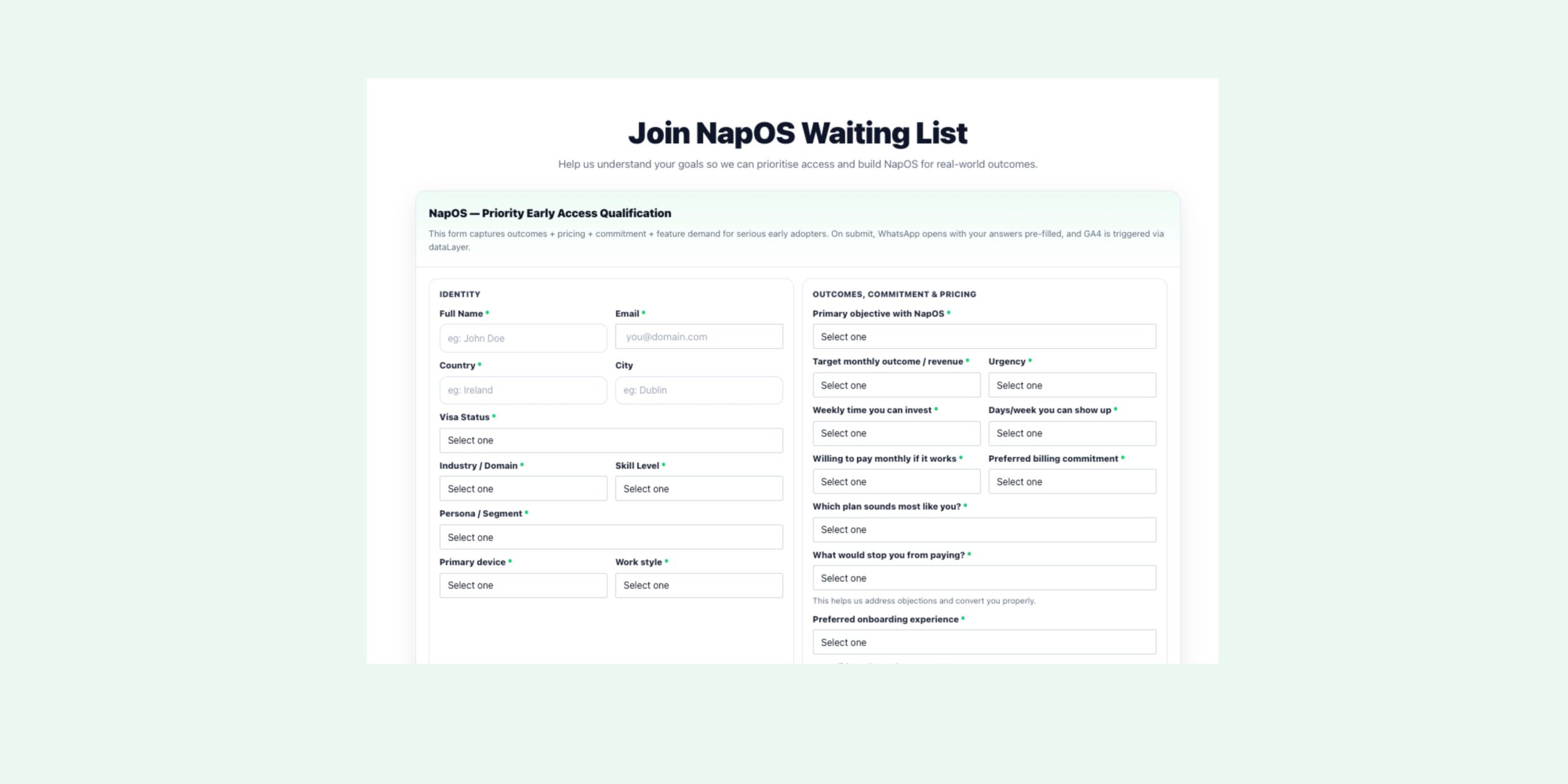
This fictional story explores the gap Nap OS aims to address: helping students turn project work into evidence they can discuss beyond the classroom.
Our proposed approach combines published criteria, practitioner feedback, and moderated assessment. The intention is not to replace a qualification or promise a job, but to make the work behind a student’s skills easier to inspect and understand.