7 min read
Before any of this, I did a mechanical engineering degree in Chennai. Most of it has left me. One thing hasn’t, and it has been in my head all week.
A gearbox cannot give you torque and speed at the same time. Low gear gives you the force to move something heavy from standstill, and it gives you almost no pace. High gear gives you pace, and if you select it too early the engine simply stalls. The skill is not in choosing the right gear. It is in noticing the moment the right gear has changed.
For two years Napblog Limited has been in low gear. On 6 October 2026, standing at a table in the RDS, I think I felt it shift.
What low gear looked like
For two years, the hard part of this business was finding people who wanted to build something.
We had no money for recruitment, so we used the free job post on LinkedIn. Not once — continuously. Every intern who has ever worked on Nap OS came through a free listing on a platform that thinks it is selling hiring software, and we used it as a user-acquisition channel for a product that did not exist yet.
I would love to tell you that was strategy. It was not. It was the only thing we could afford. The strategy was recognised afterwards, which is how most strategy actually works.
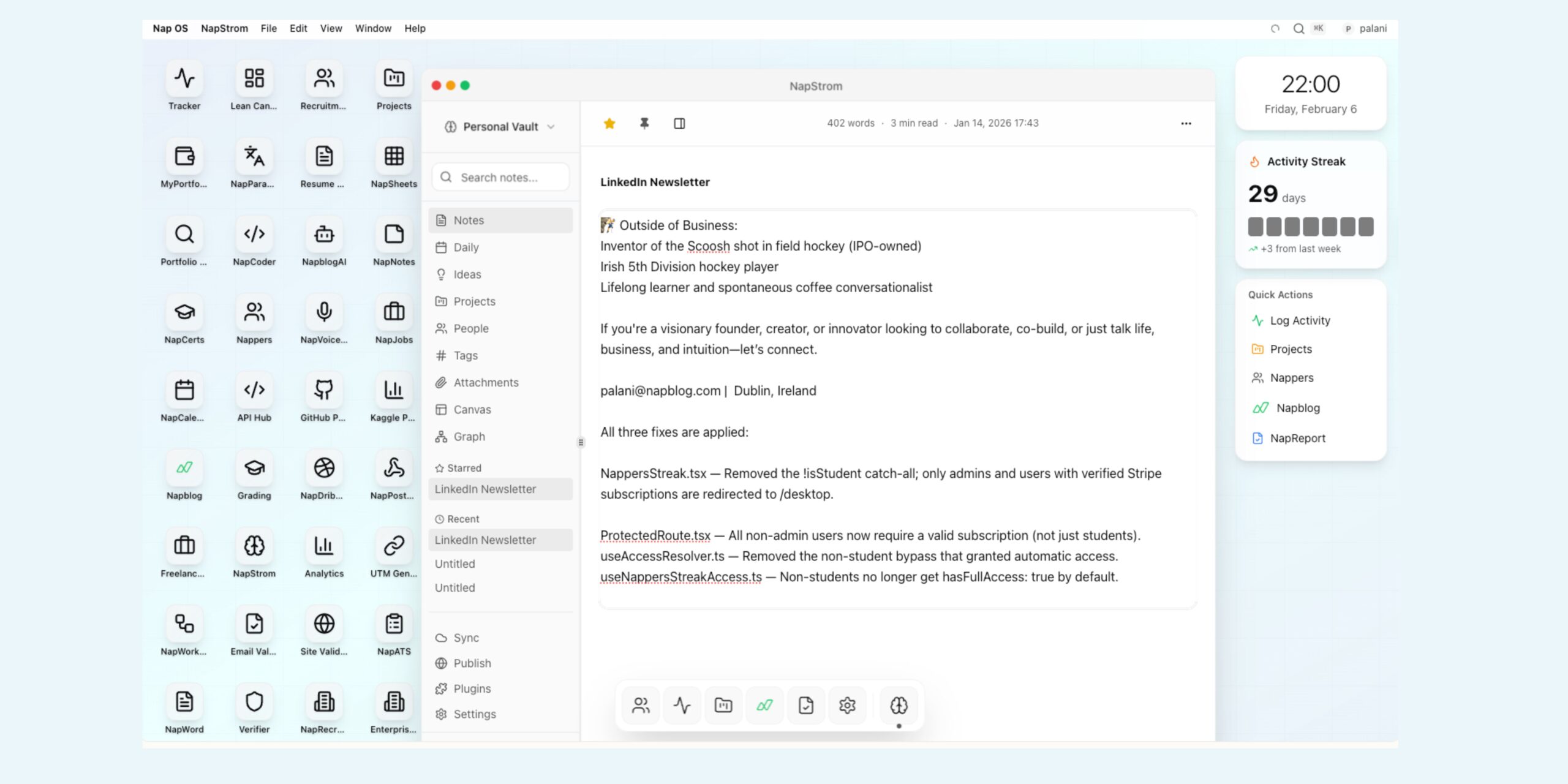
What those people built is the thing you can open today at os.napblog.com. One hundred project domains, ten briefs in each, ten tasks over a fortnight, every task carrying its deliverable and the criteria it will be judged against before you start. Fifty-odd interns and coworkers from twenty countries built that while using it, which is a strange and useful loop: the people learning on the system were the people constructing it. Twenty-eight of them are now with outside employers — Accenture, Amazon, ServiceNow, ESB Networks, Uisce Éireann, Bosch Rexroth among twenty-four companies.
Low gear. Enormous force, very little speed. Two years to move the thing off standstill.
The moment it changed
On 6 October I spoke on the Main Stage at the gradireland Graduate Careers Fair, and then went back to our table. The following afternoon we did the National College of Ireland Part-Time Jobs Fair.
Across the two days, 124 people gave us their details. A third of everyone who scanned our QR code completed a six-field form standing up in a noisy hall, which is a completion rate I did not expect and still slightly distrust. Ninety-two per cent gave a mobile number as well as an email — people do not hand over a phone number to a company they are unsure about.
And the demand was not evenly spread. Data and AI was ticked more than twice as often as any other field. Marketing, product, strategy and startup interest were all healthy and all a long way behind.
Here is the number I am not going to dress up: of those 124, five ticked a paid plan. Five is a signal. It is not a business.
But something in the shape of the problem had inverted while I was not looking. For two years, the scarce thing was people who wanted to do the work. Standing in the RDS, the scarce thing was obviously, suddenly, people qualified to review it.
That is the gear change. Not more demand — a different constraint.
What we actually sell
It is worth being exact about this, because it determines everything that follows.
Every project brief on Nap OS is free. Free to read, free to start, no CV, no application, no interview, no card. What you build stays yours permanently, whether you ever pay us anything or not. That is not a trial period and it is not a funnel trick. It is the product working as intended for someone who wants to self-learn.
The €49.99 a month buys exactly one thing: a named human’s time. Submitting your work for review. Two fifteen-minute one-to-one sessions a month with a project manager. Written feedback within seven days. And a verified completion record stating which brief you did and what you produced.
So the briefs are not the asset. The review is. Earlier this month a recruiter emailed us, unprompted, to check whether a Nap OS reference one of our members had given him was genuine. We confirmed it, with the brief she had completed and the criteria it was judged against. An employer treating our record as a thing worth verifying is the closest we have come to proof that any of this works — and that record is worth precisely as much as the rigour of the person who signed it.
Which means the thing we are now short of is not users. It is reviewers.
So we are hiring, and here is the ask
We are recruiting freelance Project Managers for the Nap OS Work Experience Program. Fully remote, self-employed, caseloads offered rather than assigned. The requirement is at least five years of professional experience in a specific field — data and AI first, given what the fairs told us, then marketing, product, finance, operations, engineering.
The work is to carry a rolling caseload of members, review what they submit against criteria published in advance, return written feedback inside seven days, hold the two short sessions a month, and confirm completion so a verified record can be issued.
We intend to build toward a thousand of them. Our target is 100,000 members by the end of 2027. I want to be careful with that number: it is an ambition, not a forecast, and I would rather say so than oversell it to people I am asking to join us.
The arithmetic I keep running
A thousand reviewers and a hundred thousand members is a hundred members each. Two fifteen-minute sessions a month, per member, is fifty hours of calls alone, before anybody reads a single submission. That is not freelance work. That is a job and a half.
So the ratio only holds if a minority of members are on the paid tier. At roughly the conversion we saw at the RDS — five in a hundred and twenty-four — a thousand reviewers is comfortable, even generous.
Sit with that for a second, because I had to. The plan is quietly sized for conversion staying low. If we get better at the thing we are explicitly trying to get better at, the reviewer bench is the first component that fails.
I do not have a clean answer to that yet. What I have is the knowledge that it is coming, which is better than finding out at the point of failure. It is the sort of thing you only see if you do the division.
The part that is harder than last time
There is an asymmetry between the two recruitment drives, and pretending otherwise would be dishonest.
When we advertised for interns, the value to the applicant was obvious. They needed real experience and a route to a job, and we had exactly that. The self-interest did the persuading for us.
A reviewer with five years behind them does not need us in the same way. The honest question — what is in this for me? — has a much thinner answer, and if I fill a thousand places with people who want the line on their profile rather than people who can give hard, specific, useful feedback, I will have hollowed out the only asset this company owns. A verified record signed by someone who skimmed it is worse than no record at all. It is a lie with a logo on it.
So the first reviewers will not come from a job post. They will come from the twenty-eight. Some of the people who worked through these briefs and are now at Accenture or ESB are already senior enough to review them, and they know the format from the inside because they lived it. That is a warm ask, not a cold one, and the loop it closes — alumni becoming the people who certify the next cohort — is the only version of this that genuinely runs itself.
The LinkedIn post goes up anyway. But I know where the good ones are.
What we are not saying
Napblog Limited trades as Nap OS and holds Licensed Employment Agency licence EA 5651, which makes the next sentence a legal statement as much as an ethical one. We sell project briefs, review and career support. We do not sell recruitment or job placement, and we do not guarantee employment.
The same precision applies to the reviewers. The “reference” a Project Manager provides is a factual confirmation of work completed and reviewed — not a character reference, not a personal endorsement. And we cannot guarantee anybody a volume of work. We will tell you how big the pipeline is, not how big we hope it will be.
Two years to move this off standstill. The engine is finally turning over, and the thing I have learned about changing gear is that the moment you do it is the moment you are most likely to stall.
If you have five years in your field and you can tell someone precisely why their work is not good enough yet, in a way that makes them want to go and fix it, I would like to talk to you.
Start free, either side: os.napblog.com
Pugazheanthi Palani is Founder and CEO of Napblog Limited, trading as Nap OS, a licensed employment agency (EA 5651) at 77 Camden Street Lower, Dublin 2. He spoke on the Main Stage at the gradireland Graduate Careers Fair, RDS, on 6 October 2026.