9 min read
Day 1 was 16 December 2025. One post went up, titled “NapblogOS™: Set to launch — Operating System for Execution-First Marketing Incubation.” There was no product behind that title. There was a name, a conviction, and a founder who had decided to start writing before there was anything to write about.
Day 300 was 11 October 2026. The post that went up was “Why Nap OS is hiring 1,000 freelance Project Managers.”
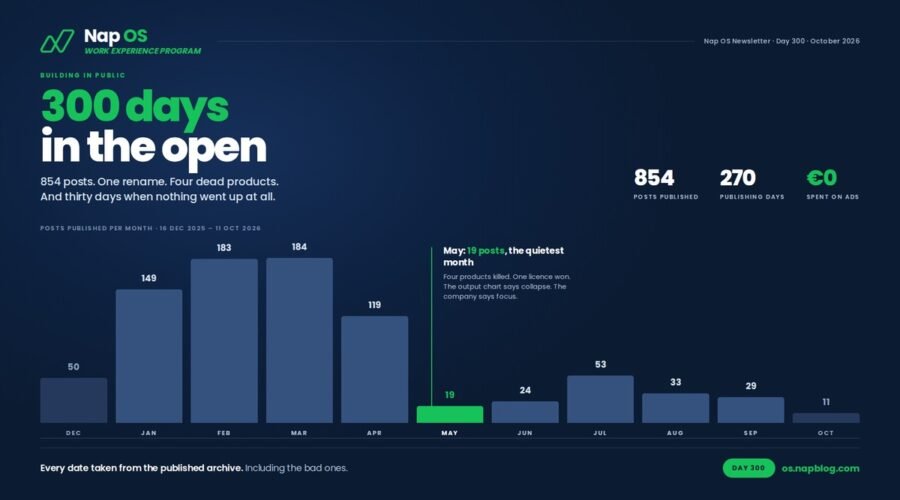
Between those two sentences sit 854 published pieces across 270 publishing days — an average of 2.85 a day, with thirty days of silence. I went back through the whole archive this week to write this, properly, with dates, rather than from memory. Memory is a flattering narrator. The archive is not.
What it shows is not a straight line. It shows a company that ran five products at once, killed four of them, nearly burned itself out in March, went quiet for a week in May, and came out the other side with one thing instead of five. I would not have been able to tell you that was the shape of it. The dates told me.
A note on arithmetic, since I am asking you to trust the numbers. Day 300 by the calendar is 11 October 2026. Our own counters — the “100th edition” in March, “250 days, 250 articles” in August — count editions, and editions run ahead of days because some days carried more than one piece. Both are true. I am using the calendar here.
Phase one — Days 1 to 25: writing the product into existence
16 Dec NapblogOS announced. 17 Dec early access invitation to Version One. 18 Dec a feature spotlight on NapCoder. 19 Dec execution-based accreditation. 22 Dec SIOS — Students Ireland Operating System — begins as a second product. 23 Dec AIEOS, an AI Europe OS, begins as a third. 27 Dec “NapblogOS Certification: When Proof Replaces Promises.” 28 Dec four posts in one day: Why NapblogOS? Why AIEOS? Why SIOS? Why Napblog?
Before 16 December, the archive is eighty-five posts of a marketing agency talking about itself — American clients, Google Ads competitors, SERP screenshots. The pivot is not gradual in the data. It happens on one day.
And the honest description of that first fortnight is that the writing came before the software. I described features that were specifications, not builds. I am not going to pretend that was a technique. It was how I thought, out loud, in public, because I did not have a team to think with.
What I did not expect is that it worked as a filter. Writing “Why is this not for you?” — I published that quartet on 2 January — forced four decisions I had been avoiding. You cannot publish the limits of a product without first deciding what they are.
Phase two — Days 26 to 75: the rename, the launch, and too many children
10 January is the first time the word NapOS appears in a title, in a piece about a third-year marketing student. NapblogOS had been the name for twenty-five days. It never appeared in a title again after 9 January. A rename nobody announced and nobody noticed, because nobody was watching yet — which is, I now think, the single best reason to start publishing before you are ready.
12 January Homeschooling OS begins. That is the fifth product. 15 January the demo video goes up. 19 January a price appears in a headline for the first time: €9.99 a month. 25 January another: €999 a month for power users. 26 and 27 January the T-2 and T-24-hour posts. 28 January, 10:00 Nap OS launches.
January closed on 149 posts. Five brands running in parallel, written by one person, all of them real to me and most of them doomed.
Phase three — Days 76 to 135: peak volume, and the trap inside it
February: 183 posts. March: 184 posts. On 22 February I published twelve pieces in one day. On 27 February, twelve again.
Inside that stretch are the things I am still proudest of — “NapProjects is Live” on 4 February, the pricing explainer on 13 March, “€0 Spent on Ads” on 20 March, the public portfolio share link on 22 March, the 100th edition on 19 March — and also the clearest mistake in the whole 300 days.
The mistake was mistaking volume for progress. Six posts a day is not discipline past a certain point; it is a way of feeling productive while deciding nothing. The archive proves it: SIOS published its last post on 8 February and I kept writing about it right up to the week it died. AIEOS lasted until 19 April. Both were quietly over long before I admitted it, and the daily cadence let me avoid the admission, because there was always another post to write tomorrow.
If you take one thing from this: a publishing habit will carry a bad strategy a long way before it drops it.
Phase four — Days 136 to 165: the month everything got cut
April: 119 posts. May: nineteen.
An 84% collapse in output, and when I looked at what the nineteen actually were, seventeen of them were Nap OS. SIOS gone. AIEOS gone. Homeschooling OS gone. NapblogOS gone as a name.
The worst-looking month in the data is the most important one. Between 20 and 27 May the site was silent for seven straight days — the longest gap in 300 days. I remember that week as failure. Reading it back, it is the week the company stopped being five things.
And the nineteen posts of May are not filler. 1 May is the first time the phrase work experience appears in a title — the language we still use. 5 May Nap OS Drive. 11 May the move to a multi-colour identity. 13 May “Nap OS (Napblog Limited) Becomes a Licensed Employment Agency in Ireland” — licence EA 5651, the single most consequential thing we published all year, in the month with the fewest posts. 17 May “The 20-Month Struggle That Built Nap OS.” 28 May “Start with Free Plan.”
Nineteen posts, one product, a licence and a free tier. I will take that over 184 posts and five identities.
Phase five — Days 166 to 255: narrowing to one sentence
June through August: 24, then 53, then 33 posts a month. Lower volume, and far more specific. This is the stretch where the writing stopped describing a platform and started describing one problem.
9 June — “92 out of 100 cold outreaches got responses. 45 signed up.” 10 June — fifty job seekers into research internships. 22 June — we sponsored a hockey team, which has nothing to do with the product and everything to do with being a company people recognise. 26 June — the first appearance of the two phrases the business now runs on: the Irish work experience Catch-22, and Project Manager.
13 July — verified status. 27 July — Ireland’s €200,000 university placement tender, published because it was evidence the category exists and someone else’s budget says so. 18 August — “250 Days, 250 Product Articles and 50+ Career Outcomes.” 24 August — our €49.99 against a competitor’s €750, in the headline, with both numbers named.
By late August the product could be said in one sentence. That took 250 days.
Phase six — Days 256 to 300: the forty-five days the writing paid for itself
2 September — a piece on the nearly 500 founders who entered New Frontiers Phase 1, written because we had applied. 16 September — Nap OS goes live on WhatsApp. 24 September — “If CoWork AI costs €25 a month, why does Nap OS cost €49.99?”, which is the question a prospect asks and most companies hope they do not.
1 October — 4,000 followers. 5 October — twelve of us in a room on a Sunday finalising a plan. 6 October — the Main Stage at the gradireland Graduate Careers Fair, RDS. 7 October — the National College of Ireland fair: 100 interested students, 30+ early adopters. 11 October, day 300 — hiring 1,000 freelance Project Managers.
Also in that window, and not in the archive because I only learned it in an email: a recruiter contacted us to verify whether a Nap OS reference one of our members had given him was genuine. He had no relationship with us. He found us, decided we were a real thing worth checking, and checked.
That is the moment the thesis of this entire article stopped being a theory.
What building in public actually bought us
Here is the claim, stated plainly, because it is the reason I kept going on the days it felt absurd.
Building in public buys trust, and trust is what makes growth organic.
Not reach. Reach you can buy. Trust you cannot, and in our category trust is the entire product — we are asking an employer to believe a record of work that we signed. A company that publishes its pricing logic, its dead products, its licence, its worst month and its own arithmetic is making a verifiable claim about how it behaves. An employer checking a Nap OS reference is not trusting a landing page. They are trusting 854 dated pieces of evidence that we were here last December saying roughly the same thing we are saying now.
And that is what makes the growth organic rather than purchased. We have spent €0 on ads — I wrote that post on 20 March and it is still true on day 300. What arrived instead: 92 of 100 cold outreaches answered, because people had seen the name before the email landed. 4,000 followers. 124 sign-ups across two careers fairs in two days, with a one-in-three completion rate on a six-field form filled in standing up in a noisy hall. 100 interested students at NCI. A recruiter doing diligence we never asked for.
None of that is a funnel. It is the compounding return on being findable, consistent and checkable for 300 days.
Now the counterweight, because an article like this is worthless without one. Of the 124 people who signed up at those two fairs, five ticked a paid plan. Five. Building in public got us the attention and the credibility; it has not yet got us a revenue line I would defend in front of an investor. Trust lowers the cost of being heard. It does not do the selling. Anyone who tells you a content habit is a business model is selling you the content habit.
Nine things I would tell someone on their day 1
1. Start before it exists. My first twenty-five days described software that was not built. The alternative was not building quietly — it was not starting. Nobody is watching on day 1, which is precisely when it is cheapest to be wrong in public.
2. Publish the limits, not just the promises. Who is this not for? Why does it cost what it costs? Those two posts did more for us than any feature announcement, because anyone can announce a feature.
3. Rename early and say nothing. NapblogOS became Nap OS on day 26, in the middle of an ordinary post, and nobody blinked. Try that on day 300.
4. Watch the volume number for the lie it hides. 184 posts in March felt like the best month of my life. It was the month I avoided four decisions. Daily output is a wonderful servant and a terrible scoreboard.
5. Your quietest month is probably your most honest. Nineteen posts in May, one product, a state licence, a free tier. The output chart says I collapsed. The company says I focused.
6. Let the dead things die on the page. SIOS and AIEOS are still in the archive, dated, unfinished. I thought about taking them down. Leaving them up is the whole point — a founder who only publishes wins is publishing marketing, and everyone can tell.
7. Put real numbers in public, including the unflattering ones. €49.99 against €750. €0 on ads. Five conversions out of 124. One reviewer for every hundred members. A specific number invites scrutiny, and surviving scrutiny is what trust is made of.
8. Write for the one person doing diligence on you. Not for the algorithm, not for the followers. For the recruiter, the grant assessor, the employer who will open the fourteenth tab. They are rare and they decide everything, and 300 days of archive is what they find.
9. Count the days. Not because 300 is a meaningful number — it is not. Because the counter is the only thing that gets you through the stretch where there is no feedback at all, which in my case ran from roughly day 1 to day 240.
Day 300 and here is the actual position, without decoration: one product instead of five, a licensed employment agency, a free tier that costs nothing to use, a €49.99 paid tier bought by a small number of people, 50-odd career outcomes the company has counted, a place on an accelerator’s first phase, twelve people who turned up on a Sunday, and a recruiter somewhere in Dublin who thought we were worth verifying.
Four of my five products are dead. The archive will tell you that for as long as the site is up. I would rather it did.
Day 301 is tomorrow.
Start free: os.napblog.com
Pugazheanthi Palani is Founder and CEO of Napblog Limited, trading as Nap OS, a licensed employment agency (EA 5651) at 77 Camden Street Lower, Dublin 2. Napblog Limited sells project briefs, human Project Manager review and career support. It does not sell recruitment or job placement and does not guarantee employment. All dates and counts in this article were taken from the napblog.com published archive on 12 October 2026: 939 posts in total, 854 of them inside the 300-day window from 16 December 2025 to 11 October 2026.