Last updated: May 29, 2026
4 min read
The Gap Everyone Sees but Few Solve
There is a visible gap.
Between education
And employment.
Students graduate.
With knowledge.
With certificates.
With expectations.
But when they enter the job market,
They face a different reality.
Employers are not asking
What you studied.
They are asking
What you can do.
And this is where the gap exists.
At Napblog Limited,
Through Nap OS,
We observe this repeatedly.
It is not a lack of talent.
It is a lack of proof.
The Rise of Simulation-Based Learning
To solve this gap,
New systems have emerged.
Simulation-based learning.
Programs that replicate real-world tasks.
Giving students exposure
To actual work scenarios.
This is a step forward.
Because it shifts
From theory
To application.
Why Simulation Matters
Simulation introduces context.
How work actually happens.
What problems look like.
How decisions are made.
This creates familiarity.
Reducing the shock
Of entering the workforce.
A Glimpse Into Real-World Roles
Job simulations provide insight.
Into day-to-day activities.
Responsibilities.
Expectations.
They answer a key question.
What does this role really involve?
This clarity is valuable.
Skill Development Through Simulation
Simulations build skills.
Analytical thinking.
Problem-solving.
Communication.
Execution.
These are essential.
And often missing
In traditional education.
Why Simulation Alone Is Not Enough
Simulation is exposure.
Not execution under pressure.
Not accountability.
Not real consequences.
It prepares.
But does not fully prove.
This distinction matters.
The Difference Between Practice and Proof
Practice builds confidence.
Proof builds trust.
Employers hire based on trust.
Confidence is internal.
Trust is external.
Bridging this gap
Requires more than simulation.
Nap OS Perspective: From Simulation to Verification
Nap OS does not stop at simulation.
It moves further.
Into execution.
Into measurable outcomes.
Into verified capability.
This is the missing layer.
Why Employers Still Hesitate
Even with simulations,
Employers face uncertainty.
Can the candidate perform
In real environments?
Under pressure?
With deadlines?
With accountability?
This uncertainty drives caution.
The Need for Execution-Based Systems
Execution removes doubt.
Real tasks.
Real timelines.
Real outcomes.
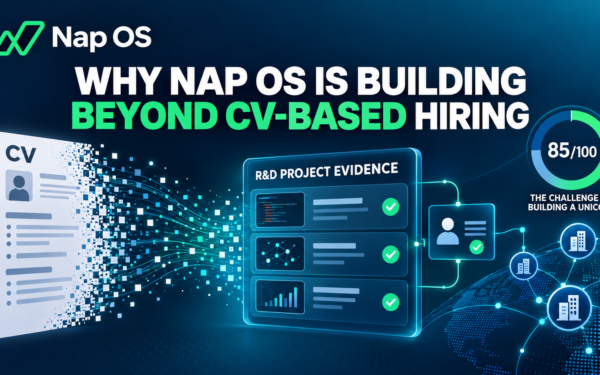
This creates evidence.
And evidence reduces risk.
Nap OS Execution Model
Structured tasks.
Defined objectives.
Continuous performance tracking.
Portfolio creation.
This creates visibility.
For both candidates
And employers.
From Learning to Doing
Education teaches concepts.
Simulation demonstrates application.
Execution proves capability.
Nap OS integrates all three.
Creating a complete system.
The Role of Live Portfolios
Live portfolios show real work.
Not claims.
Not summaries.
But actual output.
This transforms hiring.
From assumption
To verification.
Why Graduates Struggle Without Such Systems
They rely on resumes.
Generic applications.
Repeated rejections.
Lack of feedback.
This creates frustration.
And loss of confidence.
The Shift from Passive to Active Career Building
Passive approach:
Apply and wait.
Active approach:
Build and show.
Nap OS encourages the latter.
This changes outcomes.
Simulation as the First Step, Not the Final Step
Simulation introduces the environment.
But must lead to execution.
Otherwise,
The gap remains.
This is where many systems stop.
Nap OS continues.
Why Companies Value Real-World Exposure
Because it reduces training time.
Improves onboarding efficiency.
Increases productivity.
Companies seek readiness.
Not potential alone.
Reducing Hiring Risk Through Verified Skills
Hiring is risk.
Verification reduces it.
Performance data.
Project outcomes.
Consistency indicators.
These provide clarity.
The Role of Recruitment Agencies in This Evolution
Traditional agencies filter resumes.
Nap OS redefines this.
By presenting verified talent.
Reducing guesswork.
Improving match quality.
A Founder’s Perspective on Career Systems
From building Napblog Limited,
One insight is clear.
The problem is not education.
It is translation.
Translating learning
Into employability.
Why Simulation Platforms Are Important but Incomplete
They create awareness.
Build initial skills.
Provide direction.
But lack verification.
This limits their impact.
Integrating Simulation into a Larger System
Simulation should feed into execution.
Execution should feed into portfolios.
Portfolios should feed into hiring.
This creates a loop.
A complete system.
The Future of Graduate Hiring
Skill-based.
Evidence-driven.
Portfolio-focused.
Continuous evaluation.
This is the direction.
The Role of Technology in This Transformation
Technology enables:
Tracking
Measurement
Analysis
Visibility
This supports scalable systems.
Why Students Must Take Ownership
Systems can support.
But individuals must act.
Engage with simulations.
Execute projects.
Build portfolios.
Visibility requires effort.
The Advantage for Early Adopters
Those who adapt early
Stand out.
Gain opportunities faster.
Build confidence.
Accelerate careers.
Bridging Education and Career: A System Approach
Not a single solution.
But integrated layers.
Learning.
Simulation.
Execution.
Verification.
Placement.
This creates alignment.
The Role of Nap OS in This Ecosystem
Nap OS acts as the connector.
Between education.
Simulation platforms.
Employers.
Creating a unified system.
Why This Matters More Than Ever
The job market is competitive.
Expectations are rising.
Traditional pathways are insufficient.
New systems are required.
Conclusion: From Preview to Proof
Simulation provides a preview.
Execution provides proof.
Both are necessary.
But not equal.
Nap OS — by Napblog Limited —
Bridges this gap.
By moving beyond exposure
Into verification.
Because in the end,
Career success is not built
On what you know.
Or even what you practice.
It is built
On what you can prove.
And when proof becomes visible,
Opportunities follow naturally.
That is the bridge.
From education
To career success.