11 min read
When expanding operations across the Atlantic, corporate leadership often falls into a common trap: assuming that a shared language implies a shared talent landscape. On paper, the United States and the Republic of Ireland appear to be seamless mirrors of one another. Both are English-speaking global economic engines, both serve as foundational hubs for the world’s leading technology, pharmaceutical, and financial services firms, and both possess highly educated, digitally native workforces. However, once talent acquisition teams begin executing hiring strategies on the ground, this illusion of uniformity rapidly dissolves.
Recruiters tasked with managing recruitment pipelines across this corridor encounter structurally divergent landscapes. These differences manifest most acutely when identifying the right candidates through skill assessments and navigating the complex nuances of localization. From the foundational definitions of what “localisation” actually means to the rigid regulatory frameworks governing candidate data and the deeply ingrained cultural expectations of resume writing, hiring across the US-Ireland corridor requires a sophisticated, split-screen approach.
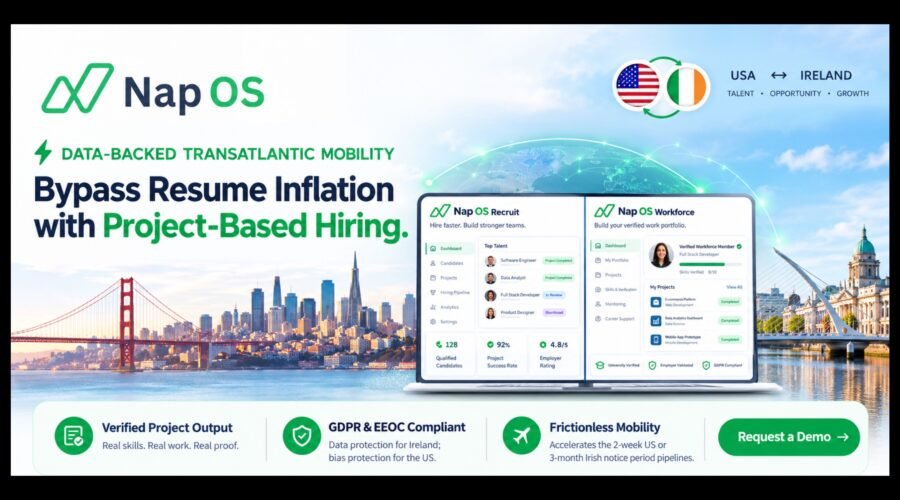
To bridge this transatlantic talent divide, organizations can no longer rely on legacy screening methods, keyword-stuffed CVs, or static multiple-choice testing. Instead, modern enterprises are deploying data-backed, project-based hiring frameworks. By leveraging Nap OS Recruit for talent acquisition and Nap OS Workforce for internal talent mobility and deployment, global companies are replacing guesswork with objective, verified proof of skill.
1. Redefining Localisation: The EMEA Gateway vs. The Domestic Melting Pot
The first and most critical hurdle for global talent acquisition leaders is acknowledging that “localisation” does not mean the same thing in Dublin as it does in San Francisco or New York. The geographic and economic context of each market dictates an entirely different set of hiring priorities and candidate skill profiles.
Ireland: The Multilingual Gateway to EMEA
For decades, Ireland—and Dublin in particular—has served as the preferred European headquarters for American multinational corporations seeking access to the European Union and broader EMEA (Europe, Middle East, and Africa) markets. Consequently, localization recruitment in Ireland is inherently macro-regional and multilingual. When an organization hires a localization specialist, a customer success manager, or a product compliance engineer in Ireland, they are rarely hiring for the Irish domestic market alone.
Instead, recruiters are looking for a highly specific type of candidate: a multilingual professional possessing native-level fluency in languages such as French, German, Arabic, or Japanese, combined with corporate literacy and a deep understanding of their home country’s market nuances. The recruitment challenge here is twofold. Recruiters must not only verify the technical or commercial aptitude of the candidate but must also rigorously assess their language proficiency and cultural competency. This requires sophisticated linguistic assessments that go beyond conversational fluency to test corporate negotiation, technical translation capabilities, and localized regulatory awareness.
United States: The Micro-Regional Melting Pot and Global Blueprint
Conversely, the United States presents a localization landscape that is simultaneously hyper-focused on its internal demographics and geared toward outbound global scaling. Within the domestic US market, localization primarily targets distinct regional, cultural, and linguistic demographics—most notably the massive and diverse US-Hispanic population. A localization recruiter in the US might spend months sourcing professionals who understand the subtle linguistic shifts between Mexican-Spanish, Puerto Rican-Spanish, and Cuban-Spanish to ensure marketing engines resonate accurately across different states.
Furthermore, localization in the US often occurs at the architecture and product development stage. US-based talent is frequently tasked with building the foundational, globalized templates of products that will eventually be handed off to regional teams like those in Ireland. Therefore, while an Irish recruiter is assessing a candidate’s ability to adapt an existing product to a specific European cultural context, a US recruiter is assessing a candidate’s ability to design a scalable, culturally neutral framework that can withstand global adaptation. The former requires deep cultural immersion and regional specificity; the latter requires systems thinking and scalable product engineering.
How Nap OS Solves It: Contextual Project-Based Verification
Traditional assessments fail to bridge this definitions gap because they measure theoretical knowledge rather than practical application.
- Nap OS Recruit solves this by utilizing localized, real-world project simulations. Instead of checking a box for “fluent in German,” an Irish recruiter can deploy a Nap OS project where the candidate must localize an active software interface, handle simulated German customer escalations, and debug encoding issues unique to EMEA regions.
- On the flip side, US recruiters can use Nap OS Recruit to evaluate a product engineer’s ability to build internationalized codebases that support multi-currency, right-to-left language structures, and dynamic UI layouts. Employers get hard, objective performance data before a single interview takes place.
2. The Legal and Compliance Matrix: GDPR vs. EEOC
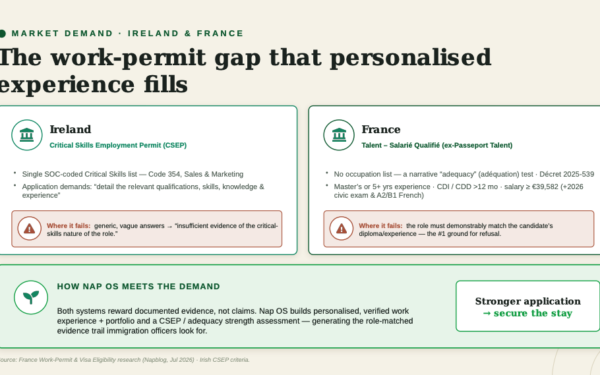
The regulatory environments of Ireland and the United States dictate how recruiters can deploy, score, and utilize skill assessments. Misjudging the legal boundaries of either market can expose an organization to severe financial penalties or systemic litigation.
Ireland: Defensive Testing under the Shadow of GDPR and Labor Laws
Recruiting in Ireland requires a defensive, highly calculated approach to skill assessment. This caution is driven by two powerful forces: the European Union’s General Data Protection Regulation (GDPR) and robust Irish employment legislation.
Under GDPR, candidates retain strict rights over their personal data, including any data generated during a recruitment process. When a recruiter deploys a skill assessment—particularly an automated, AI-driven screening tool—they must ensure absolute transparency. Candidates must be informed of how their data is processed, how the assessment scores are generated, and whether automated decision-making is being utilized. Crucially, candidates often have the right to request human intervention or contest the results of an algorithmic screen. This heavily restricts a recruiter’s ability to use “black-box” AI tools to filter massive talent pools without substantial human oversight.
This regulatory burden is compounded by the permanent nature of employment in Ireland. Once a candidate passes their initial probationary period (which is strictly capped by EU law), terminating employment due to poor performance is an incredibly difficult, legally fraught, and expensive endeavor. Because the cost of a bad hire is exceptionally high, Irish recruiters rely on highly rigorous, scientifically validated, and comprehensive skill assessments prior to making an offer. The assessment process becomes a defensive shield designed to mitigate long-term operational and legal liability.
United States: High-Velocity Hiring and EEOC Compliance
The United States operates on an entirely different legal philosophy. Rooted in the doctrine of “employment-at-will,” US employers generally retain the right to terminate an employment relationship at any time, for any lawful reason, with or without notice. Because the long-term legal risk of an underperforming hire is significantly lower than in Ireland, US recruiters prioritize speed, scalability, and friction-free application pipelines.
However, the US market carries its own distinct legal minefield: the Equal Employment Opportunity Commission (EEOC). While US recruiters have more freedom to use automated, high-velocity screening tools, those tools must strictly avoid “adverse impact.” If a pre-employment skill assessment unintentionally discriminates against a protected class—whether based on race, gender, age, or disability—the organization can face massive class-action lawsuits. Therefore, while an Irish recruiter is focused on GDPR compliance and verifying absolute technical competence to avoid a permanent bad hire, a US recruiter is focused on psychometric validation, ensuring that every assessment is directly job-related, legally defensible, and statistically neutral across demographic groups.
The Nap OS Solution: Built-In Transatlantic Compliance
Navigating this split-screen compliance nightmare is built directly into the fabric of the Nap OS ecosystem:
- GDPR-Compliant Sourcing and Selection: Nap OS Recruit treats candidate data with enterprise-grade protection. Because Nap OS assessments are based on sandboxed, project-based tasks rather than invasive psychometric tracking or biometric AI monitoring, it passes strict European data privacy reviews. Candidates own their verified project credentials, aligning perfectly with GDPR’s data portability mandates.
- EEOC-Aligned, Bias-Free Evaluation: Because Nap OS project-based hiring focuses entirely on output—can the candidate build the project, localize the assets, or solve the technical problem?—it eliminates demographic biases. The platform provides employers with data-backed, standardized scoring rubrics that are strictly job-related, drastically lowering the risk of EEOC adverse impact claims in the United States.
3. Deconstructing the Document: The Multi-Page Irish CV vs. The Hyper-Optimised US Resume
The physical document a candidate submits to a recruiter shapes the entire initial screening phase, and the cultural conventions governing these documents vary dramatically across the Atlantic.
Ireland: The Chronological, Narrative CV
In Ireland, the traditional Curriculum Vitae (CV) remains the standard. Unlike the brief summaries preferred in North America, Irish CVs are frequently multi-page documents that lean heavily into narrative and chronology. It is entirely standard for an Irish candidate to submit a three-to-four-page document detailing a comprehensive history of their responsibilities, educational backgrounds, professional certifications, and personal interests.
For a recruiter, this narrative style presents a specific screening hurdle. While Irish CVs offer rich contextual information about a candidate’s career trajectory, they often obscure hard, quantifiable metrics. A candidate might dedicate paragraphs to describing their day-to-day duties within a localization team without explicitly stating their project throughput, budget responsibilities, or technical tool proficiencies. Recruiters in Ireland must become adept at reading between the lines and using structured, early-stage skill assessments to cut through the narrative fluff and extract verifiable data.
United States: The Hyper-Optimised, Keyword-Stuffed Resume
In stark contrast, the US job market has institutionalized the hyper-optimized, single-page resume. From university career centers to professional coaching services, American candidates are trained to present a punchy, high-impact, highly curated summary of their achievements. Every line is engineered to showcase metrics, revenue generated, or scale managed.
While this makes US resumes exceptionally easy to scan quickly, it creates an entirely different problem for recruiters: extreme inflation and keyword stuffing. Because US candidates know that their resumes will first pass through an Applicant Tracking System (ATS), they optimize their documents to trigger matching algorithms. A candidate may list advanced localization tools, programming languages, or management methodologies on their resume after only minimal exposure to them.
Consequently, US recruiters frequently face the “paper tiger” phenomenon—candidates who look flawless on a one-page resume but collapse when subjected to a basic technical or practical skill assessment. In the US, the primary role of the skill assessment is not to uncover hidden talent, but to validate whether the claims made on a hyper-optimized resume hold up under real-world pressure.
Cutting Through the Noise with Nap OS Recruit and Nap OS Workforce
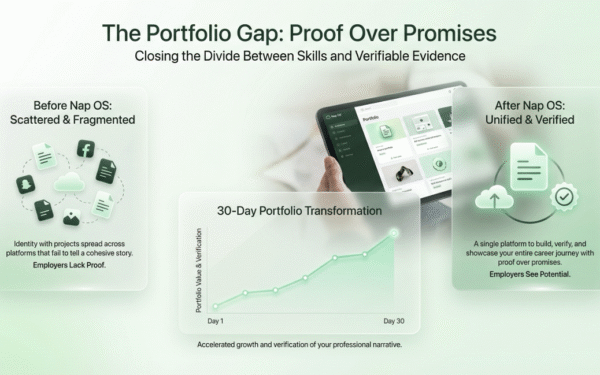
Instead of relying on written promises, the Nap OS suite shifts the evaluation paradigm from what candidates say to what candidates can prove.
Legacy Sourcing vs. Nap OS Project-Based Hiring
+-------------------------------------------------------------------------+

|  [Legacy Loop]  Resume/CV -> Keyword Match -> Unverified Interview      |
|  ❌ Result: High failure rate, resume inflation, cultural mismatch.      |
+-------------------------------------------------------------------------+

|  [Nap OS Loop]  Project Task -> Verified Skill Data -> Strategic Hire    |
|  ✅ Result: 100% compliant, bias-free, validated output.               |
+-------------------------------------------------------------------------+
- For External Sourcing (Nap OS Recruit): When tracking applicants from either market, Nap OS Recruit bypasses the limitations of both the multi-page Irish CV and the keyword-stuffed US resume. Candidates are prompted to complete sandboxed, bite-sized projects that simulate real work. The recruiter receives a standardized, objective scoreboard showing execution speed, accuracy, and problem-solving methodologies, eliminating the risk of hiring a “paper tiger.”
- For Internal Mobility (Nap OS Workforce): Often, the perfect candidate for a cross-border expansion is already within the company. Nap OS Workforce allows enterprises to continuously map the verified skills of their existing team members. If a US company needs to deploy a team to a new Dublin office, Nap OS Workforce uses historical project-based performance data to instantly identify internal talent with the precise language, technical skill, and localization capabilities required, reducing the time-to-hire to zero.
4. Market Velocity and Notice Periods: The Hidden Operational Constraint
Beyond assessments and language, the structural mechanics of talent mobility fundamentally alter how recruiters manage their time-to-hire in both regions.
In Ireland, statutory and contractual notice periods are deeply institutionalized. While entry-level roles may require a standard one-month notice, mid-level and senior professionals—particularly those in highly sought-after tech and localization roles—frequently have contractual notice periods ranging from two to three months. This means that from the moment a candidate accepts an offer, it will be a quarter of a year before they actually log on for their first day. Because of this massive lag, recruiters cannot afford delays in their assessment pipeline. If a multi-stage skill test takes two weeks to administer and grade, the organization risks losing the candidate to a competitor, stretching an already lengthy vacancy even further.
In the United States, the standard notice period is a mere two weeks, regardless of seniority. This creates a hyper-volatile talent market where candidates move with immense speed. If a US company loses a key localization engineer, they expect to source, assess, and onboard a replacement within a matter of weeks. To survive in this environment, US skill assessments must be friction-free, instantaneous, and highly automated. A candidate who encounters a clunky, multi-day take-home test in the US will simply walk away and accept a competing offer from a company with a streamlined one-day assessment loop.
Balancing Velocity with Nap OS Automations
The integrated Nap OS ecosystem addresses both sides of this operational operational speed limit.
- In the fast-moving US market, Nap OS Recruit automates the delivery and grading of project-based tasks. Because grading is data-backed and instantaneous, recruiters can move top-tier candidates from application to offer within days, out-pacing competitors who use manual take-home tasks.
- In the long-notice Irish market, Nap OS Workforce steps in to de-risk the massive timeline gap. By giving hiring managers absolute, verified confidence in a candidate’s skills early on, organizations can confidently trigger the 3-month onboarding runway, knowing their selected candidate has already proven their technical capabilities under real-world conditions.
Direct Comparison: Ireland vs. US Recruitment Landscapes
| Recruitment Factor | Ireland Market 🇮🇪 | United States Market 🇺🇸 |
|---|---|---|
| Language Needs | High demand for diverse European & EMEA languages in hubs like Dublin. | Heavy focus on English and regional US-Spanish localization. |
| Data Compliance | Strict GDPR compliance required for all assessment data and AI tools. | Compliance focused on EEOC laws to avoid systemic demographic bias. |
| Notice Periods | Long notice periods (1 to 3 months), requiring highly accurate early-stage testing. | Short notice periods (typically 2 weeks), requiring rapid, friction-free testing. |
| Assessment Focus | Heavy emphasis on cross-cultural collaboration and European market nuances. | High emphasis on speed, scalability, and immediate technical output. |
| Nap OS Core Tool | Nap OS Workforce (Internal skill mapping & compliance risk mitigation) | Nap OS Recruit (High-velocity, automated project assessments) |
Conclusion: Driving Transatlantic Growth via Project-Based Hiring
Expanding a workforce across Ireland and the United States offers organizations an unparalleled competitive advantage, blending the massive scale and innovation of the US market with the multilingual, regional expertise of Ireland’s EMEA gateway. However, success relies entirely on a recruiter’s ability to look past the shared English language and respect the profound differences beneath the surface.
By replacing subjective, outdated testing methods with Nap OS Recruit and Nap OS Workforce, global enterprises can implement a data-backed, project-based hiring strategy. This unified approach respects local legal boundaries, cuts through resume and CV variations, and delivers verified, high-performing talent across every border.