7 min read
Meet the work before requesting the CV
What if a recruiter’s first introduction to a candidate was not a list of claims, but a short explanation of something they had actually built?
A dashboard. A research report. A campaign proposal. A product prototype. An operational improvement plan.
The candidate explains the problem, shows their contribution and describes what changed after professional feedback. The recruiter can then inspect the output, understand the assessment and decide whether to request application documents or arrange a conversation.
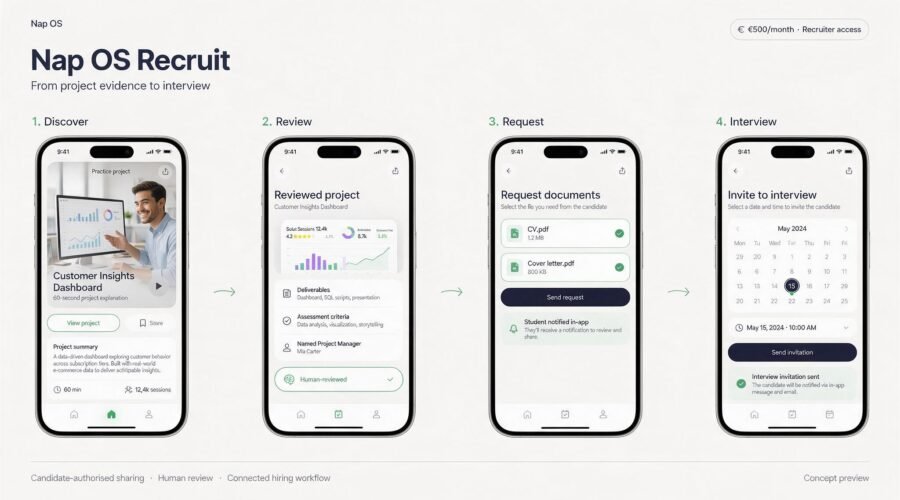
That is the proposed direction of Nap OS Recruit: proof-first recruitment, supported by candidate-authorised project evidence and a connected screening-to-interview workflow.
The proposed price is €500 per month for a recruiter organisation.
The subscription is not simply access to a feed of videos. It is access to an organised process that connects project discovery, evidence review, screening, document requests and interview scheduling.
The ambition is straightforward: make the first hiring conversation more informed.
A short explanation, with substance behind it
A 60-second video can introduce a project quickly. But the video should be the beginning of the evidence—not the evidence in its entirety.
Consider a candidate presenting a data-analysis project.
They explain the question they investigated, show a dashboard, describe an important analytical decision and identify a limitation. They then explain how they improved the work after a Project Manager’s review.
The recruiter can open the underlying project and see:
- The original brief.
- The candidate’s stated contribution.
- The submitted deliverables.
- The assessment criteria.
- The named reviewer.
- The approved feedback.
- The revision history, where shared.
This creates a different starting point for a conversation.
Instead of asking only, “Tell me about your skills,” the recruiter can ask, “Why did you choose this approach, and what would you change?”
The project gives both parties something specific to discuss.
Not every project is employment experience
Credibility depends on describing the work accurately.
A practice project is not automatically a commercial assignment. A fictional-client exercise is not employment with a real company. A reviewed portfolio item is not a university qualification or a guarantee of future performance.
Nap OS Recruit’s proposed evidence structure keeps those categories visible.
A project might be labelled as a reviewed practice project, an anonymised case or an authorised external assignment. The record should explain what was assessed without suggesting that more was verified than actually occurred.
Likewise, a Project Manager’s review of one deliverable does not verify every statement in a candidate’s CV.
The value lies in specificity: this person produced these outputs, against these criteria, and this reviewer assessed the stated work.
Clear limits make the evidence more useful, not less.
Why 60 seconds?
The short format is intended to make discovery manageable.
Candidates should not need to produce a documentary about themselves. Recruiters should not need to watch a long presentation before understanding whether a project is relevant.
A useful explanation can follow four steps:
- What was the problem?
- What did I personally produce?
- Why did I make an important decision?
- What improved after feedback?
The emphasis is on contribution and reasoning.
A narrated screen recording may communicate that better than a talking-head video. A text or audio alternative should also be available so that camera confidence, equipment or accessibility requirements do not become unnecessary barriers.
The objective is not to find the most entertaining presenter. It is to help a recruiter understand the work well enough to decide what to inspect next.
Borrow the convenience of a feed—not the popularity contest
A mobile-friendly, vertical discovery feed could make projects easy to browse.
But recruitment should not become a competition for likes, appearance or attention.
The proposed interface would place useful actions beside each project:
- View the brief.
- Inspect the deliverable.
- Read the assessment summary.
- Save for this role.
- Request further information.
- Invite to interview.
Swipe gestures could provide shortcuts, but equivalent buttons should remain available. Important decisions should be recoverable and connected to a particular opportunity.
“Not progressing for this role” is more accurate than a universal judgement about the candidate.
The interface should encourage relevant inspection—not make rejection feel like a game.
What the €500 subscription would provide
The proposed recruiter organisation subscription brings the hiring workflow together.
An approved organisation would be able to publish opportunities, inspect authorised project evidence, manage expressions of interest, request screening responses and collect application documents.
Recruiters could also coordinate interviews and collaborate with permitted hiring-team members.
The value proposition is continuity.
A candidate discovered through a project should not have to repeat the entire story across disconnected messages. A recruiter should be able to return to the same evidence while preparing for an interview.
However, the subscription would not purchase ownership of candidate information.
It would not override privacy settings, guarantee responses or promise a minimum number of suitable applicants.
The €500 price remains a commercial proposition to validate through actual employer use and renewal.
From project discovery to a complete application
Imagine a recruiter hiring for a junior marketing role.
They inspect a candidate’s campaign project and its assessment summary. The work appears relevant, but they want to understand the candidate’s broader background and interest in the organisation.
They request a CV and a role-specific cover letter.
The student receives an in-app notification identifying the employer, role, requested documents and suggested deadline.
Before submitting, the student chooses the document versions and sees exactly what will be shared.
The recruiter receives a secure notification when the documents are ready.
Keeping the exchange in-app creates a clearer application history. It also reduces reliance on attachments scattered across personal inboxes.
Email can support the process through secure links rather than becoming the only record of it.
Screening questions should connect to the role
An initial screening question should help clarify relevant evidence.
For example:
“Explain one limitation in your analysis.”
“Which part of this project did you complete yourself?”
“What changed after the reviewer’s feedback?”
“How would you adapt this approach for a different customer?”
These prompts create a more focused discussion than asking candidates to perform an undefined personality pitch.
Recruiters should state the purpose and expected effort. Substantial unpaid commercial work should not be disguised as a short screening exercise.
A one-minute response can be useful, but it cannot answer every question about professional suitability.
The next interview remains important.
Analytics that explain—not secretly judge
Nap OS Recruit’s proposed analytics should organise evidence and hiring activity.
For an individual application, that could mean showing which role criteria have relevant shared evidence, which have not been assessed and where clarification is needed.
For a recruiter team, it could mean identifying unanswered applications, scheduling delays and time spent in different stages.
That is different from monitoring private learning behaviour to predict employability.
Scrolling speed, late-night logins, reminder preferences and social popularity should not become hidden hiring scores.
Nor should the platform infer personality or professional competence from facial expressions, accents or video appearance.
The intended product is decision support: clearer information, visible uncertainty and accountable human judgement.
“Evidence not available” should never silently become “candidate cannot do this.”
Notifications should report facts
A connected workflow can keep students informed without exaggerating recruiter interest.
Useful notifications include:
“Your screening response was submitted.”
“Example Company requested your CV.”
“Your shared project record was opened.”
“An interview invitation is available.”
Each message should correspond to an actual event.
Opening a project does not mean the employer liked it. Watching a video does not mean a candidate has been shortlisted. An interview invitation is not a job offer.
Repeated views should be aggregated rather than creating constant alerts.
Candidates should also be able to mute low-value activity notifications while retaining important application updates.
The purpose is clarity, not anxiety.
Learning continues alongside hiring
Nap OS Recruit sits alongside the €999, twelve-month International Workforce Development Programme.
The programme supports project-based learning, professional guidance, review and portfolio development. The recruiter subscription funds a separate employer-facing workflow.
Students should not face an additional charge to apply, submit documents or accept an interview invitation.
Their learning progress should also remain independent of hiring results.
An application rejection does not invalidate a completed project. An interview delay does not reduce a learner’s assessment. A student who changes direction should not lose recognition for work genuinely completed.
Recruitment is one possible use of the evidence—not the only reason to develop it.
A community beyond the application
The wider Nap OS experience could also support moderated questions, professional answers and progress sharing.
Students could discuss project challenges, ask about workplace communication and learn from Project Managers or recruiters speaking within their expertise.
Participants who secure a role could choose to post an achievement and explain what they learned.
Those posts should remain voluntary. A personal update is not automatically a verified placement claim or permission for marketing reuse.
Community popularity should not influence hiring rankings.
The aim is a useful professional learning environment, not another pressure to perform publicly.
Proving the model through use
The next step is a focused pilot with relevant candidates and employers who have genuine hiring needs.
Success would not be measured by video views alone.
More meaningful questions include:
Did recruiters inspect the underlying work? Did the evidence help them ask better questions? Did candidates understand what they shared? Did employers request interviews—and choose to renew?
Nap OS Recruit’s opportunity is not to replace judgement with a feed.
It is to connect a candidate’s explanation to the work behind it, the review attached to it and a clear next action.
Meet the project. Understand the contribution. Inspect the evidence. Then decide whether to start the conversation.