7 min read
A structured route from learning to evidence—before departure and after arrival
“You need experience to get the job.”
“But how do I get experience if nobody gives me the opportunity?”
This is the Catch-22 Nap OS is being designed to address: the gap between having knowledge and having something practical to show.
For an international student, that challenge can feel especially difficult. They may be preparing to enter an unfamiliar professional environment while managing university applications, travel plans and uncertainty about what employers expect.
Napblog Limited’s response is not to promise a shortcut into employment. It is to create a structured route to evidence: project work, guidance from experienced professionals, assessment against stated criteria and a portfolio that explains what the participant actually produced.
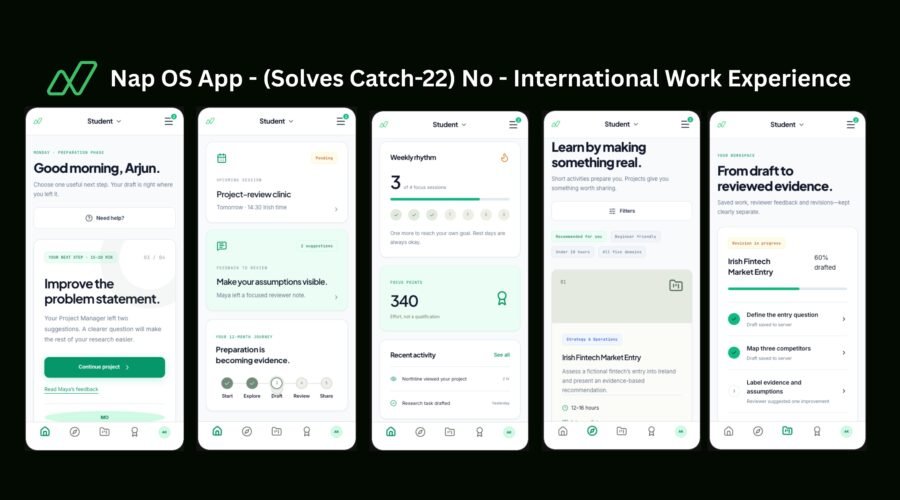
The Nap OS App is intended to make that journey easier to access and follow.
The problem is not always a lack of knowledge
A student can understand a subject and still struggle to demonstrate how they would apply it.
Knowing marketing terminology is different from preparing a campaign recommendation. Studying analytics is different from explaining a dashboard’s limitations. Understanding product development is different from turning ambiguous feedback into a useful research plan.
A CV may list these skills, but the person reading it may still have questions:
What did you build?
Which decisions were yours?
How did you handle uncertainty?
What changed when someone challenged your approach?
Nap OS focuses on giving participants material for those conversations. The objective is not to replace a degree or dismiss existing experience. It is to add practical, clearly described work alongside it.
Breaking the circular dependency
The conventional experience barrier can appear absolute: an employer must first give someone a job before that person has anything relevant to demonstrate.
Nap OS challenges part of that dependency.
A participant does not need to wait for employment to practise analysing a dataset, researching a market, developing a proposal or presenting a recommendation.
They do, however, need a suitable brief, clear expectations and feedback that helps them improve.
That is the proposed learning loop:
Choose a project → understand the criteria → produce an output → receive professional review → revise → document the result.
This does not turn every practice activity into employment. It creates an alternative starting point for demonstrating capability.
International context, with honest limits
Nap OS’s initial proposed pathway focuses on Ireland-bound participants.
The intention is to connect learning with professionals who understand the environment participants are preparing to enter. Where an appropriately experienced Project Manager is available in the intended destination market, their perspective can help make feedback more relevant.
They might ask whether a recommendation is sufficiently clear, whether assumptions have been explained or whether the participant can defend a decision.
But destination matching must follow actual capacity. Nap OS should not imply that every country, profession and language is already covered.
International relevance comes from the quality and context of the review—not simply placing a country flag beside a profile.
What the Project Manager contributes
A project library provides somewhere to begin. A capable reviewer helps the participant understand how to improve.
The proposed Project Manager role includes clarifying expectations, discussing obstacles and reviewing submitted work against published criteria.
Useful feedback should explain more than whether something is right or wrong.
For example:
“Your chart is readable, but your recommendation assumes that correlation establishes causation.”
Or:
“You have identified an audience, but you have not explained why this channel is appropriate.”
The participant then has a specific next action.
This human judgement is central to the programme. Technology can organise the workflow, but a polished interface cannot substitute for someone carefully examining the work.
The 6+6 journey
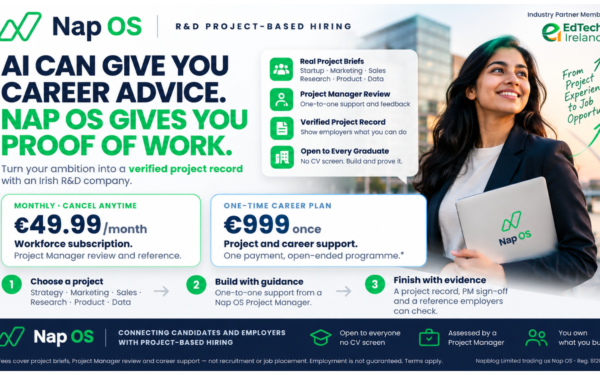
The proposed programme lasts twelve months and costs €999 per participant.
Its 6+6 structure connects two periods.
During the first six months, participants begin project work before departure. They can establish a routine, practise communicating decisions and start building reviewed outputs.
During the next six months, they continue after arrival, alongside their academic and personal commitments.
The timeline provides continuity rather than a guarantee that travel will happen on schedule.
If plans change, the learning should not suddenly become meaningless. The projects, feedback and development remain relevant independently of an admission or visa outcome, subject to the programme’s actual continuation and pause arrangements.
Making access easier through the app
The Nap OS App is intended to bring the journey into one understandable place.
A participant should be able to:
- Choose a project domain.
- Read the brief and assessment criteria.
- Save drafts and supporting files.
- Request a suitable mentoring session.
- Submit work.
- Read feedback.
- Upload a revision.
- Organise selected outputs into a portfolio.
The five proposed domains are Startup and Entrepreneurship, Strategy and Operations, Marketing and Sales, Product and Research, and Data and AI.
Accessibility does not mean the work becomes effortless. It means participants spend less energy figuring out the process and more energy doing the learning.
One clear programme—not a maze of upgrades
Napblog Limited’s current student offer is one €999 programme for twelve months.
The proposed package combines individual career and progress sessions, mock interviews, group workshops, project-review clinics, CV and LinkedIn review cycles, assessed practice projects and defined support.
The final service schedule must be confirmed before enrolment.
A participant should understand what is included, how sessions are booked and what responsibilities remain theirs.
There should not be a second payment to make an included assessment meaningful or a surprise upgrade required to view feedback.
The commercial proposition must be supported by delivery: a clear price is valuable only when the promised service is clear too.
A systematic model behind the experience
Nap OS’s approach is not simply to connect a student with an available professional and hope that useful learning follows.
The proposed operating model connects several responsibilities.
Education and training partners can introduce suitable participants.
Napblog contracts with the participant and manages the programme.
Approved professionals deliver assigned mentoring, workshops and assessments.
The app coordinates bookings, submissions, feedback and records.
Internal programme management monitors capacity, delays, questions and unresolved issues.
This structure matters because consistency cannot depend entirely on the founder remembering every conversation.
The system should make commitments visible—and make problems easier to identify before they become repeated failures.
Partners expand access without owning the learning
Study-abroad consultancies and training organisations can help Nap OS reach students during their planning journey.
The proposed referral arrangement offers a 10% fee on eligible collected programme revenue under written terms. A qualifying full-price €999 enrolment would therefore generate €99.90 before relevant adjustments.
That fee is for a programme referral, not for obtaining employment.
Partners would use approved materials and introduce suitable students. Napblog would retain responsibility for programme delivery, support, complaints and refunds.
An introduction does not automatically authorise unrestricted sharing of student information.
The partnership should make the programme easier to discover without making the student’s journey less transparent.
What a reviewed record should mean
After an assessment, the participant needs an accurate account of what happened.
A useful record can identify the project, its type, the outputs reviewed, the criteria, the reviewer and the assessment date.
It should distinguish a fictional-client exercise from an authorised external assignment.
It should also distinguish learner-reported effort from independently observed activity.
The record is not a degree, professional licence or employment contract.
Its credibility comes from the precision of the statement.
“This output was reviewed against these criteria” is more useful than an impressive badge whose meaning nobody can explain.
Participants should control which eligible records and deliverables they share externally.
Connecting evidence to recruitment
The proposed Nap OS Recruit service adds an employer-facing route.
For €500 per month, a recruiter organisation would access an authorised workflow for inspecting shared project evidence, requesting application information and arranging interviews.
A candidate could explain a project in approximately sixty seconds, with an appropriate alternative format available.
The recruiter could then inspect the actual work and approved review before requesting a CV or cover letter.
The short explanation introduces the evidence; it does not replace it.
Students should not pay an additional application fee. Purchasing the learning programme must not be presented as buying employment access or a guaranteed hiring outcome.
A realistic answer to an apparently impossible problem
Nap OS cannot guarantee that an employer will hire someone, create a vacancy that does not exist or remove every obstacle associated with moving country.
It also cannot make every learner equally prepared through the same brief.
What it can seek to do is make one part of the journey more structured:
Give the participant a meaningful task, provide experienced guidance, assess the output honestly and help them explain what they learned.
The next test is practical—paid demand, reliable delivery, useful feedback and employers finding the evidence relevant.
The Catch-22 is not broken by declaring that experience no longer matters.
It is challenged by helping someone move from “I have never been given the chance” to “Here is work I completed, here is how it improved, and here is what was reviewed.”