7 min read
For decades, Ireland has positioned itself as one of Europe’s most attractive economies. Home to the European headquarters of Apple, Google, Meta, and dozens of other global giants, the country’s corporate reputation is second to none. Official unemployment rates have hovered at historically low levels in recent years, often cited as among the best in the European Union. Government reports and recruitment agency brochures paint a vibrant picture: a young, educated workforce, a thriving startup culture, and a talent-hungry market desperately seeking skilled professionals.
This image is not entirely false. Ireland does offer genuine opportunities. The FDI-driven economy has created tens of thousands of high-quality jobs. The country’s investment in higher education has produced a large cohort of degree-educated young people. Recruitment agencies, employment services, and online platforms have multiplied, theoretically giving candidates more routes into the workforce than ever before.
Yet for the graduate clutching their degree and the experienced professional returning to the workforce after a gap, this image feels deeply disconnected from reality. The polished brochure of Irish employment does not show the CV rejected by an algorithm, the interview that never came, or the silence from an agency that promised to be in touch.
The Reality: A System Failing Graduates and Job Seekers
The modern Irish recruitment system, despite its apparent sophistication, contains fundamental flaws that systematically disadvantage job seekers. Three problems stand out with particular clarity.
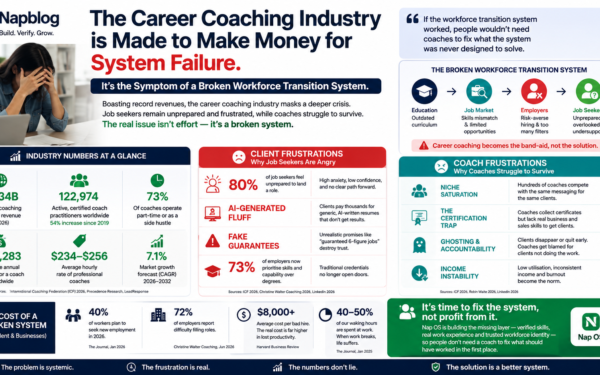
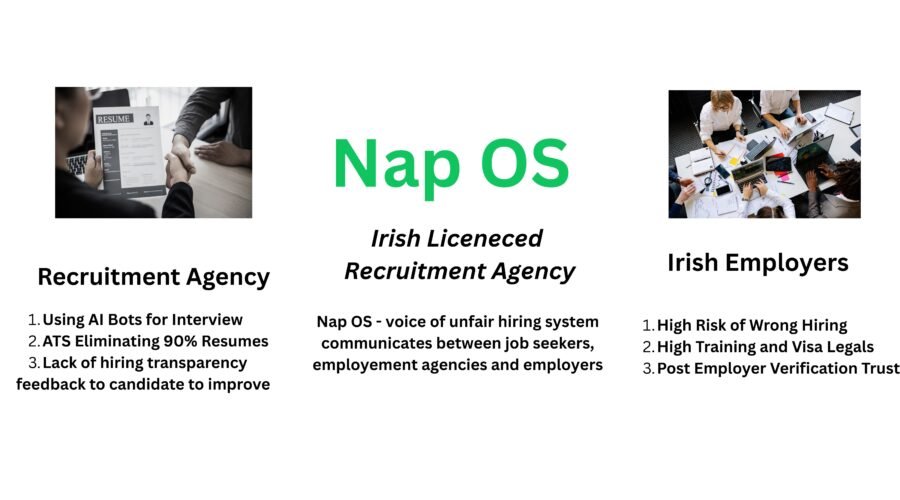
First, the widespread adoption of AI-driven bots and Applicant Tracking Systems (ATS) has created an invisible wall between candidates and employers. Recruitment agencies now routinely deploy AI interview bots and automated screening tools that filter candidates based on keyword matching, formatting, and algorithmic scoring. It is estimated that ATS systems eliminate up to 90% of submitted resumes before a human recruiter ever sees them. This means that a highly qualified graduate who has not optimised their CV for a machine — who has not learned the art of keyword stuffing or ATS-friendly formatting — may never receive a single response, regardless of their genuine talent or suitability for a role.
This is not a minor inconvenience. For a recent graduate applying for their first professional role, or for an immigrant worker trying to break into the Irish market, the ATS barrier is often insurmountable. The system was designed to save recruiters time, but its unintended consequence has been to create a hiring process that is profoundly unfair and deeply opaque.
Second, Irish recruitment is plagued by a lack of transparency and feedback. Candidates regularly apply for dozens, sometimes hundreds, of positions and receive nothing in return — no acknowledgment, no feedback, no guidance on how to improve. This feedback vacuum is particularly damaging for graduates who are still learning how to navigate professional environments. Without constructive feedback, they cannot improve. Without improvement, they remain stuck in the same cycle of rejection. The absence of transparency in hiring decisions is not just frustrating — it is a structural barrier to social mobility and workforce development.
Third, employers themselves face significant risks in the current system, including the high cost of wrong hiring decisions, complex visa and training obligations for international candidates, and the challenge of verifying post-employment credentials and references. These pressures cause employers to become overly conservative in their hiring, defaulting to safe choices that often exclude exactly the kind of innovative, diverse talent that Ireland needs to sustain its economic growth.
Nap OS: The Voice of a Fairer System
Into this broken landscape steps Nap OS, an Irish Licensed Recruitment Agency that is repositioning itself not merely as a staffing solution, but as the voice of an unfair hiring system. Nap OS recognises that the employment crisis in Ireland is not a talent shortage — it is a communication failure. The gap between job seekers, employment agencies, and employers is not filled with opportunity; it is filled with silence, algorithmic noise, and institutional inertia.
Nap OS bridges this gap. By acting as a transparent communicator between all three parties — candidates, agencies, and employers — Nap OS challenges the assumptions that have allowed the current system to persist. It advocates for candidates who have been screened out by machines before their potential was ever considered. It demands transparency from a recruitment ecosystem that has grown comfortable with opacity. And it works with employers to reduce the risks that make them reluctant to take chances on promising graduates and international talent.
This is not a marginal reform. It is a revolutionary proposition. The employment system in Ireland has operated on the same fundamental logic for decades: employers set the terms, agencies filter the candidates, and job seekers compete in a game whose rules they cannot fully see or understand. Nap OS proposes to change the game itself.
The Revolutionary Change Ireland Needs
Resolving graduate and job seeker unemployment in Ireland requires more than job fairs and CV workshops. It requires a structural rethinking of how hiring works, who it serves, and what values it should reflect. Several transformative changes are essential.
Transparency must become a legal and professional standard in recruitment. Every candidate who applies for a role should receive meaningful feedback, particularly graduates entering the workforce for the first time. This is not just a courtesy — it is an investment in human capital. A workforce that receives honest, constructive feedback grows faster, becomes more skilled, and fills the positions that employers say they cannot find candidates for.
Toward a Fairer Irish Employment Future
The image of Ireland as a land of employment opportunity is not entirely wrong — but it is dangerously incomplete. The reality, experienced daily by graduates and job seekers sending CVs into silence, is one of a system that is technically functional but humanly broken. It processes applications without seeing people. It filters talent without measuring it.
The Revolutionary Change Ireland Needs
Resolving graduate and job seeker unemployment in Ireland requires more than job fairs and CV workshops. It requires a structural rethinking of how hiring works, who it serves, and what values it should reflect. Several transformative changes are essential.
Transparency must become a legal and professional standard in recruitment. Every candidate who applies for a role should receive meaningful feedback, particularly graduates entering the workforce for the first time. This is not just a courtesy — it is an investment in human capital. A workforce that receives honest, constructive feedback grows faster, becomes more skilled, and fills the positions that employers say they cannot find candidates for. Ireland should consider following the lead of progressive employment markets that mandate feedback within defined timeframes.
ATS and AI screening tools must be regulated and reformed. The use of automated systems to eliminate the majority of candidates before human review is ethically problematic and economically counterproductive. Regulatory bodies should require recruitment agencies and employers to disclose when AI screening is used, to audit their systems for bias, and to ensure that automated rejection does not occur without human oversight. Candidates should have the right to know why they were screened out and how to address those reasons.
Employer support must be expanded and restructured. The high risks associated with wrong hiring decisions, visa complexities, and training obligations are real barriers that push employers toward conservative, homogeneous hiring. Government-backed schemes, employer verification networks, and post-hire support services can reduce these risks and open the door to more diverse, more innovative talent pipelines. Nap OS’s focus on Post Employer Verification Trust is a model worth scaling — creating accountability and confidence on both sides of the employment relationship.
Graduate support must begin before graduation. Universities and colleges in Ireland must develop deeper, more practical relationships with employers and licensed recruitment agencies. This means not just career fairs, but integrated work placement programmes, transparent hiring simulations, and honest conversations about what the job market actually requires. Graduates who understand the real mechanics of hiring — including the role of ATS, the importance of networking, and the realities of entry-level competition — are far better equipped to succeed.
Toward a Fairer Irish Employment Future
The image of Ireland as a land of employment opportunity is not entirely wrong — but it is dangerously incomplete. The reality, experienced daily by graduates clutching degrees and job seekers sending CVs into silence, is one of a system that is technically functional but humanly broken. It processes applications without seeing people. It filters talent without measuring it. And it leaves thousands of capable, motivated individuals on the margins of an economy that claims it cannot find enough skilled workers.
The revolution in Irish employment is not a distant aspiration. It is already beginning, driven by organisations like Nap OS that refuse to accept the current ystem’s failures as inevitable. By restoring transparency, challenging algorithmic gatekeeping, and rebuilding trust between all parties in the employment relationship, it is possible to close the gap between image and reality — and to build an Irish workforce that is as inclusive, dynamic, and human as the country aspires to be.
The graduates are ready. The job seekers are ready. The question is whether the system is ready to meet them.