7 min read
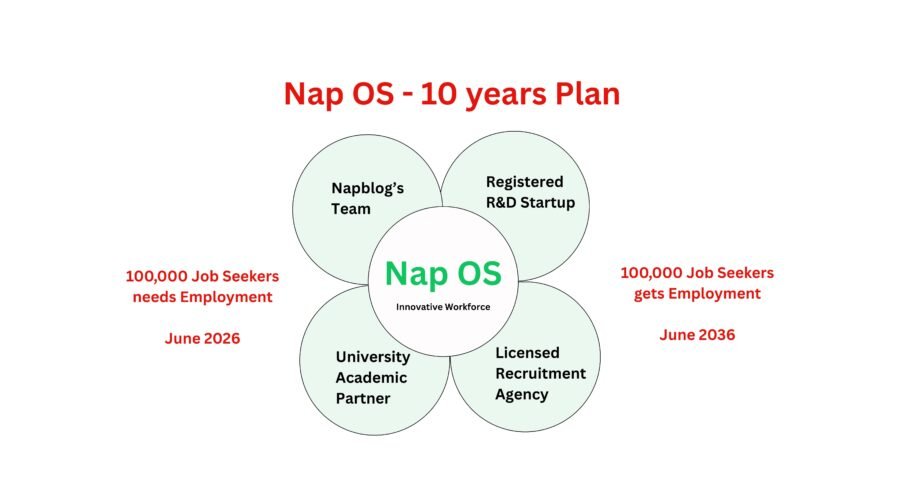
By 2036, Nap OS is committed to one audacious mission — connecting 100,000 job seekers to meaningful employment. Everything else is secondary.
A Mission Born From a Crisis
The global employment landscape has never been more complex. On one hand, businesses are struggling to find the right talent. On the other, hundreds of thousands of qualified, capable, and eager job seekers are stuck in a system that was never designed to serve them well. Traditional recruitment agencies chase commissions. Job boards reduce people to keywords. Universities graduate students into uncertainty. Somewhere in the gap between a candidate’s potential and an employer’s opportunity, human futures are being lost.
Nap OS was built to close that gap.
Starting in June 2026, Nap OS formally acknowledges what is already a lived reality for far too many people: 100,000 job seekers need employment. That number is not a statistic. It is 100,000 individuals — each with a skill set, a dream, a family, a mortgage, a student loan, or a vision for their future — who are waiting for a system that finally works for them. By June 2036, Nap OS commits to ensuring that same number of people gets employment. Not just any job. The right job. A qualified match that enriches not just a CV, but a life.
This is the sole reason Nap OS exists.
What Makes Nap OS Different
To understand why Nap OS has the potential to deliver on a promise that other platforms have failed to keep, you need to understand its architecture. Nap OS is not a single product or a single service. It is an innovative workforce ecosystem — a deliberate, interconnected structure built on four foundational pillars, each one designed to address a specific failure point in the traditional employment pipeline.
Napblog’s Team sits at the creative and communicative heart of Nap OS. The people behind Napblog have spent years building communities, publishing insights about the world of work, and understanding what job seekers actually need. They are not removed executives making decisions in boardrooms; they are practitioners who have worked alongside candidates, understood their anxieties, and translated those insights into tools and strategies that genuinely help. The team ethos is simple: every article written, every resource published, every piece of content created, serves the singular goal of moving a job seeker closer to employment.
Registered R&D Startup status gives Nap OS something rare in the recruitment world — a mandate to innovate. By operating as a registered research and development startup, Nap OS is able to invest in new methodologies, test emerging technologies, and explore non-traditional pathways to employment that conventional agencies cannot or will not pursue. This is what allows Nap OS to look beyond the standard CV-and-interview model and ask harder questions: How do we identify hidden talent? How do we assess potential, not just pedigree? How do we ensure that a candidate from a non-traditional background gets the same fair hearing as someone from a top-ranked institution? R&D is not a department at Nap OS — it is a philosophy.
University Academic Partnerships ensure that the mission begins long before a candidate sends their first application. By embedding Nap OS within academic ecosystems, the platform is able to engage with talent at the point where their careers are still being shaped. University partnerships allow Nap OS to co-design curricula that reflect real market needs, provide students with early exposure to employment pathways, and create a pipeline of job-ready graduates who have been equipped — not just educated. This is workforce enrichment in its truest sense: preparing people for careers that exist today and building adaptability for the careers that will emerge tomorrow.
Licensed Recruitment Agency operations bring credibility, compliance, and commercial effectiveness to the mission. A licence is not merely a legal requirement — it is a commitment to professional standards, ethical practice, and accountability. Nap OS operates as a licensed recruitment agency because trust matters. Employers need to know that the candidates presented to them have been thoroughly vetted, properly prepared, and genuinely suitable. Job seekers need to know that the organisation advocating for them is operating within a framework designed to protect their interests. Licensing ensures both.
The Ten-Year Timeline: Ambition With Accountability
Ambitious missions without timelines are merely wishes. Nap OS has chosen to anchor its vision to two specific dates — June 2026 and June 2036 — because accountability requires specificity.
June 2026 marks the formal acknowledgement of the problem. It is the moment Nap OS publicly declares: we see the 100,000. We are counting them. We are building for them. This is not a soft launch or a pilot programme. It is a declaration of intent that puts a number on a crisis that many organisations prefer to discuss in vague terms. By naming the number — 100,000 job seekers who need employment — Nap OS removes the comfort of ambiguity.
June 2036 is the delivery date. In ten years, those 100,000 job seekers will have found employment through the Nap OS ecosystem. That is the target. That is the measure by which the entire enterprise should be judged. Not revenue. Not platform users. Not media coverage. Employment outcomes.
Ten years is both a long time and a very short one. It is long enough to build something truly transformative — a licensed agency with deep university relationships, a research pipeline that keeps evolving, and a community-driven content engine that attracts and supports candidates at every stage of their journey. But it is short enough to demand urgency. With 100,000 placements needed over a decade, that translates to roughly 10,000 job seekers finding employment each year, or approximately 833 per month. There is no time for complacency.
Why “Enriching” Candidates Is the Right Word
It is worth pausing on the language. Nap OS does not simply aim to place candidates. It aims to enrich them.
Enrichment implies something beyond transactional. It means that a person who comes into contact with the Nap OS ecosystem should leave it more capable, more confident, more informed, and more empowered than when they arrived — regardless of whether they secure a job on their first interaction or their tenth.
This is a critical distinction. A recruitment agency that only measures success by placements will inevitably cut corners on candidate development. It will focus on the easiest wins and overlook the most challenging cases. Nap OS’s commitment to enrichment means investing in every candidate — the recent graduate with no work experience, the career changer facing scepticism, the experienced professional whose industry has been disrupted, the returner who has been out of the workforce for years. Each of them deserves not just a job listing but a journey.
Enrichment through Nap OS looks like access to real-world knowledge through Napblog’s content. It looks like curriculum co-design through academic partnerships that means students graduate with skills employers actually need. It looks like ethical, transparent recruitment practices that respect candidates as people rather than treating them as units of labour. It looks like ongoing R&D that constantly asks whether the current system is serving its users well — and changes course when the answer is no.
The Bigger Picture: What 100,000 Employed People Means
One hundred thousand employed people is not just a corporate milestone. It is a social transformation.
Employment is the single most powerful lever for individual economic stability. A person who is employed is better positioned to support their family, contribute to their community, pay taxes that fund public services, and participate in the civic and economic life of their society. Employment reduces poverty. It improves mental and physical health. It creates networks that generate further opportunity. It builds dignity and agency.
When Nap OS talks about enriching 100,000 job-qualified candidates, it is talking about a ripple effect that extends far beyond those individuals. Each employed person potentially supports dependents, spends within local economies, and models possibility for others in their community. The second and third-order effects of 100,000 quality job placements are immeasurable.
This is why Nap OS describes itself as an Innovative Workforce platform rather than merely a recruitment business. The goal is not to fill vacancies. The goal is to change how the relationship between talent and opportunity functions — to make it more human, more equitable, and more effective for the people who need it most.
Conclusion: The Sole Reason to Exist
Every organisation should be able to answer one question clearly: why do you exist?
For many companies, the honest answer is profit. For others, it is growth, market share, or competitive advantage. These are not shameful motivations, but they are insufficient foundations for something that genuinely matters.
Nap OS has a different answer. Nap OS exists because 100,000 people need employment. Its team, its R&D mandate, its university partnerships, and its licensed recruitment operations are all instruments of a single purpose. The ten-year plan from June 2026 to June 2036 is not a business roadmap — it is a promise.
When every platform, every process, every partnership, and every piece of content is oriented around one north star — enriching qualified candidates and connecting them to meaningful work — the result is not just a successful company. The result is a legacy.
That is the sole reason Nap OS exists. And it is reason enough.