6 min read
The Irish job market is one of the most dynamic and fast-evolving in Europe. Whether you are a recent graduate stepping into the professional world for the first time, a career changer pivoting into a new industry, an experienced worker returning after a break, or someone new to the country seeking their first Irish role — the path to employment is rarely straightforward. The barriers are real, the competition is fierce, and the gap between a candidate’s potential and their ability to prove it to employers has never been wider.
At the same time, Irish employers are navigating their own serious challenges. Wrong hiring decisions carry enormous financial and operational costs. Visa obligations, onboarding, and compliance requirements consume HR bandwidth. And building genuine trust in a candidate’s post-hire performance remains one of the most persistent pain points in modern recruitment.
This is precisely the space that Nap OS — an Innovative Workforce platform — was built to address. Nap OS does not just serve a niche demographic. It serves every job seeker who is struggling to get a fair shot, and every employer who wants to hire with greater confidence and clarity.
The Real Barriers Every Job Seeker Faces
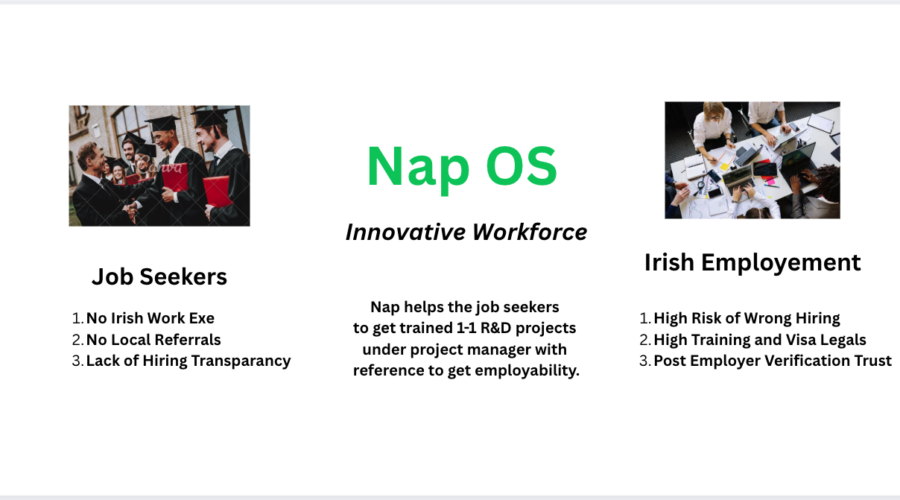
The challenges that keep job seekers out of the Irish workforce are not limited to those arriving from abroad. Local candidates — including recent graduates, those re-entering employment after a gap, or professionals transitioning between industries — face the same fundamental obstacles. Nap OS has identified three core barriers that affect job seekers across the board.
1. No Irish Work Experience
The “experience paradox” is one of the most universal frustrations in the modern job market. Employers consistently demand demonstrated experience, yet candidates — regardless of whether they are homegrown or internationally trained — cannot build that experience without first being given the opportunity. A local graduate with a first-class degree in computer science faces this wall just as much as a skilled professional who has recently relocated. Without a track record of project delivery within an Irish professional context, even the most talented candidates find their CVs sidelined in favour of those who already have verifiable local outputs. This creates a self-reinforcing cycle that shuts out capable people at scale.
2. No Local Referrals
Ireland’s professional ecosystem places enormous value on referrals, recommendations, and personal endorsements. A significant portion of roles — across industries from technology to finance to healthcare — are filled through professional networks long before they ever appear on a public job board. This means that candidates without an established local professional network are systematically disadvantaged, regardless of their skills or qualifications. A young graduate who has not yet had time to build industry relationships, a parent returning to the workforce after years of caring responsibilities, or a professional switching careers — all find themselves outside the informal referral web that powers much of Irish hiring. Talent alone is not enough when the gatekeepers rely on trusted introductions.
3. Lack of Hiring Transparency
Across the Irish recruitment landscape, a persistent lack of transparency causes significant frustration and lost opportunity for job seekers of all backgrounds. Applications are submitted and go unanswered. Interview feedback is rarely provided. The criteria used to shortlist or reject candidates are seldom communicated clearly. For job seekers, this opacity makes it nearly impossible to understand what employers genuinely value, to identify areas for self-improvement, or to build confidence through the process. Without visibility into how hiring decisions are made, even the most motivated candidates can feel they are applying in the dark, burning time and energy with little sense of progress or direction.
The Challenges Irish Employers Are Dealing With
While job seekers are struggling to break in, employers are grappling with their own equally serious set of problems. Nap OS recognises that the employment relationship is a two-sided equation, and solving it effectively means addressing friction on both ends.
1. High Risk of Wrong Hiring
Hiring the wrong person is one of the most expensive mistakes a business can make. Research consistently shows that the total cost of a bad hire — accounting for recruitment fees, onboarding time, lost productivity, team disruption, and eventual replacement — can amount to several times the annual salary of the role in question. In a competitive market, where skilled professionals are in demand and notice periods can stretch for months, Irish employers cannot afford to make frequent hiring errors. Yet traditional CV screening and interview processes offer limited insight into how a candidate will actually perform on the job.
2. High Training and Visa Legals
For employers open to hiring internationally, the administrative burden can be substantial. Work permits, visa sponsorship requirements, skills shortage frameworks, and evolving immigration rules create a complex compliance landscape that demands considerable time and expertise to navigate correctly. Add to this the cost of onboarding and training new hires who may arrive without job-ready skills aligned to the employer’s specific needs, and the investment required per hire becomes significant. Many smaller Irish businesses, in particular, simply do not have the internal HR resources to manage this complexity smoothly.
3. Post-Employer Verification Trust
One of the most underappreciated challenges in Irish hiring is the difficulty of verifying what a candidate has genuinely delivered in their previous roles. References are frequently cursory. Employment records can be embellished. Claimed project ownership is difficult to validate. Employers increasingly need a mechanism for trusting not just that someone held a job title, but that they produced meaningful, measurable work within it. The lack of reliable post-employment verification erodes confidence in the hiring process and pushes employers toward cautious, risk-averse decisions that can inadvertently exclude strong candidates.
How Nap OS Bridges the Gap
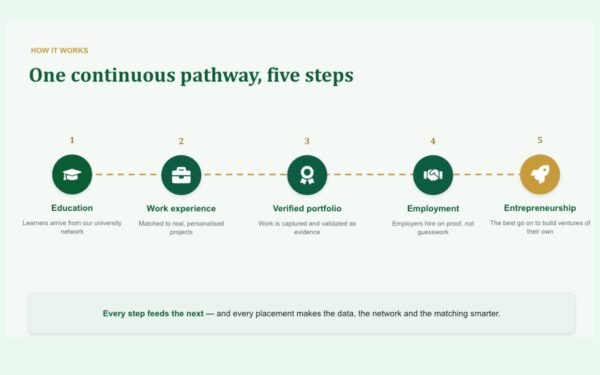
Nap OS addresses both sides of the employment challenge through a single, coherent solution rooted in structured, hands-on learning and professional credibility building.
The platform helps job seekers — every job seeker, local or otherwise — to get trained through 1-1 R&D projects under a project manager, with reference, to gain genuine employability. This approach is transformative for several reasons.
First, it directly solves the experience paradox. By working on real R&D projects under professional supervision, candidates build verifiable, portfolio-ready experience that speaks directly to what Irish employers are looking for. This is not simulated coursework or theoretical training — it is authentic project delivery that mirrors the demands of the professional workplace.
Second, the project manager relationship creates exactly the kind of trusted local reference that job seekers typically lack. Upon completing their project, candidates leave with a credible, named professional endorsement from within the Irish employment ecosystem — the kind of referral that opens doors.
Third, the structured and transparent nature of the Nap OS training model directly counters the opacity that plagues traditional hiring. Candidates know what they are working toward, can demonstrate their progress, and emerge with documented proof of capability rather than a vague collection of qualifications and unverifiable claims.
For employers, Nap OS-trained candidates represent a lower-risk hire. They arrive with demonstrable project experience, a verified reference, and a track record of completing structured professional work. The cost and uncertainty of training from scratch is reduced. The verification problem is addressed at source.
Why Nap OS Matters for the Future of Irish Work
The conversation around employment in Ireland needs to expand beyond the assumption that the challenges of the job market are only faced by a particular type of candidate. Every fresh graduate, every career returner, every professional pivoting their path, every person who lacks the right connections regardless of where they were born — all of them deserve a fair, transparent, and skill-focused route into meaningful employment.
Nap OS is building that route. By combining structured R&D project training, professional mentorship, and credible reference generation, it creates a bridge that serves the full spectrum of job seekers while simultaneously solving the most costly problems facing Irish employers today.
In a labour market that increasingly rewards demonstrable skills over pedigree and connections, Nap OS is not just a useful tool — it is a necessary one. The future of Irish employment is more transparent, more skills-based, and more inclusive. Nap OS is helping to build it, one project at a time.