8 min read
For millions of students and graduates, the hardest part of entering the workforce is not necessarily a lack of ability.
It is knowing what to do next.
A student may have completed a degree, attended career fairs, submitted CVs, applied for internships, completed coursework, joined societies, built small projects, or developed valuable technical and professional skills. Yet when an employer asks, “What experience do you have?”, the answer can still be difficult to demonstrate.
This is the problem Nap OS is building around.
Nap OS is developing its own AI Hiring Advisor designed to actively guide students and graduates through the journey from learning to projects, projects to verified evidence, and evidence to hiring opportunities.
The objective is ambitious:
Help millions of students understand what they should build, how they should demonstrate it, and how their project experience can become visible to employers.
This is not intended to be another generic AI chatbot that simply answers career questions.
The vision is to build an AI-guided workforce pathway around real projects, verified skills and employer requirements.
The Problem Is Not Just “Finding a Job”
Students already have access to enormous amounts of career information.
They can search for:
- graduate jobs
- internships
- CV advice
- interview questions
- career fairs
- courses
- certifications
- LinkedIn advice
- job boards
- skills assessments
- university career services
The problem is that information does not automatically become actionable experience.
A student might ask:
“How do I get a data analyst job?”
They may receive hundreds of recommendations.
But the more useful question is:
“What should I build this month that would give an employer evidence that I can actually perform data-analysis work?”
That is a fundamentally different question.
Nap OS wants its AI Hiring Advisor to focus on this second problem.
From Career Advice to Career Action
The proposed Nap OS approach is:
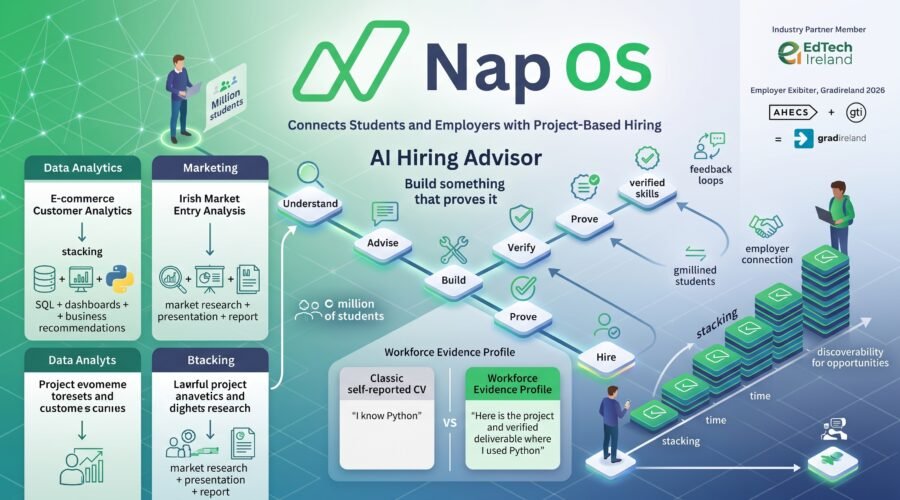
Understand → Advise → Build → Verify → Prove → Hire
Instead of stopping at career advice, the AI Hiring Advisor should help a student identify the next practical piece of workforce evidence they can create.
For example:
Student:
“I am a business student and I want to work in consulting, but I don’t have experience.”
The adviser could guide the student toward a project such as:
Business Market Analysis Project
The student might then produce:
- market research
- competitor analysis
- customer segmentation
- financial assumptions
- recommendations
- presentation
- written report
The important change is that the conversation moves from:
“I don’t have experience.”
to:
“Here is something I have actually done.”
That is the foundation of project-based hiring.
What the Nap OS AI Hiring Advisor Is Designed to Understand
The adviser is being designed around the questions that students actually face.
A student could ask:
Career questions
“What type of job could I target with my degree?”
“I have a degree but don’t know which career to choose.”
“What skills are employers looking for in this role?”
Experience questions
“I don’t have work experience. What can I do?”
“How can I get practical experience before graduating?”
“What project could I build to demonstrate my skills?”
Project questions
“Give me a project that would help me demonstrate Python.”
“What project would make my portfolio stronger for a marketing role?”
“How can I turn my university assignment into something employers can understand?”
Hiring questions
“What evidence would an employer want to see?”
“How do I demonstrate that I can actually do the job?”
“What should I show instead of relying only on my CV?”
International career questions
“I am an international student. How can I demonstrate my experience to an Irish employer?”
“I have experience from another country. How can I make it understandable to employers here?”
These questions all lead toward the same destination:
evidence.
The Project Becomes the Unit of Workforce Evidence
One of the most important ideas behind Nap OS is that a student’s capability should not exist only as a statement on a CV.
Instead of:
“I know Python.”
an employer should eventually be able to see:
“Here is the project where I used Python.”
Instead of:
“I have leadership skills.”
the student can demonstrate:
“Here is the project where I coordinated a team, managed deadlines and delivered an outcome.”
Instead of:
“I have marketing experience.”
the evidence becomes:
“Here is the campaign analysis, customer research and recommendation I produced.”
This creates a much stronger relationship between skill → project → evidence → employer decision.
What a Nap OS Project Could Look Like
A project does not necessarily need to be a huge software product.
It could be a structured piece of work designed around an employer-relevant skill.
For example:
Data Analytics
Project: E-commerce Customer Analytics
A student could:
- analyse customer data
- clean datasets
- use SQL or Python
- identify trends
- create dashboards
- present recommendations
Marketing
Project: Irish Market Entry Analysis
A student could:
- research a market
- identify competitors
- analyse customers
- develop positioning
- create a campaign proposal
- present findings
Software
Project: Workforce Skills Dashboard
A student could:
- define requirements
- develop the application
- test functionality
- document the architecture
- demonstrate the finished product
Finance
Project: SME Financial Analysis
A student could:
- analyse financial statements
- calculate key ratios
- identify risks
- develop scenarios
- present recommendations
The project itself becomes a unit of evidence.
The AI Advisor Can Help Students “Stack” Projects
This is where the Nap OS vision becomes more interesting.
The objective is not simply to help someone complete one project.
The AI Hiring Advisor is being designed to help students understand how multiple projects can progressively build their workforce profile.
For example:
Project 1 — Foundation
Excel + research + presentation
↓
Project 2 — Applied
SQL + analytics + reporting
↓
Project 3 — Advanced
Python + dashboard + business recommendations
↓
Project 4 — Employer Project
Real business problem + stakeholder feedback
The student is effectively stacking evidence.
Instead of waiting until graduation and asking:
“How do I get experience?”
the student can progressively build experience throughout their education.
From a CV to a Workforce Evidence Profile
The long-term vision for Nap OS is therefore not to eliminate the CV.
It is to put the CV into context.
A CV says:
“I have these skills.”
A workforce evidence profile can say:
“Here are the projects where I demonstrated those skills.”
The profile could potentially connect:
Skill
→ Project
→ Deliverable
→ Verification
→ Feedback
→ Employer relevance
This is much closer to how an employer actually evaluates capability.
What Employers Need to Know
The AI Hiring Advisor is not being designed only for students.
The other side of the system is the employer.
Employers need answers to different questions:
- Can this candidate actually perform the work?
- What has the candidate built?
- What skills were demonstrated?
- How difficult was the project?
- What was the candidate responsible for?
- Was the work independently delivered?
- Was it reviewed?
- What outcomes were achieved?
- Does the evidence relate to our vacancy?
This is where project-based hiring can create a common language between education and employment.
The student says:
“Here is what I built.”
The employer asks:
“Is this relevant to the work I need done?”
Nap OS aims to create the infrastructure connecting those two questions.
The AI Hiring Advisor Should Not Replace Human Hiring
This distinction is important.
Nap OS is not building an AI that should ultimately decide:
“Hire this person.”
The purpose is to help people prepare better evidence and navigate opportunities more effectively.
The adviser can help students understand what to build.
Projects create evidence.
Verification can increase confidence.
Employers still make hiring decisions.
That creates a model in which AI supports the workforce journey without pretending that an algorithm can completely replace human judgement.
FAQ: What Students and Graduates May Ask
Do I need previous work experience to use the Nap OS approach?
No. The purpose is partly to help people who have limited traditional employment experience identify practical ways to demonstrate capability.
Your starting point could be coursework, personal interests, university projects, technical skills or an idea you want to develop.
Do projects need to be paid?
Not necessarily. A project can be academic, personal, community-based, employer-led or another legitimate form of practical work. What matters is that the work and contribution can be clearly described and, where appropriate, verified.
Can a university assignment become a Nap OS project?
Potentially, yes. The important question is whether the work can be translated into meaningful evidence of skills, outputs, responsibilities and outcomes.
What if I don’t know what project to build?
That is one of the problems the AI Hiring Advisor is intended to address.
You could ask:
“I want to become a product manager. What project should I build?”
The adviser could help you identify a project aligned with the skills and evidence relevant to that career direction.
Can I build projects in more than one career area?
Yes. Students often discover their interests through experimentation. Multiple projects can help reveal patterns in skills, interests and strengths.
Will completing a project guarantee me a job?
No.
Nap OS should not promise employment simply because someone completes a project.
The objective is to improve the quality, visibility and relevance of evidence available to employers.
Can international students use it?
The vision includes both local and international students.
For international students, project evidence can be particularly useful because it can provide a more direct way of demonstrating capability when previous education or employment experience comes from another country.
FAQ: What Employers May Ask
Why look at projects instead of only CVs?
A CV is useful, but it is largely self-reported.
A project can provide additional evidence of what someone has actually done.
Does project-based hiring replace qualifications?
No.
Qualifications, professional experience and other credentials remain important.
Project evidence adds another layer:
What can the candidate demonstrate?
Can employers create their own projects?
The broader Nap OS vision supports employer-relevant projects where organisations can define real business problems or practical challenges and identify candidates capable of working on them.
What makes a project valuable?
Relevance, quality, complexity, responsibility, outputs, skills demonstrated and verification can all matter.
The objective is not to create projects simply for the sake of having more projects.
It is to create useful workforce evidence.
The Bigger Nap OS Vision
The AI Hiring Advisor is one part of a larger Nap OS Workforce vision.
The ambition is to create a continuous pathway:
Student
→ asks a question
→ receives guidance
→ identifies a project
→ builds something
→ develops skills
→ receives feedback
→ creates verified evidence
→ builds a Workforce profile
→ becomes discoverable for relevant opportunities
→ connects with employers
→ progresses toward hiring.
This turns career development from a largely passive process into a more active evidence-building system.
Building for Millions Starts With One Student
The ambition to guide millions of students does not begin with millions of users.
It begins with one useful answer.
One project.
One verified skill.
One employer connection.
One student who moves from:
“I don’t have experience.”
to:
“Here is what I have built.”
That is the shift Nap OS wants to enable.
The future of early-career hiring will increasingly require better ways to understand skills, capability and evidence, not simply better ways to distribute CVs.
Nap OS is building toward that future with a simple proposition:
Don’t just tell employers what you can do. Build something that proves it.
And the AI Hiring Advisor is being developed to help students understand what to build, why to build it, how to stack their projects, and how those projects can become part of a workforce profile that employers can actually understand.
Universities teach. Nap OS proves. Employers hire.
Learn → Build → Verify → Prove → Hire.