9 min read
The Nap OS Newsletter · Napblog Limited, Dublin
1. The decision
We are not entering the United States as a market in 2027. We are recruiting American assessors in 2027, and entering the market in 2028.
That distinction is the whole strategy, so it is worth being precise about.
Nap OS assesses student project work against criteria published in advance, by a named practitioner who works in the market the student is moving to. The assessor has to be in the destination country. The customer does not.
Most of the students we serve are Indian, and most Indian students going abroad go to America — not Ireland. Today we can only serve the Ireland-bound minority, because Ireland is where our reviewers are. Put practitioners in Chicago, Austin and New York on the bench and the same product serves the majority of that corridor, sold through the same Indian channels, invoiced by the same Dublin company.
No US office. No US institutional sales cycle. No American procurement. One new capability, and the addressable market multiplies.
The market entry proper — selling to American universities and employers — comes later, on the Enterprise Ireland pathway, in 2028. We will say why in section 7.
2. What we need from America, now
Project Managers. This is the ask that matters and everything else is secondary to it. We want practitioners with five or more years in their field and real hiring responsibility, working in Startup & Entrepreneurship, Strategy & Operations, Marketing & Sales, Product & Research, or Data & AI. You would review student work against published criteria, under your own name, and be paid for your time. Remote, fortnightly, a few hours a month.
Nine senior practitioners applied to review for us before we ever advertised for reviewers. We would like to find the American version of those nine.
A US co-founder or market lead. Someone who has sold into American career services, staffing, or higher-education procurement, and knows how those budgets actually move. Honest terms: this is equity in a company with no US revenue. If you need a salary from day one, this is not yet your conversation, and we would rather say so than waste your time.
Investors. Enterprise Ireland co-funds; it does not fund alone. We are looking for co-investors to come in alongside the Irish state as we move toward High Potential Start-Up designation, with an appetite for the India-to-anywhere student corridor. We are pre-institutional-revenue, so look at the unit economics before the narrative: €999 per student for twelve months, €382–512 delivery cost per seat depending on cohort size, 49–62% gross margin.
Universities and career services. One or two American institutions willing to run a ten-place pilot with an international cohort — an academic lead attached, outcomes agreed in writing before it starts. You would get employability evidence you did not have to manufacture. You would not be accrediting us, and we will put that in the contract.
Recruitment agencies and employers. If you hire international graduates, you are currently assessing proxies. We can show you assessed work instead, where the student has authorised it. In the United States we offer assessment only, not placement — see section 7 for why.
Training companies and technology partners. Organisations already delivering vocational training who could supply reviewers or run briefs at volume. And integration partners: a portable assessment record should plug into the systems where student records and careers infrastructure already live, rather than becoming one more silo.
3. Why America, on the evidence
In 2024/25 the United States hosted 1,177,766 international students. India accounted for 363,019 — roughly 31% of the total, up 10% in a year.
But the pipeline is contracting. New enrolments fell 7% that year, and the following autumn’s snapshot showed new enrolments down 17%.
Over the same period the number staying on to work went the other way. Optional Practical Training participation rose 21%, to 294,253, and rose a further 14% in that snapshot.
Fewer arriving. More staying, competing for the same first job. And the route beyond that first job has become unpredictable in a way employers can feel: a $100,000 H-1B fee proclamation now extends to September 2027, is currently not being collected because a court vacated the policy implementing it, and is still contested elsewhere. Employers are not reading the litigation. They are reading “sponsorship just became expensive and uncertain,” and hiring accordingly.
All of that compounds onto one person — an international graduate with twelve months of work authorisation, no American work history, and an employer who will not take a risk they cannot price.
It is the problem we built Nap OS for. It is simply larger and sharper in the United States than in Ireland.
4. What we would actually export
A student takes a structured project brief every fortnight — up to ten briefs across five domains, or one industry project on the thesis track. The marking criteria are published before the student begins. A named practitioner who works in the student’s destination market assesses each submission and returns written feedback within seven days.
The programme runs for twelve months and starts up to six months before departure, while the student is still at home waiting on a visa. That pre-departure window is the part nobody else occupies: a domestic work-experience provider cannot deliver it, and a provider in the origin country cannot deliver the destination-market judgement.
At the end the student holds a record — the brief, the deliverable, the criteria it was measured against, and the name of the person who measured it. Where the student authorises it, an employer inspects that record before asking for a CV.
Not a course. Not a badge. Not a simulation marked by a rubric nobody signed.
5. The number that was not real
Here is where an expansion story would normally show you a traffic chart.
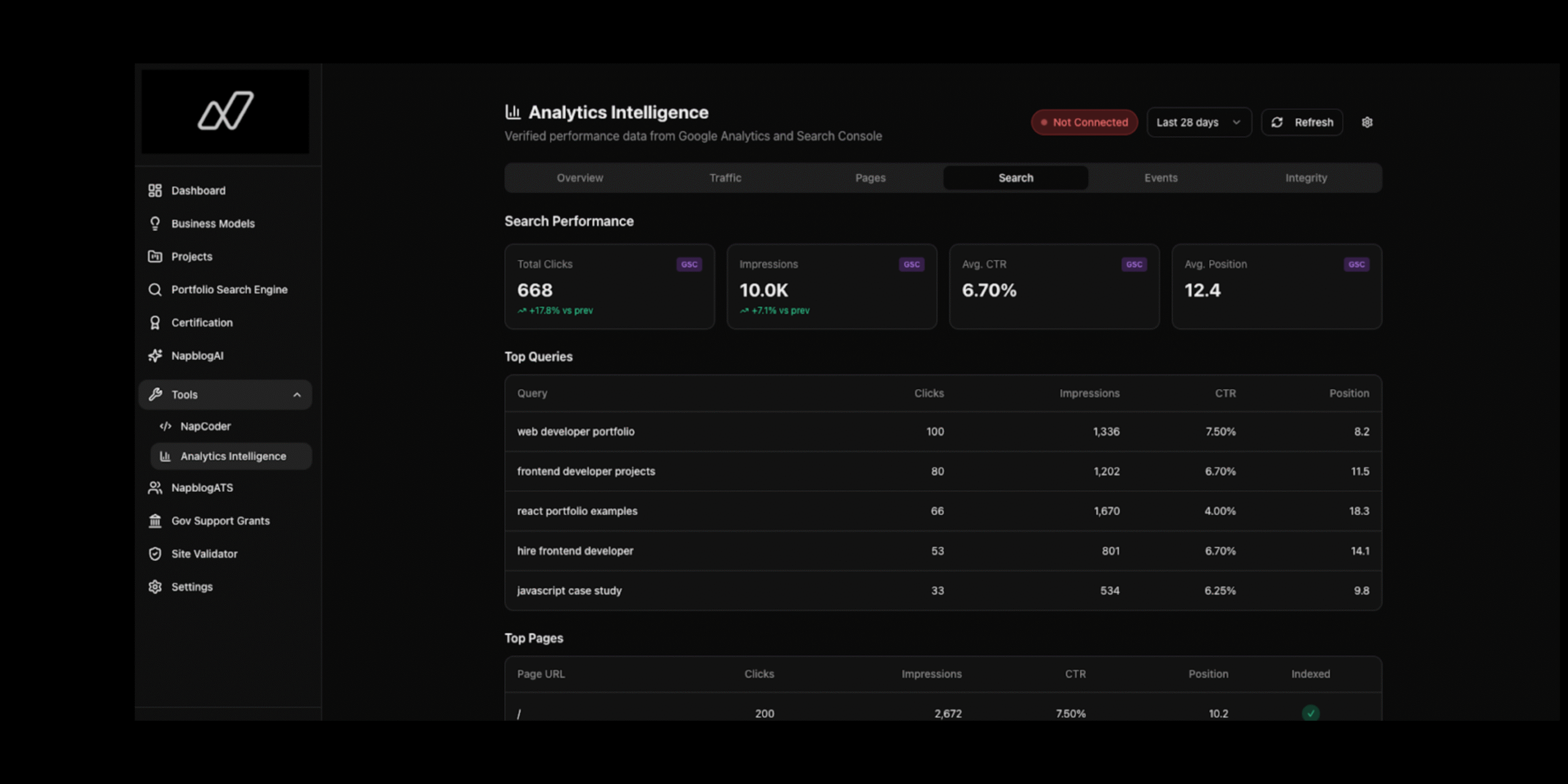
Year to date, the United States is our second-largest source of web sessions: 3,850 of roughly 15,500, about a quarter of everything, with no American advertising spend at any point. A tempting number to build a story on.
We checked it. It is not real.
Those 3,850 American sessions produced 22 engaged sessions and zero conversions. Average engagement: two to three seconds. The views-per-session ratio sits at exactly 3.00 across row after row — 622 sessions to 1,867 views, 471 to 1,413, 189 to 567. People do not browse with that kind of arithmetic precision. Crawlers do.
And the cities identify themselves: Boardman, Prineville, The Dalles, Ashburn, Des Moines, Cheyenne, Altoona, Forest City, Fort Worth, Luleå. Those are not student towns. They are where Amazon, Google, Meta and Microsoft keep their data centres.
We are publishing this rather than the chart, for a reason that goes to the heart of the product. Nap OS exists because the artefact stopped being evidence — anyone can generate a deliverable now, so the deliverable proves nothing until a named person has examined it. A traffic number works the same way. If we are going to tell students that unverified work is not proof, the least we can do is apply the rule to our own dashboard before we put it in a newsletter.
So we are entering the United States with no American traction. We would rather say that than be caught saying otherwise.
6. The number that was
Of 119 conversions on our site this year, 93 came from printed collateral — QR codes on stand materials, flyers and individually tracked team ID cards at a single graduate careers fair in Dublin. Those sources accounted for about 385 sessions, converting at 23% to 34%.
Two and a half per cent of our traffic produced seventy-eight per cent of our conversions.
One day, in one room, twelve people each carrying an ID card with their own tracked code so every conversation was attributable to the person who had it. That beat fifteen thousand sessions of internet.
Our Irish web traffic behaves like people too — 18% to 21% engaged sessions, thirty-five seconds to over a minute of attention — against two seconds from the data centres.
We think this is the most useful thing we learned this year, and it is the same finding as the product: assessment by a named human beats assessment at scale by nobody, and a conversation with a named human beats a thousand anonymous impressions. It would be strange to sell one and not believe the other.
It is also why our American ask starts with people rather than advertising.
7. Why this should be an Irish company
We are a Dublin company — Napblog Limited, CRO 812006 — and we intend to stay one.
Ireland funds companies that sell abroad. Enterprise Ireland’s High Potential Start-Up pathway exists for exactly this: an Irish-headquartered business supplying internationally traded services, capable of €1m in sales and ten Irish jobs within three years, with co-funded equity to accelerate an international plan. We hold a Phase 1 place on New Frontiers and are applying for Phase 2.
So American revenue is not a detour from our Irish case. It is the Irish case. Every dollar an Irish company earns abroad is the outcome the Irish state is trying to buy.
The sequence, stated plainly so nobody has to guess: Phase 1 now; Phase 2 through the first half of 2027, during which we must sign and deliver a paid cohort; Phase 3 and a Pre-Seed Start Fund application in late 2027; HPSU designation and a co-funded round after that; US market entry in 2028. The gate is not a programme. It is the first institution or agency that pays for a cohort — until that happens, nothing downstream is real.
One more thing an Irish company has to be honest about. We hold Licensed Employment Agency EA 5651, under the Employment Agency Act 1971. In Ireland it is what permits us to charge employers rather than students, and most student-employability providers never cross that line. It does not travel. American staffing regulation is a different system, state by state, and we are not going to pretend an Irish licence means anything in Boston. In the United States our posture is assessment, not placement, until somebody properly qualified tells us how to do more.
8. What we are not claiming
If we are asking strangers to back us, they are owed the list.
We do not guarantee employment, interviews, or any immigration outcome, and we never will. We are not an accredited award and do not want to be — academic credit and academic supervision belong to the institution.
We have never measured our reviewer agreement rate. If two qualified assessors mark the same work against the same published criteria and reach different conclusions, the criteria are doing no work and the assessment is one person’s opinion on one afternoon. We measure it for the first time by 31 January 2027, and we will publish the number including if it embarrasses us.
Our belief that students who arrive holding destination-market-assessed work get hired sooner is a belief, not a finding. We think the mechanism is obvious. We have not proven it, and until we have, we will keep calling it a hypothesis.
We have not closed a paid university contract in any country. We have delivered work with University College Dublin and with Grenoble École de Management, and we are in pilot discussions with three further institutions. Those are three different things and we will not blur them into one word.
Our record with people is better than our record with institutions. Forty-nine people have contributed to Nap OS, and twenty-six of them are now at twenty-four outside employers — Amazon, JPMorgan Chase, ESB Networks, ServiceNow, Bosch Rexroth and Trinity College Dublin among them. We brokered none of those moves, and we claim no credit for them. We claim only that capable people chose to work here.
9. How to reach us
The artefact became free. The judgement did not. Nobody has yet built the judgement layer in a form an employer can inspect and a student can carry across a border.
We would rather build it with people who will tell us where we are wrong — beginning with anyone who read section 5 and thought good, they check their own numbers before they publish them.
Pugazheanthi Palani, Founder & CEO palani@napblog.com · +353 89 453 0418 Napblog Limited t/a Nap OS · CRO 812006 · Licensed Employment Agency EA 5651 77 Camden Street Lower, Saint Kevin’s, Dublin 2, D02 XE80 · os.napblog.com
US enrolment and OPT figures: IIE Open Doors 2025. H-1B fee status: Yale Office of International Students and Scholars. Traffic and conversion figures: Google Analytics, property 501378010, year to date.