8 min read
For many students and recent graduates, the transition from education into employment presents a familiar problem:
You need experience to get the opportunity, but you often need the opportunity to get experience.
This is the Catch-22 that Nap OS is designed to address.
Across Europe, however, there is already a powerful model demonstrating the importance of structured practical experience: EU traineeships.
Around 1,900 young graduates each year have the opportunity to participate in EU trainee programmes. Most EU institutions offer traineeships lasting approximately three to five months, with many programmes typically lasting five months. These opportunities allow vocational education and training (VET) and university graduates to develop professional skills, expand their networks and gain insight into how the European civil service operates.
For Nap OS, this model provides an important lesson:
The transition from education to employment should not be treated as a single application. It should be treated as a journey of experience, evidence, feedback, networking and professional development.
The Traineeship Is More Than an Internship
The word “trainee” can sometimes sound like a temporary job title.
But the EU traineeship model illustrates something much more important.
A traineeship creates an environment where an individual can move from learning about work to actually participating in work.
The EU Careers information describes traineeships as an opportunity for graduates to increase their professional skills, expand their network and enhance their knowledge of the EU.
That combination matters.
A graduate does not simply need another certificate.
They need opportunities to answer questions such as:
- What can I actually do?
- Can I work with a team?
- Can I deliver against a deadline?
- Can I communicate professionally?
- Can I solve a real problem?
- Can someone verify the work I have completed?
- Can I explain my contribution to an employer?
These are questions that a traditional CV often struggles to answer.
A practical experience environment can answer them much more effectively.
The Experience Gap Between University and Employment
University education plays an essential role in developing knowledge, critical thinking and specialist capabilities.
But employers ultimately need to understand how a candidate can apply those capabilities.
That creates a gap between:
Education → Employment
Nap OS believes there is another layer that needs to sit between them:
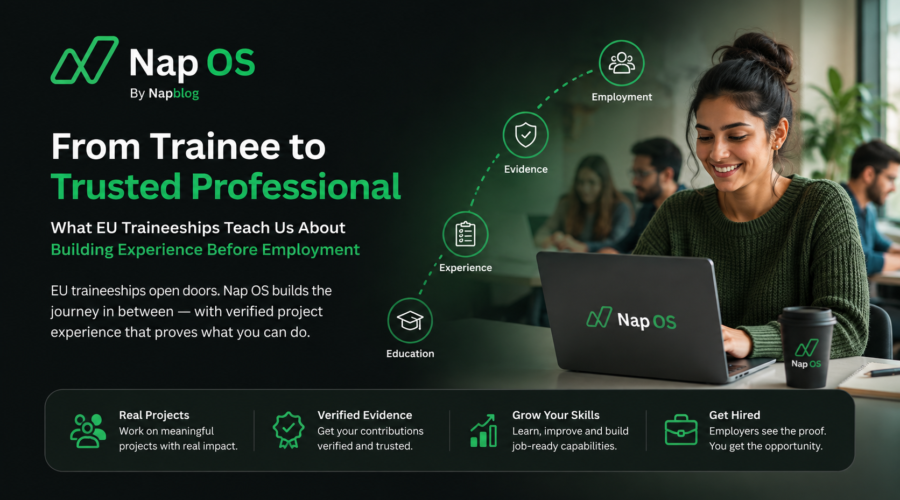
Education → Experience → Evidence → Employment
This is where structured project work becomes important.
A student studying communication, IT, finance, law, data, marketing or another discipline may understand the theory behind their field.
But imagine that same student completing a real project, receiving feedback, improving the work, documenting the outcome and having the experience independently validated.
The candidate now has something substantially more powerful than a statement on a CV.
They have evidence.
What EU Traineeships Demonstrate
EU traineeships are available across a wide range of professional areas, including:
- Law
- Human resources
- Environment
- Communication
- IT
- Finance
- Data protection
- Scientific research
- Foreign policy
- Intellectual property
- And many other areas
This breadth demonstrates an important principle:
Practical experience is not limited to one profession.
Every professional discipline has some form of applied work.
The question is therefore not whether students need experience.
The question is:
How can we create more structured, accessible and meaningful opportunities for people to obtain it?
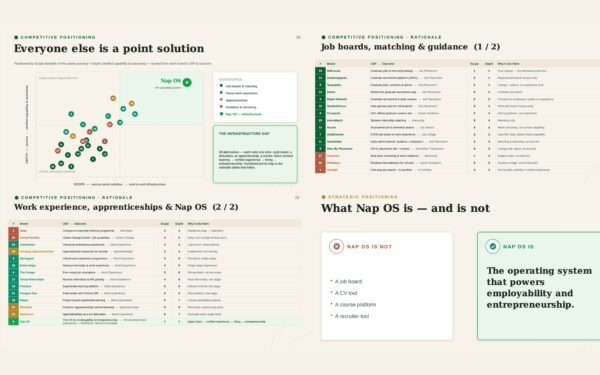
This is one of the questions Nap OS is exploring through its Workforce Operating System.
The Five-Month Principle
The fact that many EU institutional traineeships typically last around five months is also significant.
Professional capability does not necessarily emerge from a one-day workshop.
It develops through repetition.
A person receives a task.
They attempt it.
They receive feedback.
They improve.
They take on another responsibility.
They make mistakes.
They learn.
They produce another outcome.
Over time, a collection of experiences begins to demonstrate capability.
This is why Nap OS sees workforce development as a continuous process rather than a one-off training event.
The objective isn’t simply to give someone a project.
It is to create a pathway through which they can progressively build evidence of what they can do.
Paid Experience Matters
The majority of EU traineeships are paid, with the information provided by EU Careers indicating that remuneration is usually around €1,500 per month.
This is an important part of the discussion around early-career experience.
Young people should not have to choose between gaining experience and being able to support themselves.
A structured professional opportunity becomes significantly more meaningful when the participant’s contribution is recognised.
For Nap OS, this raises an even broader question:
How can the future workforce experience economy become more accessible, transparent and equitable?
The answer cannot simply be “get an internship.”
There need to be better systems connecting:
Students → Projects → Organisations → Mentors → Evidence → Employers
That is the ecosystem Nap OS is trying to build.
From Traineeship to Workforce Identity
One of the most interesting aspects of a traineeship is what remains after the placement ends.
The trainee leaves with more than a line on a CV.
Ideally, they leave with:
Experience.
Professional relationships.
Knowledge.
Projects.
References.
Confidence.
A better understanding of their career direction.
This creates the foundation for a professional identity.
Nap OS takes this concept further by asking:
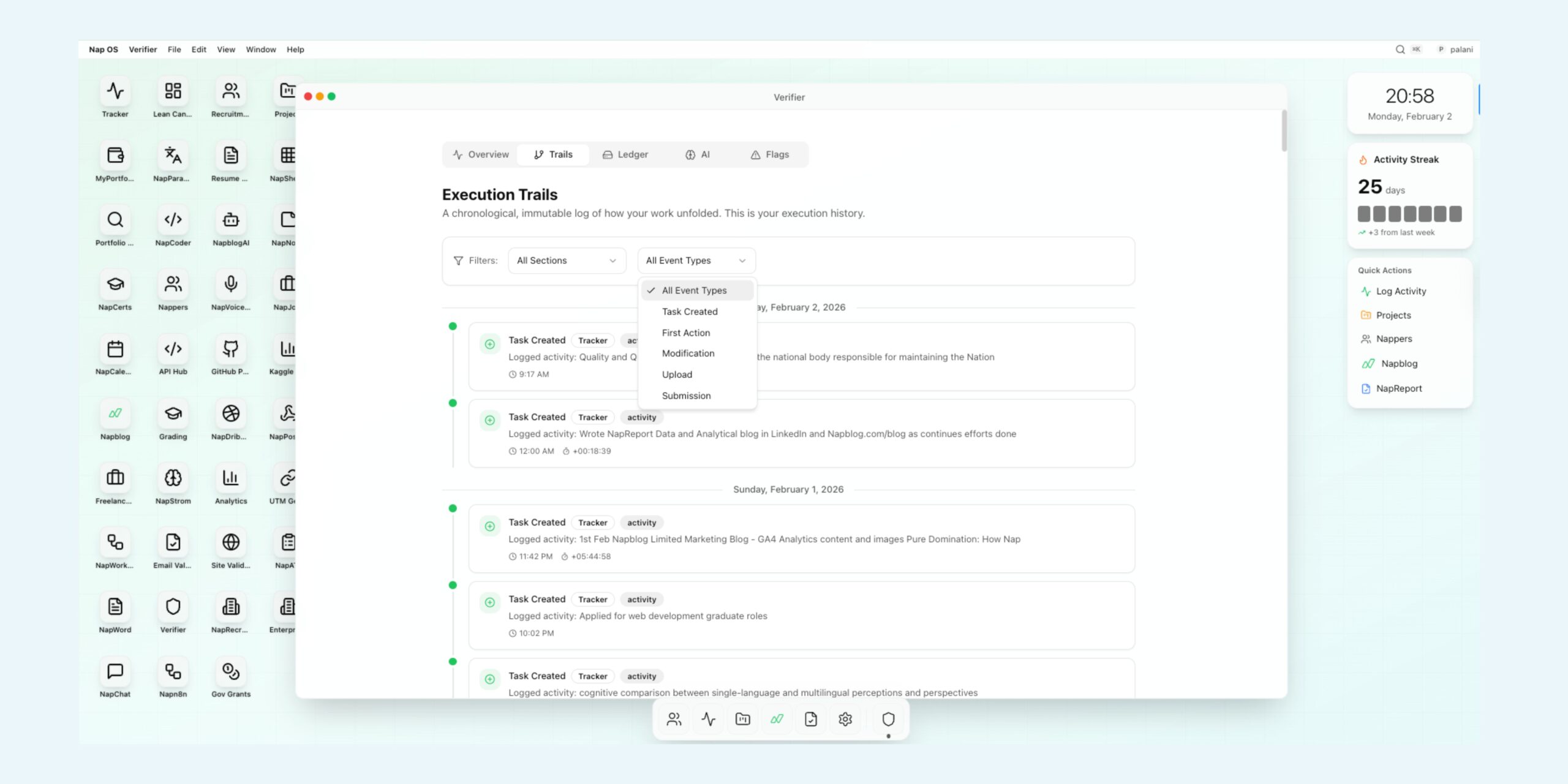
What if the evidence created during practical work could become part of a persistent digital workforce identity?
Instead of repeatedly telling every new employer what someone has done, the individual could progressively build a verified body of work.
Their career journey becomes cumulative.
A project completed during university can contribute to their professional portfolio.
An employer-validated project can strengthen their workforce profile.
Mentor feedback can demonstrate development.
Future work can add another layer of evidence.
The individual does not start from zero every time they apply for an opportunity.
The EU Careers Ambassador Model Is Also Interesting
The EU Careers ecosystem provides another fascinating example through its EU Careers Student Ambassadors programme.
The programme invites selected university students to promote EU career opportunities among their peers.
According to the programme information, ambassadors can develop experience in areas such as public speaking, marketing and human resources, while building networks, receiving training and coaching, participating in events and potentially receiving a reference letter based on their performance.
This is another example of experience being created through responsibility.
The student is not simply consuming information.
They are actively doing something.
They become a point of contact for other students.
They organise or participate in events.
They communicate information.
They research audiences.
They develop networks.
They maintain an online presence.
In other words, the student creates evidence of capability through action.
That is fundamentally aligned with the philosophy behind Nap OS.
Don’t Just Tell Employers What You Can Do. Show Them.
This is perhaps the most important lesson.
Imagine two graduate candidates.
Candidate A says:
“I have strong communication skills.”
Candidate B says:
“Here is a communication project I completed. Here was the objective. Here was my responsibility. Here is the work I produced. Here is the feedback I received, and here is how I improved it.”
The second candidate has transformed a claim into evidence.
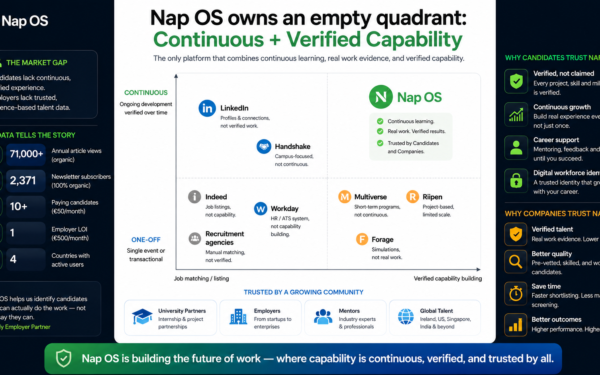
This distinction sits at the heart of Nap OS.
A CV is useful.
A qualification is valuable.
A reference is valuable.
But evidence of actual work can provide another dimension of confidence.
That is why Nap OS is built around the idea of verified project-based experience.
What Happens After the Traineeship?
The biggest opportunity is not simply improving the internship itself.
It is connecting the internship to the rest of the person’s career.
Consider the lifecycle:
University
The individual develops academic knowledge.
↓
Practical Project
They apply knowledge to a real problem.
↓
Feedback
Someone reviews the work and helps them improve.
↓
Verification
The work and contribution become independently validated.
↓
Portfolio
The individual builds a body of demonstrated experience.
↓
Employment
Employers can assess evidence alongside qualifications.
↓
Continuous Development
The individual continues adding new experience throughout their career.
This is the direction in which Nap OS sees the workforce moving.
Nap OS: Turning Potential Into Proof
The EU traineeship model demonstrates that structured professional experience can play an important role in the transition from education to employment.
But there will never be enough traditional traineeship places for everyone who wants one.
That is where the broader opportunity exists.
What if practical experience could be created through a much larger ecosystem of structured projects?
What if students, graduates and career changers could participate in meaningful projects before graduation?
What if organisations could provide real challenges while gaining access to emerging talent?
What if mentors, universities and employers could contribute to validating the experience?
And what if all of that evidence could stay with the individual as they progress through their career?
That is the problem Nap OS is working to solve.
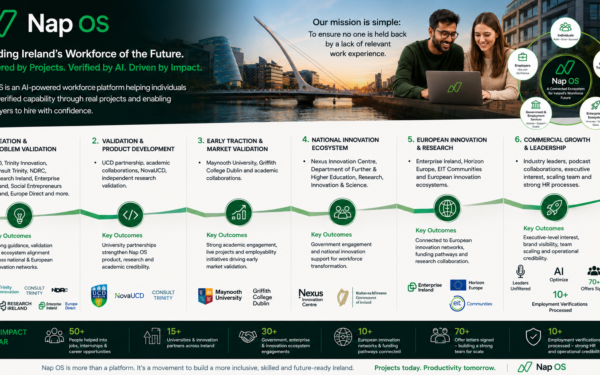
Nap OS is a Workforce Operating System designed to help individuals build verified work portfolios and connect employers with trusted, work-ready talent through continuous workforce verification.
The goal is not to replace university education.
It is not to replace employers.
It is not to replace established traineeship programmes.
Instead, Nap OS aims to help build the missing bridge between learning and employment.
From Trainee to Trusted Professional
The future of early-career employment may not be defined simply by where someone studied or which job titles they have held.
It may increasingly depend on the evidence of what they have actually done.
EU traineeships offer one established model: structured professional exposure, real responsibilities, networking, skills development and experience.
The EU Careers Student Ambassador programme adds another dimension: students can gain experience by taking responsibility, communicating, organising and building networks while still studying.
Nap OS takes the underlying principle and asks how it can be extended beyond a limited number of formal traineeship places.
Because the ultimate objective should not be to make graduates better at saying:
“I am ready to work.”
It should be to help them demonstrate:
“Here is the work I have already done.”
That is the transition from potential to proof.
And that is where Nap OS believes the next generation of workforce technology can make a meaningful difference.
Nap OS Product Perspective
Education gives you knowledge.
Projects give you experience.
Verification creates evidence.
Evidence builds trust.
Trust creates opportunity.