9 min read
For many students and recent graduates in Ireland, the transition from education to employment can feel like a contradiction.
Employers ask for experience.
Students need a job to gain experience.
Graduate vacancies ask candidates to demonstrate practical capability.
Yet many candidates have had limited opportunities to demonstrate that capability in a real working environment.
This is the “no experience” Catch-22 that Nap OS was created to address.
Nap OS is building a different approach: project-based hiring rather than CV-based hiring.
Instead of asking a student or job seeker to rely primarily on a CV to tell an employer what they can do, Nap OS aims to give people an opportunity to actually demonstrate what they can do through structured, real-world projects.
That mission is now reaching an important stage in Ireland.
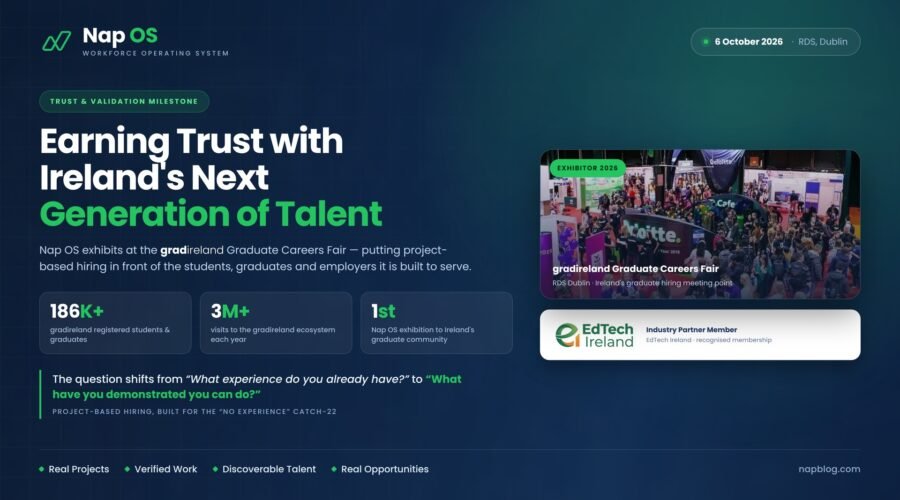
On 6 October 2026, Nap OS will exhibit at the GradIreland Graduate Careers Fair at the RDS in Dublin, creating an opportunity to engage directly with students, graduates and job seekers who are navigating the transition into employment.
This is more than an exhibition for Nap OS.
It is an opportunity to build trust.
Trust Has to Be Earned
In the employment market, trust is particularly important.
Students are constantly exposed to promises about employability, career development, internships, graduate programmes, recruitment platforms and professional opportunities.
For a new workforce technology company, simply saying that it can help people is not enough.
Nap OS believes trust has to be built through consistent action, transparency and real opportunities.
That is why the company has focused on building relationships with students, graduates, employers, universities and other stakeholders rather than positioning itself simply as another online recruitment platform.
The objective is not to tell students:
“Trust us because we have a platform.”
The objective is to demonstrate:
“Here is a way you can build evidence of your capability.”
That distinction is fundamental to the Nap OS proposition.
From CV-Based Hiring to Project-Based Hiring
The traditional graduate recruitment process often starts with the CV.
A student prepares a CV.
The employer receives hundreds or thousands of CVs.
Recruiters filter candidates based on education, previous employment, keywords and other indicators.
Candidates who have already accumulated experience can therefore have a significant advantage.
But what happens to a highly capable student who has never had the opportunity to demonstrate that capability?
This is where Nap OS sees an opportunity.
The company is developing a workforce platform where individuals can build verified work portfolios through project-based experience.
The philosophy is simple:
Don’t just tell employers what you can do. Show them.
A student could participate in a real-world project, complete defined tasks, receive feedback, demonstrate relevant skills and build evidence of the work completed.
That evidence can then become part of the person’s professional portfolio.
The result is a different type of employment signal.
Instead of:
“I have strong analytical skills.”
The candidate can potentially demonstrate:
“Here is a project where I applied analytical skills to a real business problem, here is what I delivered, and here is the feedback I received.”
That is the foundation of project-based hiring.
Why GradIreland Matters
Nap OS’s presence at GradIreland is strategically important because of the scale and relevance of the community it serves.
GradIreland has more than 186,000 registered users and records more than 3 million visits per year from students and graduates across Ireland.
That makes the GradIreland ecosystem an important meeting point between students, graduates and employers.
For Nap OS, participating in this environment provides an opportunity to listen directly to the people experiencing the employment transition.
The company can learn:
- What students struggle with when applying for jobs.
- What prevents graduates from demonstrating their capabilities.
- How candidates currently build experience.
- What employers expect from early-career candidates.
- What students think is missing from traditional recruitment.
- How candidates respond to project-based opportunities.
- What evidence students would like to show employers.
This feedback is extremely valuable.
Nap OS is not trying to build a workforce product in isolation.
It is trying to build a product around a genuine problem experienced by people entering the workforce.
The 6 October Exhibition
On 6 October 2026, Nap OS will have the opportunity to bring this proposition directly to the GradIreland audience at the RDS in Dublin.
The conversation at the exhibition will be different from a conventional recruitment conversation.
Nap OS does not simply want to ask students to upload another CV.
It wants to introduce a different question:
What if you could build experience before you are hired?
That question goes directly to the Catch-22.
A student may not have traditional employment experience.
But that does not mean they cannot demonstrate their ability.
They may be able to solve a business problem.
They may be able to build a software feature.
They may be able to analyse a dataset.
They may be able to conduct market research.
They may be able to create a marketing campaign.
They may be able to support an operational project.
They may be able to contribute to a consulting assignment.
These activities can create evidence.
Nap OS aims to structure that evidence into a professional experience record.
Creating Opportunity for Every Student
One of the most important principles behind Nap OS is accessibility of opportunity.
The company wants every student to have the possibility of building meaningful project-based experience, rather than allowing opportunities to depend entirely on whether someone already has a strong professional network.
This is particularly relevant for international students, career changers and graduates who may find it difficult to obtain their first relevant role.
The challenge is not necessarily a lack of talent.
Sometimes the challenge is a lack of evidence.
A candidate may possess technical knowledge, communication skills, creativity, problem-solving ability and determination.
But an employer may still ask:
“Where have you demonstrated this?”
Nap OS seeks to help answer that question.
Experience That Can Be Demonstrated
The concept of a work portfolio is not new.
Artists, designers, developers and researchers have long used portfolios to demonstrate their capabilities.
Nap OS is extending that philosophy to a broader workforce.
The platform is designed around the idea that project experience should become structured, documented and verifiable.
A project can create multiple forms of evidence:
The work itself.
What did the individual actually produce?
The contribution.
What role did the person play?
The skills.
What capabilities were demonstrated?
The feedback.
What did the employer, mentor or project evaluator observe?
The outcome.
What changed or was achieved through the work?
Together, these elements can create a much richer picture of an individual than a conventional CV alone.
This is particularly powerful for early-career candidates because it gives them an opportunity to start building their professional identity before securing their first major full-time position.
Building Trust Through Real Relationships
Nap OS’s approach to trust is also based on relationships.
The company has been engaging with universities, employers, students and ecosystem stakeholders to understand how its model can fit into existing employability and placement structures.
These conversations are helping Nap OS understand that the employment problem cannot be solved by technology alone.
Universities have an important role.
Employers have an important role.
Students have an important role.
Mentors and other professionals have an important role.
A workforce platform has to connect these stakeholders rather than operate independently from them.
This is why institutional and employer relationships are becoming increasingly important to the Nap OS strategy.
The company wants universities to be able to support students with structured project opportunities.
It wants employers to gain access to emerging talent through demonstrated capability.
And it wants students to gain evidence that they can carry forward into their careers.
From Student Experience to Employer Confidence
Ultimately, project-based hiring only works if employers trust the evidence.
That is why verification is central to the Nap OS model.
A project should not simply become another line on a CV.
The objective is to create a credible record of what happened.
Who provided the project?
What was the candidate asked to do?
What did they deliver?
What skills did they demonstrate?
What feedback did they receive?
What was the outcome?
The more credible the evidence, the more useful it becomes to an employer.
This creates the possibility of moving recruitment away from assumptions and toward demonstrated capability.
Instead of judging someone primarily on whether they have already been given an opportunity, employers can potentially assess what the candidate has demonstrated through previous projects.
That is a fundamental change in the hiring philosophy.
Why This Matters for Irish Students and Graduates
Ireland has a large and diverse student and graduate population.
Every year, thousands of people enter the workforce looking for their first opportunity.
Many will succeed through traditional routes.
Others will face repeated rejection because they lack the experience employers expect.
Nap OS is particularly interested in the second group.
The candidate who has talent but lacks experience.
The graduate who has qualifications but limited local experience.
The international student who understands the theory but needs an opportunity to demonstrate practical capability.
The career changer who has transferable skills but cannot easily communicate them through a conventional CV.
The person who repeatedly hears:
“Come back when you have experience.”
For these candidates, project-based work could provide a bridge.
GradIreland as a Trust-Building Milestone
The 6 October GradIreland exhibition therefore represents more than a marketing opportunity for Nap OS.
It represents a chance to meet the community that Nap OS is trying to serve.
Students can challenge the team.
Graduates can explain their experiences.
Employers can provide feedback.
Career professionals can question the model.
And Nap OS can demonstrate what it is building.
That interaction matters because trust should not be created through marketing claims alone.
It should be created through conversation.
Through transparency.
Through evidence.
And ultimately through outcomes.
The company’s ambition is to build a workforce operating system where people can continuously create verified evidence of their capabilities.
GradIreland provides an important environment in which that vision can be discussed directly with the next generation of Irish talent.
A Different Question for the Future of Hiring
The traditional recruitment question is:
“What experience do you already have?”
Nap OS wants to introduce another question:
“What have you demonstrated that you can do?”
That difference may appear small, but it represents a significant shift.
If someone has never been given a job, they may have very little conventional experience.
But they can still have capability.
They can learn.
They can contribute.
They can solve problems.
They can work with others.
They can complete projects.
They can receive feedback.
They can improve.
And they can build evidence.
Nap OS believes the employment system should make it easier for that capability to be seen.
The Next Stage of the Nap OS Journey
Exhibiting at GradIreland on 6 October is one step in a much larger journey.
Nap OS is not trying to replace universities, employers or existing career services.
Its ambition is to build infrastructure that connects them more effectively around real work and verifiable capability.
The company wants to work with universities to create structured project opportunities.
It wants to work with employers to source meaningful projects and discover emerging talent.
It wants students to have a practical way to build experience.
And it wants job seekers to have evidence they can take with them throughout their careers.
The long-term vision is therefore not simply another job board.
It is a workforce platform where experience can be created, verified and continuously developed.
For Nap OS, trust begins with giving people something valuable.
An opportunity to demonstrate what they can do.
And on 6 October at the RDS in Dublin, Nap OS will have the opportunity to bring that message directly to Ireland’s student and graduate community.
The goal is simple:
Give every student the opportunity to experience project-based hiring — not just CV-based hiring.
Because the future of graduate recruitment should not be determined only by who already has experience.
It should also recognise the people who have been given the opportunity to prove they can do the work.